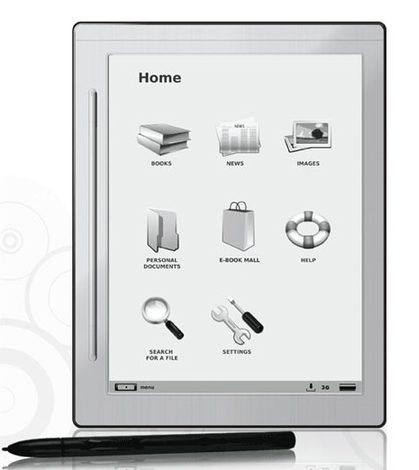
 The electronic reader marketplace keeps getting more crowded: electronics retailer Best Buy has announced it will varry the DR800SG iRex Digital Reader in its U.S. retail locations this fall for a retail price of $399. The iRex Reader will compete with electronic readers from the likes of Amazon and Sony, as well as the forthcoming digital reader from Plastic Logic. However, unlike the market-leading Amazon Kindle, the iRex will have a presence in one of America’s top electronic brick-and-mortar retailers, enabling customers to get a hands-on experience with the device before buying it.
Although detailed specs aren’t available for the DR800SG iRex Digital reader, the unit sports an 8.1-inch eInk display, and will come with integrated 3G wireless connectivity that will enable users to download titles wirelessly from the Barnes & Noble electronics bookstore, and tap into newspapers via Newspapers Direct. The unit supports both Adobe PDF and the open standard Epub format, and reports have the unit supporting HSDPA wireless connectivity, meaning the unit should work on networks outside the United States; overseas connectivity will apparently be handled by Vodafone. The 3G connectivity means that, in areas where users can access good network service, books and periodicals should be very quickly downloadable.
The DR800SG will feature a touchscreen display—the unit will ship with a stylus—and users will be able to adjust the text size on the iRex Reader, as well as dynamically change the unit’s orientation.
Best Buy didn’t offer any specific date when the iRex reader would be available for sale.
iRex is a spin-off of Royal Philips Electronics.