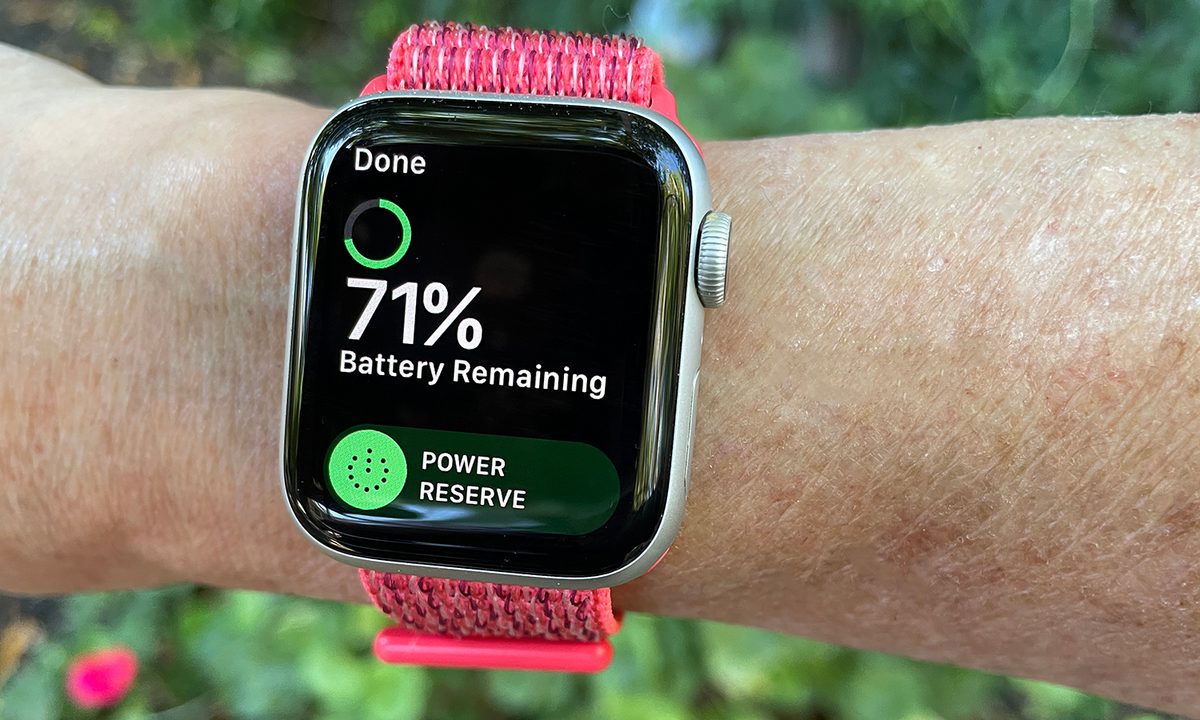
Regardless of which Apple Watch model you have — from the older Series 3 to the current Series 7 — a battery life of roughly 18 hours after a fresh recharge is generally expected. The way you use and set up your watch determines the amount of real-time operation you're likely to get, while Apple's estimate relies on 90 time checks, 90 notifications, 45 minutes of app use, and a 60-minute workout with music from Bluetooth. Your mileage may vary significantly, depending on how much you use your Watch.
Battery life matters because of how long you must wait to use your watch again after the battery is totally depleted. Apple says it takes about two hours to reach an 80% charge via it's magnetic charging cable. The Series 6 takes about one and a half hours to get from zero to a 100% charge, and for the SE, it takes two hours to fully charge. Things change with Series 7, which promises an 80% charge in 45 minutes and the ability to track a night's sleep with just eight minutes of charging.
If you always want your Apple watch charged up and ready for a long day when you need it, here are some tips for conserving battery life.
Disable the always-on display
The Apple Watch Series 5 or newer (but not the SE) supports a continuous live display, just like a regular wrist watch. However, that always-on display devours battery life. If you don't need or want the perpetual display mode, here's what to do to turn it off.
Step 1: On your Watch, go to Settings.

Step 2: Tap Display & brightness.

Step 3: Tap Always on to turn the feature on or off.

Disable Wake on Wrist Raise
On the Apple Watch 4 and older, the wearable uses its gyroscope and accelerometer to activate the display when you raise your wrist. Each time that happens, the battery takes a hit. Once you disable Wrist Raise, you need to tap the Display, rotate the crown, or press the Side button to see the time. Here's how to disable Wrist Raise on your Apple Watch.
Step 1: On your Watch, tap on Settings.
Step 2: Tap Display & brightness.
Step 3: Toggle off Wake on wrist raise.

Turn off the heart rate monitor
If you don't need your watch tracking your heart rate, go ahead and disable the heart rate monitor. While constantly checking your pulse improves the accuracy of calorie count, it also uses significant battery power.
Step 1: Open Settings on your Apple Watch.
Step 2: Tap Privacy.

Step 3: Tap Health.

Step 4: Tap Heart rate to turn off the setting.

Step 5: You can turn off fitness tracking if the fitness elements of the watch aren't necessary via Privacy > Motion & fitness > Fitness tracking.

Keep WatchOS updated
Apple updates its WatchOS on a regular basis, so it's always a good idea to make sure your Apple Watch is running the latest software. This enhances the security and efficiency of all your watch operations. Here's how to automatically update your Apple Watch, which lets your Apple Watch automatically install software updates overnight when your watch is on the charger and in range of your iPhone.
Step 1: On your iPhone, launch the Watch app.

Step 2: Tap General.

Step 3: Tap Software update.

Step 4: Tap Automatic updates and toggle on Automatic updates.

Use a dark watch face
The watch face you choose impacts your battery life. That's because the Apple Watch face is an OLED panel with self-emissive technology such that each pixel generates its own light. With a black or dark screen, pixels use less or no battery power. Avoid using watch faces that showcase bright colors or animations. The best watch face features the most black and avoids complications. To find a different watch face, do the following.
Step 1: Tap and hold the existing Watch face to change it, and swipe left or right to select the new one you want.

Step 2: Alternatively, tap the Plus sign (+) to add a new one.

Step 3: Tap Add.

Step 4: The Simple, Numeral Duo, or X-Large faces are optimal battery-saving choices.

Reduce notifications
Notifications are a huge battery drain for the Apple Watch, so eliminating some non-critical notifications will improve battery life. Your iPhone mirrors all notifications to your Apple Watch. Disabling selected alerts prevents your Apple Watch from checking for them and reduces the power needed to send haptic alerts or light the screen. Here's how to alter that formula.
Step 1: On your iPhone, launch the Watch app.
Step 2: Tap Notifications.

Step 3: Under Mirror iPhone alerts from, scroll down to find the apps you want to disable and toggle them off.

Use the built-in Power Reserve feature
If your watch battery is rapidly draining, summon the Power Reserve mode to the rescue. This shuts down all features except the time, so your watch stays functional until you can charge it again. Power Reserve mode comes in handy for when you're driving, attending meetings, watching a movie, or any time you don't need to see more than the time. To exit Power Reserve, press and hold the Side button until your Apple Watch restarts.
Step 1: On the Time face of your Apple Watch, swipe up from the bottom.

Step 2: Tap the Battery percentage icon.

Step 3: Slide the Power reserve toggle.

Step 4: Tap Proceed.

Manage apps
The Apple Watch comes with a large variety of apps, some of which download and update data in the background. Whenever you download an iPhone app from the App Store, its companion Apple Watch app also gets installed. These apps consume significant battery power for Watch functions you may not care about. Here's how to handle it.
Step 1: To disable auto app downloads, launch the Watch app on your iPhone and tap App Store.

Step 2: Disable the Automatic downloads setting.

Step 3: To delete apps you don't need, launch the Watch app on your iPhone, and then scroll down to the Install on Apple Watch list.

Step 4: To delete an app, tap it, and then disable the Show on Apple Watch setting.

Enable Bluetooth
Apple Watch uses Bluetooth LE (Low Energy) to link with your iPhone. This tech is designed to minimize energy consumption. If it’s disabled, the Apple Watch must use Wi-Fi, which consumes more energy.
Step 1: Tap Settings > Bluetooth.

Step 2: Toggle Bluetooth on.

Reduce background refresh
Your Apple Watch apps are constantly refreshing in the background, updating and pulling in new information so that when you open up the app, you have the latest. That convenience comes at the expense of battery life. You can turn off non-essential apps you rarely use or don't need, thus saving battery life.
Step 1: In your iPhone's Watch app, go to General.

Step 2: Scroll down until you reach the Background app refresh option.

Step 3: Toggle off Background app refresh or pick and choose which individual apps you want to remain operative in the listing.