“Why you can trust Digital Trends – We have a 20-year history of testing, reviewing, and rating products, services and apps to help you make a sound buying decision. Find out more about how we test and score products.“
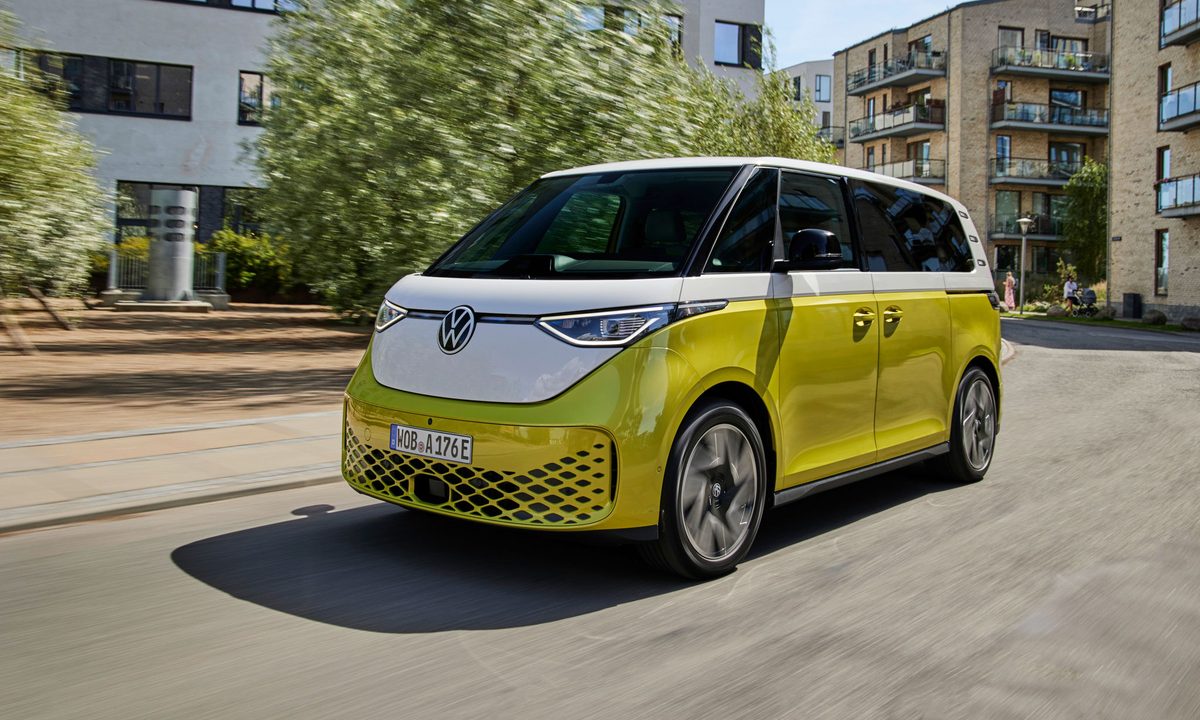
Volkswagen’s growing family of ID-badged electric cars has a new mascot: the ID. Buzz. Inspired by the vintage air-cooled Bus models and previewed by a close-to-production concept unveiled in 2017, the heritage-laced van offers an electric powertrain, an eye-catching design, plus an interior that’s high-tech and almost lounge-like. I tested a Buzz prototype in England in February 2022 and walked away impressed, and time driving a regular-production model in and around Copenhagen, Denmark, confirmed these impressions. This was worth the wait.
Design and interior
While you can tell that the Buzz is on the same branch of the Volkswagen family tree as the split- and bay-window Buses prized by hippies decades ago, designers decided not to go full-retro as they did with the New Beetle released in 1997. The headlights aren’t round, for example, and they’re much higher than the original van’s. It’s the same story out back: The lights are horizontal, located right below the big hatch’s window, and connected by a light bar. This is intentional — Volkswagen aimed to echo the original model without cloning it.
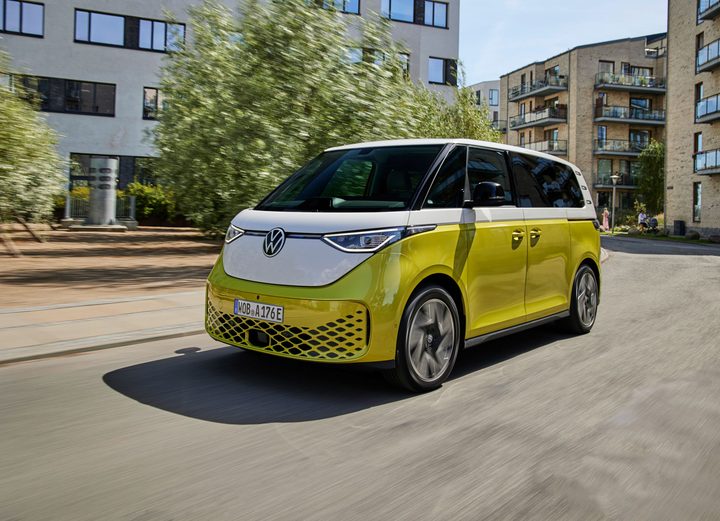
In terms of proportions, the Buzz is pretty spot on. The front end isn’t entirely flat and the front doors are positioned behind the front wheels rather than over them, but the design is as close to the old van’s as modern regulations allow. The Buzz variant that I drove in Denmark measures 185.5 inches long, 78.1 inches wide, and 76.8 inches tall, so it’s about as long as a Tiguan but around 10 inches taller and five inches wider. This is what Volkswagen refers to as the short-wheelbase model, and it’s not coming to the United States. We’ll get a long-wheelbase model that hasn’t been unveiled yet; it should look just like the European-spec model but with more space between the front and rear axles.
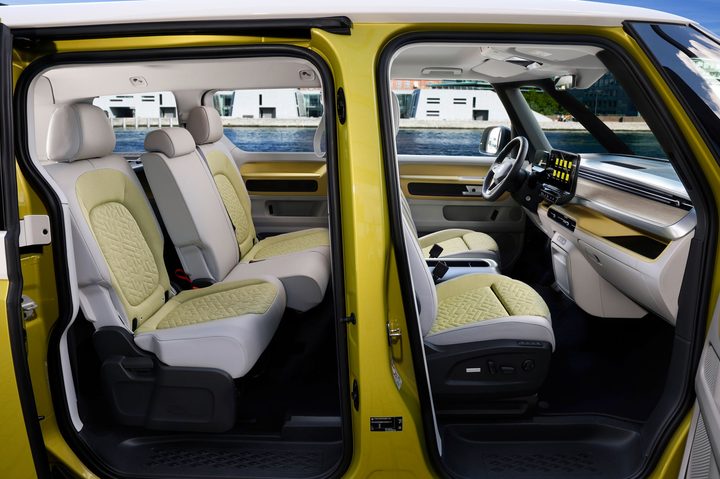
Predictably, the interior went through roughly the same toning down process as the exterior as the Buzz morphed into a production model. Up front, you’ll find a pair of individual seats mounted relatively high, a 5.3-inch digital instrument cluster that looks like the one fitted to the ID.3 hatchback sold in Europe and the ID.4 crossover, and a 10-inch touchscreen for the infotainment system (a 12-inch unit is optional). Sliding open the rear doors reveals a two-piece folding rear bench, kid-approved folding tray tables integrated into the front seatbacks, and one of several Easter eggs scattered across the cabin: the Buzz’s outline on the piece of trim that covers each outer seat’s sliding mechanism.
There’s another Easter egg right at the driver’s feet: The accelerator and brake pedals are labeled play and pause, respectively. This is a neat touch that we’ve seen on a wide selection of ID models, including the cool ID Buggy concept that I drove in sunny California in 2019.
Tech, infotainment, and driver assist
Volkswagen and Pennsylvania-based Argo AI are jointly developing an autonomous, Buzz-based prototype tentatively due out in 2025. We’re not there yet, and the Buzz doesn’t drive itself in spite of its futuristic design, but it offers a generous list of technology features. Car2X technology relies on swarm data to send warnings to nearby compatible vehicles, and the optional Travel Assist function analyzes this same set of data to keep the Buzz centered in its lane even when one of the markings is missing. The Buzz can change lanes on its own in the right conditions, though I didn’t get to test out this feature, and drivers can teach the Park Assist Plus system up to five parking maneuvers.
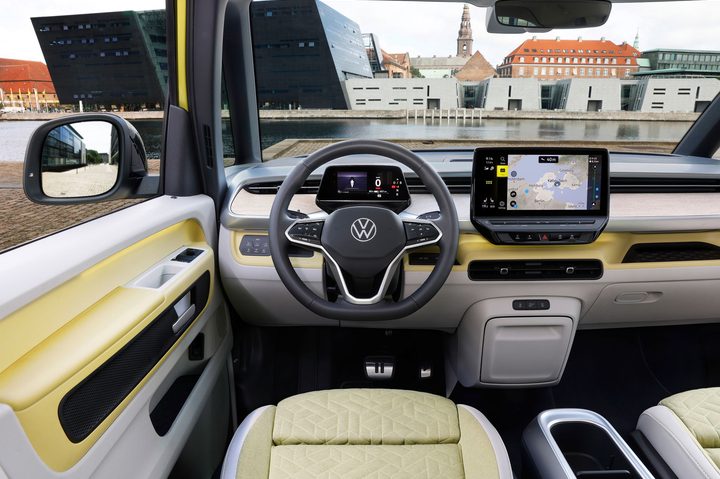
The infotainment system is relatively straightforward; Volkswagen designed it to look and feel like a tablet. It’s reasonably easy to use, it offers sharp-looking graphics, and it responds relatively quickly to input. The touch-sensitive sliders located directly below the screen are a different story. They let the front passengers control the volume and the various climate control functions, and they help give the dashboard a clean and uncluttered look, but they take some getting used to. Old-fashioned buttons and knobs would arguably be more intuitive.
Driving experience
Volkswagen went to significant lengths to remove as many buttons from the dashboard as possible. Only a handful remain, including one used to start the electric motor. Rear-mounted, it draws electricity from an 82-kilowatt-hour lithium-ion battery pack to send 204 horsepower and 229 pound-feet of torque to the rear wheels via a single-speed transmission. That’s enough for a 10.2-second zero-t0-62-mph time, and Volkswagen limited the Buzz’s top speed to 90 mph. While those figures aren’t jaw-dropping, the Buzz feels relatively quick off the line (especially considering it’s a big box that weighs about 5,447 pounds) because the electric motor delivers instant torque.
It looks like a van, it’s marketed as a van, it feels like a van, but it doesn’t drive like a van.
Spending time behind the wheel of a regular-production Buzz confirmed my initial impressions: it looks like a van, it’s marketed as a van, it feels like a van, but it doesn’t drive like a van. It feels more like a crossover, and that’s a good thing. Sitting high with a good view of the road ahead, you’re surrounded by a tremendous amount of space; that’s par for the course in the van world. What’s not is a low center of gravity that keeps body roll in check (the heavy battery pack is stuffed under the floor) and a turning radius that’s on par with a Golf’s. Maneuvering a van in a big European city is normally the automotive equivalent of a horror show; the Buzz takes a great deal of the stress out.
One of the main aspects that differentiates EVs in terms of the driving experience is how the powertrain handles energy recuperation. Some carmakers eschew one-pedal driving; others embrace it and let drivers dial in the amount of recuperation they prefer. Volkswagen’s approach is somewhere in the middle: The system is either on or off. Leave the gear selector in “D” and the Buzz coasts like a gasoline-powered car when you lift your foot off of the accelerator pedal. Twist it once into “B” mode and the brake energy recuperation system kicks in as soon as your foot comes off the pedal. One-pedal driving is possible on country roads but you’ll need to push the brake pedal to come to a full stop.
Range and charging
Volkswagen hasn’t released the American-spec Buzz’s specifications so I’m providing the following figures for context. Built on an 82-kilowatt-hour lithium-ion battery pack, the European-spec van offers a maximum driving range of 263 miles when put through the European testing cycle, which returns higher numbers than the testing cycle used in America. Zapping the battery pack from 5% to 80% takes around half an hour if you can find a 170-kilowatt quick charger. If you’re the charge-at-home type, a full charge takes seven and a half hours.
Bi-directional charging is available, meaning the Buzz can store electricity from solar panels during the day and feed it back to your house. And, the available 230-volt (that’s the standard voltage in Europe) outlet allows it to power tools and appliances, even when it’s turned off.
Worth the wait
It took Volkswagen over 20 years to release a modern-day interpretation of the original Bus but the wait was worth it. While the design isn’t 100% retro, the concept of carving out as much space as possible in a relatively small footprint is what made the Bus popular when it was new, and this idea lives on in the ID. Buzz. Comfortable and versatile, the ID. Buzz is to the Volkswagen brand what the New Beetle was in the late 1990s: a re-imagined icon that’s a flagship in terms of image and in terms of design, not in terms of price and positioning.
Deliveries on the European market will start before the end of 2022. Volkswagen will release details about the long-wheelbase American-spec ID. Buzz in the coming months and deliveries are tentatively scheduled to start in 2024. The wait isn’t over for everyone, then.