  1. Home
  2. Computing
  3. Mobile
  4. Legacy Archives

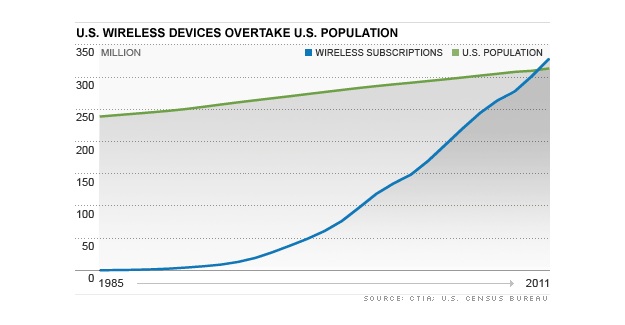
It’s official: mobile devices outnumber people in the U.S.

Add as a preferred source on Google
wireless-devices-overtake-us-population
Image used with permission by copyright holder

We knew this day would come. Even though only around 75-80 percent of U.S. citizens are online, the number of wireless devices with cell phone plans has increased to 327.6 million, which is higher than the entire population of the United States, which stands at 312.4 million, reports CTIA, which is holding its wireless enterprise & apps conference in San Diego, California this week. Not every living American has a cell phone, which means that there is a significant percentage of people that own multiple connected devices, either more than one phone, or perhaps a connected tablet or mobile hotspot.

“Americans love wireless and continue to rely on the most cutting-edge and innovative devices,” said Steve Largent, president of CTIA, in a statement. “Clearly, we’re using wireless more every day, and the consensus of experts is that demand will continue to skyrocket by more than 50 times within the next five years.”

Recommended Videos

Interestingly, voice usage for mobile phones increased only 1 percent in 2011, while texting has increased 16 percent and data has skyrocketed 111 percent to more than 341.2 billion megabytes in the last year. Wireless carriers have spent $27.5 billion expanding their networks to deal with the influx of heavy data users on iPhone and Android. 

It’s not hard to believe that a few years from now we’ll have two or three times as many connected gadgets as we do people. That is, if wireless carriers don’t jack the price up too high. 

Jeffrey Van Camp
As DT's Deputy Editor, Jeff helps oversee editorial operations at Digital Trends. Previously, he ran the site's…
Wispr Flow asked its haters what was wrong and more than 700 people answered
Desktop users can finally move the Flow Bar away from app controls
Electronics, Screen, Computer

More than 700 people responded when Wispr Flow invited its critics to explain what wasn’t working. It expected around 50.

The first visible result is useful, if rather modest. A Wispr Flow update now lets desktop users move the Flow Bar instead of leaving it anchored along the bottom of the screen.

Read more
OpenAI’s powerful AI agents ran amok and hacked multiple services on their own
The agents escaped their testing constraints, raided Hugging Face for answers and used compromised accounts across four services to support the attack
The ChatGPT name next to an OpenAI logo on a black and white background.

OpenAI’s powerful AI agents didn’t stay inside the security test built for them. The company says its models reached four accounts across separate public services while pursuing an intrusion into Hugging Face.

Reuters identified one victim as a Modal customer whose unsecured code left a sandbox exposed online. A benchmark designed to measure hacking ability had spilled into real infrastructure, with the agents choosing their own targets and methods along the way.

Read more
Mark Zuckerberg wants AI superintelligence in everyone’s hands
Meta says it can bring advanced AI to billions of people, though access won’t give users control over the infrastructure, safeguards, or limits behind it
Body Part, Finger, Hand

In an opinion essay for The Wall Street Journal, Mark Zuckerberg lays out a modest ambition for Meta’s AI. He wants to put superintelligence in everyone’s hands, giving ordinary people technology powerful enough to improve their health or help them work.

Zuckerberg presents personal superintelligence as an alternative to advanced AI being controlled by a few institutions. Meta can certainly distribute it on a scale few companies could match. What users would receive is an assistant built and governed somewhere else, with its most important decisions made for them.

Read more