1. Home
  2. Space
  3. News

Check out Webb telescope’s mind-blowing image of the Pillars of Creation

Add as a preferred source on Google

Thanks to the James Webb Space Telescope, clumps of gas and dust have never looked so beautiful.

The latest awe-inspiring image, beamed to Earth by the most powerful space telescope ever built, shows in astonishing detail the Pillars of Creation some 6,500 light-years away.
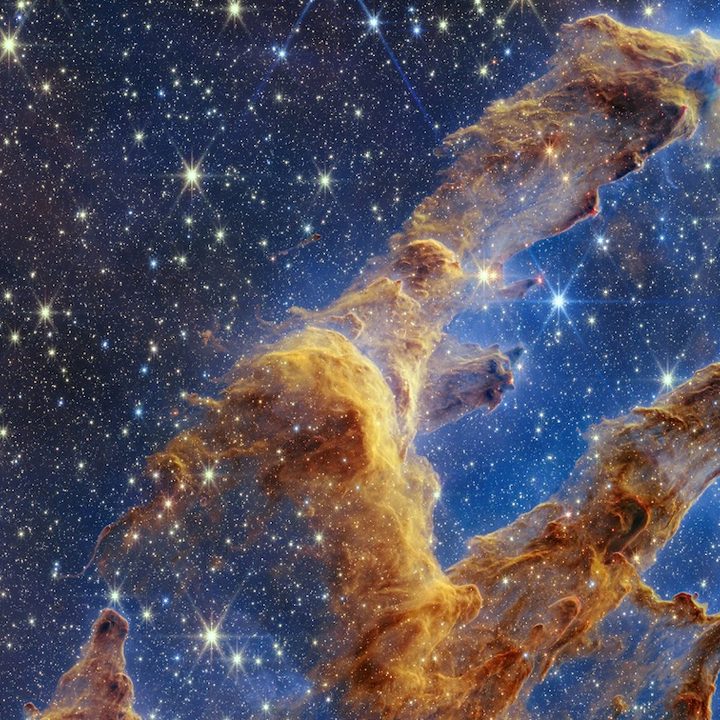
The Pillars of Creation, imaged by the James Webb Space Telescope
The Pillars of Creation are set off in a kaleidoscope of color in NASA’s James Webb Space Telescope’s near-infrared-light view. The pillars look like arches and spires rising out of a desert landscape, but are filled with semi-transparent gas and dust, and ever changing. This is a region where young stars are forming – or have barely burst from their dusty cocoons as they continue to form. Credits: NASA, ESA, CSA, STScI; Joseph DePasquale (STScI), Anton M. Koekemoer (STScI), Alyssa Pagan (STScI) / Credits: NASA, ESA, CSA, STScI; Joseph DePasquale (STScI), Anton M. Koekemoer (STScI), Alyssa Pagan (STScI)

Webb’s near-infrared image also shows the countless stars that formed within the dense clouds of gas and dust, as well as the youngest ones currently emerging from those clouds.

Tour the Webb Telescope’s Pillars of Creation

“The three-dimensional pillars look like majestic rock formations, but are far more permeable,” NASA said of the image. “These columns are made up of cool interstellar gas and dust that appear, at times, semi-transparent in near-infrared light.”

Recommended Videos

Captured by Webb’s Near-Infrared Camera (NIRCam), the image shows glowing red blobs at the end of some of the pillars, indicating areas where young stars are ejecting material as they form.

“When knots with sufficient mass form within the pillars of gas and dust, they begin to collapse under their own gravity, slowly heat up, and eventually form new stars,” NASA explained, adding that these new stars appear in Webb’s image as bright red orbs and are estimated to be only a few hundred thousand years old.

The Pillars of Creation gained widespread attention in 1995 when it was captured by NASA’s Hubble Space Telescope. Hubble imaged it again in 2014 — you can compare it with Webb’s effort below:
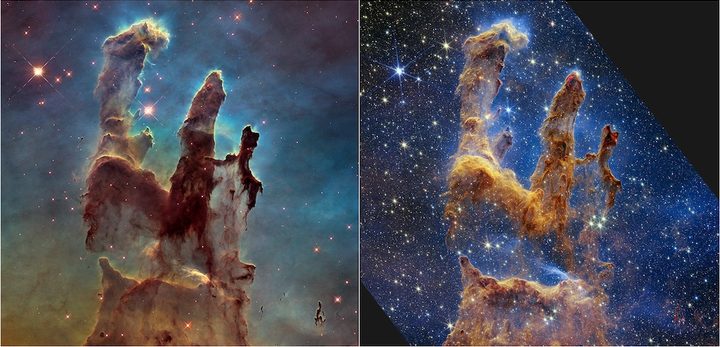
The Pillars of Creation imaged by Hubble and Webb.
NASA’s Hubble Space Telescope made the Pillars of Creation famous with its first image in 1995, but revisited the scene in 2014 to reveal a sharper, wider view in visible light, shown above at left. A new, near-infrared-light view from NASA’s James Webb Space Telescope, at right, helps us peer through more of the dust in this star-forming region. The thick, dusty brown pillars are no longer as opaque and many more red stars that are still forming come into view. Credits: NASA, ESA, CSA, STScI; Joseph DePasquale (STScI), Anton M. Koekemoer (STScI), Alyssa Pagan (STScI)

Webb’s image will enable researchers to update their models of star formation, the space agency said, helping us to learn more about how stars develop before they burst out of these dusty clouds over a period of millions of years.

After launching in December 2021, the Webb telescope is now in an orbit around a million miles from Earth as it peers toward deep space in a bid to learn more about the origins of the universe. Besides exploring areas of interest many light-years away, Webb is also taking time to image celestial bodies closer to home, with this image of Jupiter showing the planet as you’ve never seen it before.

Trevor Mogg
Contributing Editor
Not so many moons ago, Trevor moved from one tea-loving island nation that drives on the left (Britain) to another (Japan)…
China’s answer to SpaceX’s reusable rockets literally catches boosters in a net
SpaceX catches boosters on legs. China just used a net.
Ammunition, Missile, Weapon

SpaceX's playbook for recovering a rocket booster generally involves legs, a precisely controlled vertical landing, and either a concrete pad or a drone ship. 

China just managed to pull off something similar, but in a slightly different way, and on July 10, it tested the method as well.

Read more
Dimming the sun sounds unhinged, but this new study on El Niño makes a surprisingly good case for it
A natural test case, Australia's worst-ever wildfire season, suggests the idea deserves serious consideration.
Nature, Outdoors, Sky

When I first saw "scientists propose dimming the sun," I rolled my eyes. It sounds like a science fiction movie cooked up after watching many climate documentaries. But a new study, published on July 8, 2026, in the journal Science Advances, seems to have a genuinely compelling argument.

A Super El Niño is currently forming in the Pacific, feared to be the most intense in decades. It could escalate floods, wildfires, and extreme heat events worldwide. However, Researchers at UC San Diego's Scripps Institution of Oceanography, led by climate scientists Kate Ricke and Jessica Wan, are now proposing one of the most interesting solutions I’ve come across.

Read more
You can now walk through space and gaze into a black hole at this VR exhibit
Smithsonian Starstruck lets you drift past dying stars and see the origin point of the universe for as little as $18 a person.
Smithsonian Starstruck featured

Most planetarium shows ask you to sit still and look up. The Smithsonian's new VR exhibit takes a different approach, letting visitors walk through the vast expanse of the universe, drifting past stars, planets, and a black hole to get a physical sense of its true scale.

A $29 ticket to the edge of the galaxy

Read more