1. Home
  2. Space
  3. News

Astronomers spot a monster black hole ‘practically in our backyard’

Add as a preferred source on Google

Black holes come in a variety of sizes, from stellar black holes a few times the mass of the sun all the way up to supermassive black holes, which are millions of times the mass of the sun and lurk at the heart of galaxies. Recently, astronomers discovered a massive black hole just 1,550 light-years away, which is right in our neighborhood, astronomically speaking. It is one of the closest black holes ever discovered, with a mass 12 times that of the sun. Being so close to us, it’s an exciting target for future research.
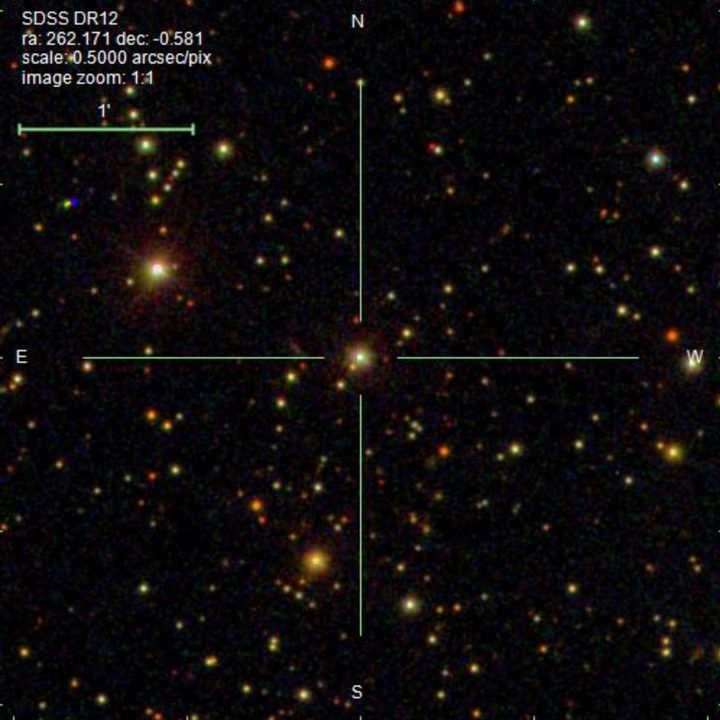
The cross-hairs mark the location of the newly discovered monster black hole.
The cross-hairs mark the location of the newly discovered monster black hole. Sloan Digital Sky Survey / S. Chakrabart et al.

“It is closer to the sun than any other known black hole, at a distance of 1,550 light years,” said Sukanya Chakrabarti, lead author of the study from the University of Alabama in Huntsville, in a statement. “So, it’s practically in our backyard.”

Recommended Videos

The black hole was discovered using data from the European Space Agency’s Gaia mission, which is building a 3D map of the entire galaxy. The researchers looked at nearly 200,000 binary stars, in which a star orbits a companion, to search for cases where the brightness of one star was sufficient to explain the brightness of the binary. That implies that the companion in these binaries must be dark, which suggests the companion could be a black hole.

Then, the researchers took these selected binaries and studied the Doppler shift of their light, which shows how massive the companion must be and gives information about the pair’s orbit and rotation. This is how they identified and learned about the nearby black hole.

“In this case we’re looking at a monster black hole but it’s on a long-period orbit of 185 days, or about half a year,” Chakrabarti said. “It’s pretty far from the visible star and not making any advances toward it.”

As well as finding a useful target for research because of its location, the study also demonstrates how more black holes can be identified in the future.

“Simple estimates suggest that there are about a million visible stars that have massive black hole companions in our galaxy,” Chakrabarti said. “But there are a hundred billion stars in our galaxy, so it is like looking for a needle in a haystack. The Gaia mission, with its incredibly precise measurements, made it easier by narrowing down our search.”

The research has not yet been peer reviewed but has been submitted to The Astrophysical Journal.

Georgina Torbet
Georgina has been the space writer at Digital Trends space writer for six years, covering human space exploration, planetary…
China’s answer to SpaceX’s reusable rockets literally catches boosters in a net
SpaceX catches boosters on legs. China just used a net.
Ammunition, Missile, Weapon

SpaceX's playbook for recovering a rocket booster generally involves legs, a precisely controlled vertical landing, and either a concrete pad or a drone ship. 

China just managed to pull off something similar, but in a slightly different way, and on July 10, it tested the method as well.

Read more
Dimming the sun sounds unhinged, but this new study on El Niño makes a surprisingly good case for it
A natural test case, Australia's worst-ever wildfire season, suggests the idea deserves serious consideration.
Nature, Outdoors, Sky

When I first saw "scientists propose dimming the sun," I rolled my eyes. It sounds like a science fiction movie cooked up after watching many climate documentaries. But a new study, published on July 8, 2026, in the journal Science Advances, seems to have a genuinely compelling argument.

A Super El Niño is currently forming in the Pacific, feared to be the most intense in decades. It could escalate floods, wildfires, and extreme heat events worldwide. However, Researchers at UC San Diego's Scripps Institution of Oceanography, led by climate scientists Kate Ricke and Jessica Wan, are now proposing one of the most interesting solutions I’ve come across.

Read more
You can now walk through space and gaze into a black hole at this VR exhibit
Smithsonian Starstruck lets you drift past dying stars and see the origin point of the universe for as little as $18 a person.
Smithsonian Starstruck featured

Most planetarium shows ask you to sit still and look up. The Smithsonian's new VR exhibit takes a different approach, letting visitors walk through the vast expanse of the universe, drifting past stars, planets, and a black hole to get a physical sense of its true scale.

A $29 ticket to the edge of the galaxy

Read more