  1. Home
  2. Emerging Tech
  3. Web
  4. Legacy Archives

Honda demonstrates new version of its ASIMO humanoid robot

Add as a preferred source on Google

A few years ago Honda’s ASIMO robot humiliated the Japanese car company when it demonstrated how well it could tumble down stairs, when it was supposed to walk up them.

Whether the engineers that made that ASIMO ended up on the scrapheap along with their failed invention isn’t known, but what is clear is that ASIMO is back.

Recommended Videos

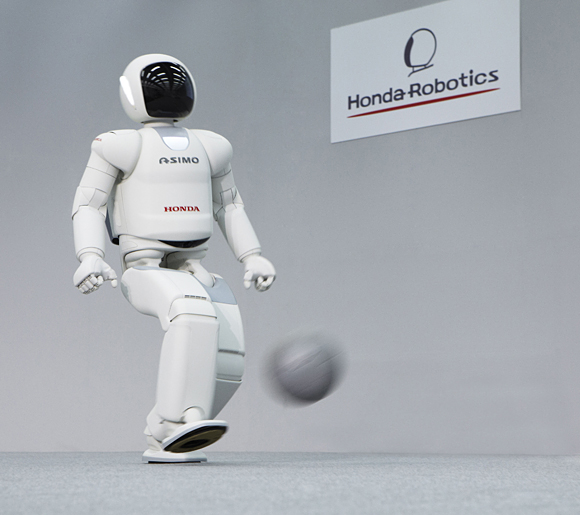
At a press conference held in Tokyo on Tuesday, Honda unveiled an all new ASIMO robot – one that can run, walk across bumpy surfaces, hop, and even pour a coffee. There was no sign of those stairs though.
The original ASIMO promised much when it was first unveiled back in 2000 but ended up being looked upon as a rather novel high-tech toy, offering little in the way of practical use.

However, according to the Washington Post, Honda researchers have been hard at work with the astronaut-looking ASIMO, determined to prove its worth. On Tuesday Honda president Takanobu Ito told a gathering of journalists that technology associated with ASIMO has been developed to make a robotic arm which can be used, for example, to open and close valves at the stricken nuclear power plant in Fukushima.

The original idea had been to send ASIMO itself into the damaged plant, but engineers quickly realized that the robot – even the new version – wouldn’t be able to navigate the rubble. Stairs, maybe. Rubble, definitely not. So the company developed the robotic arm instead.

ASIMO’s running speed has also improved, increasing from 3.7 mph in 2005 to 5.6 mph today. According to the Post, its running style was a lot smoother than before, too.

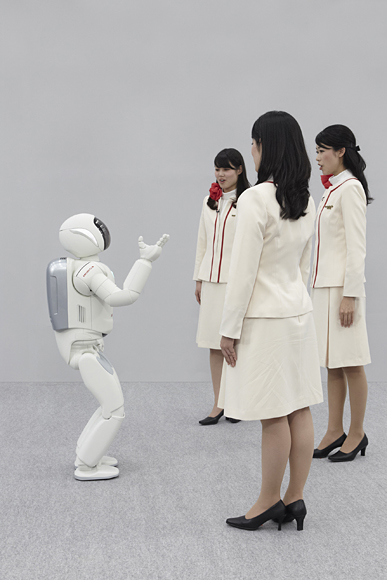
It could even identify different voices speaking at the same time and respond to different instructions from each one. And if all that wasn’t enough to demonstrate that ASIMO had made some significant improvements, it even engaged in a spot of sign language. “My name is ASIMO,” it said with its fingers.

Honda’s president said he knew that much more time would be required to make robots into a practical business, telling reporters, “Maybe at the start this was a dream of engineers to make a machine that was close to a human being, like Astro Boy,” adding “We think ASIMO is good.”

Comparing the stairs video to a news piece broadcast in Japan on Tuesday, the humanoid robot has certainly come a long way. But you really would’ve expected the car company to have sent ASIMO up the biggest staircase ever, just to prove a point.

Old ASIMO:

New, improved ASIMO:

Trevor Mogg
Contributing Editor
Not so many moons ago, Trevor moved from one tea-loving island nation that drives on the left (Britain) to another (Japan)…
The Apple Car may be dead, but it became the foundation of Apple Intelligence
A decade of work on a canceled car project reportedly laid the groundwork for Apple Intelligence.
Apple Intelligence in Apple Car

The Apple Car may have never left the garage, but it apparently gave birth to Apple's AI ambitions. According to Bloomberg's Mark Gurman, Apple's canceled autonomous vehicle project, one that consumed more than a decade of work and over $10 billion before being scrapped in 2024, ended up laying the technological foundation for Apple Intelligence. In a rather ironic twist, one of Apple's most expensive failures may also become one of its most important long-term investments.

The Apple Car forced Apple to think like an AI company

Read more
Researchers hid a prompt injection inside a PNG, and AI fell for it
Hacker

AI coding assistants like Claude are becoming every developer's favorite coworker. They can review code, explain confusing functions, and even write entire features with a single prompt. But new research suggests that this growing trust could also become their biggest weakness.

A team of security researchers (professor Sudipta Chattopadhyay and researcher Murali Ediga) has demonstrated an unusual attack that doesn't target the AI model directly. Instead, it targets what the AI doesn't pay enough attention to during code reviews. Rather than hiding malicious instructions in lines of code, the researchers tucked them inside an image file. Since many AI review tools treat images as decorative assets rather than as something worth inspecting, the pull request can appear perfectly harmless and sail through the review.

Read more
AI has already fallen into the wrong hands and they’re using it to make bombs
Logo, Text

Artificial intelligence has quickly become the go-to tool for everything from writing emails and summarizing meetings to helping students study or developers debug code. But the same technology that saves people time can also be misused, and a new report suggests that terrorist organizations are finding ways to do exactly that.

According to a research paper shared with The New York Times ahead of its publication, researchers found evidence that members of Boko Haram have been using popular AI chatbots to support both day-to-day activities and combat-related tasks. Interviews with 27 former members conducted in Nigeria over the past two years suggest that tools such as ChatGPT, Gemini, Claude, Grok, Meta AI, and DeepSeek were used to gather technical information, troubleshoot weapons, and even assist with planning attacks.

Read more