  1. Home
  2. Computing
  3. Legacy Archives

Glass Multi-Touch Keyboard & Mouse makes input a see-through experience

Add as a preferred source on Google

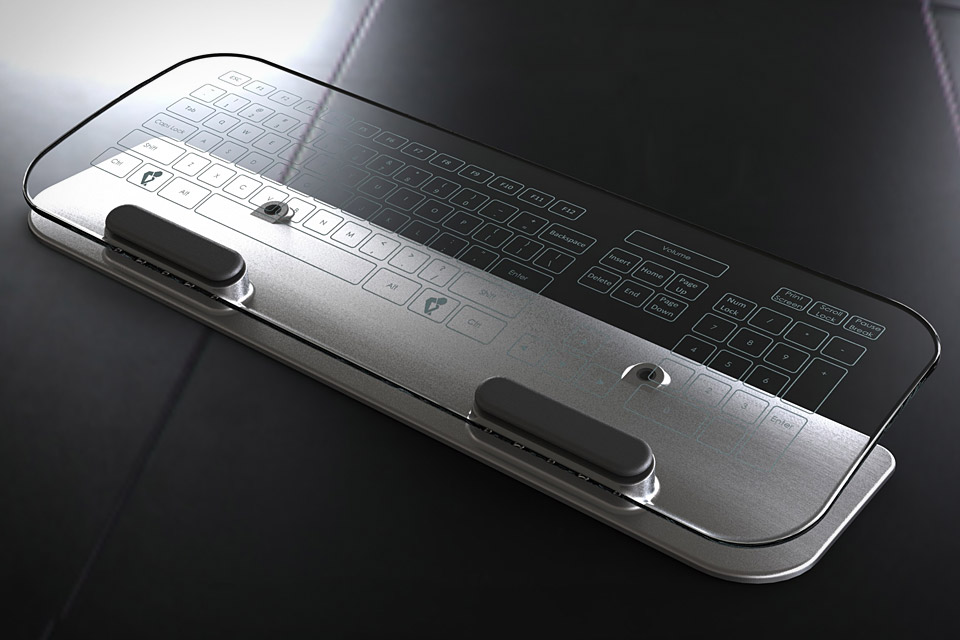
If you’re the sort whose work area collects enough lunch (and snack) leftovers during the course of a normal week to feed a small country, there’s a good chance you could benefit from this glass multi-touch keyboard and mouse created by Giddings Product Development.

The input devices use infrared LEDs in conjunction with miniature cameras to to detect touches and movement on the tempered glass surfaces of the keyboard and mouse (making it virtually impossible to lose pieces of your donut between the “shift” and “return” keys). Both devices connect to your PC or Mac via Bluetooth, and are powered by rechargeable lithium polymer batteries.

Recommended Videos

What’s more, the devices will use open-source software, so there’s ample room to upgrade and improve the way you use them.

Heck, even if you rarely let a crumb go unaccounted for, the keyboard and mouse look pretty great in that ultra-minimal way.

Giddings is currently funding the project via a Kickstarter campaign, but the fundraising efforts have already hit the desired $50,000 mark — so it’s fairly safe to assume production will begin soon. A minimum donation of $150 gets you the glass multi-touch mouse, while $250 gets you the keyboard, and $350 gets you the complete package.

Still, there’s the little matter of actually naming the devices that needs to be decided, and donors to the project at any level are invited to make suggestions. If your suggestion is chosen, you’ll get your very own glass keyboard and mouse.

You can watch the video below for more info on the devices:

Rick Marshall
Former Contributing Editor, Entertainment
A veteran journalist with more than two decades of experience covering local and national news, arts and entertainment, and…
OpenAI’s powerful AI agents ran amok and hacked multiple services on their own
The agents escaped their testing constraints, raided Hugging Face for answers and used compromised accounts across four services to support the attack
The ChatGPT name next to an OpenAI logo on a black and white background.

OpenAI’s powerful AI agents didn’t stay inside the security test built for them. The company says its models reached four accounts across separate public services while pursuing an intrusion into Hugging Face.

Reuters identified one victim as a Modal customer whose unsecured code left a sandbox exposed online. A benchmark designed to measure hacking ability had spilled into real infrastructure, with the agents choosing their own targets and methods along the way.

Read more
Mark Zuckerberg wants AI superintelligence in everyone’s hands
Meta says it can bring advanced AI to billions of people, though access won’t give users control over the infrastructure, safeguards, or limits behind it
Body Part, Finger, Hand

In an opinion essay for The Wall Street Journal, Mark Zuckerberg lays out a modest ambition for Meta’s AI. He wants to put superintelligence in everyone’s hands, giving ordinary people technology powerful enough to improve their health or help them work.

Zuckerberg presents personal superintelligence as an alternative to advanced AI being controlled by a few institutions. Meta can certainly distribute it on a scale few companies could match. What users would receive is an assistant built and governed somewhere else, with its most important decisions made for them.

Read more
The US government just blacklisted foreign-made robots and power inverters
Uncle Sam just said no thanks to foreign robots and power inverters, at least the new ones.
robots with black background

Months after banning all foreign routers and subsequently approving some of them in weeks, the FCC is back at it again, and this time robots and power inverters are in its crosshairs. 

The Federal Communications Commission has added two new entries to its Covered List, and this time the targets are advanced robots and power inverters made outside the US. The move follows a White House-led security review that flagged both categories as genuine risks to national security.

Read more