1. Home
  2. Space
  3. News

How to see the green comet this week before it leaves us for good

Add as a preferred source on Google

This weekend will see a special visitor to the skies over our planet, as a 50,000-year-old comet will be passing by. Named C/2022 E3 ZTF, this comet appears greenish in the skies due to the chemicals it is composed of, and it will come close enough to the planet that it will be visible using binoculars or a telescope, and may even be visible to the naked eye.
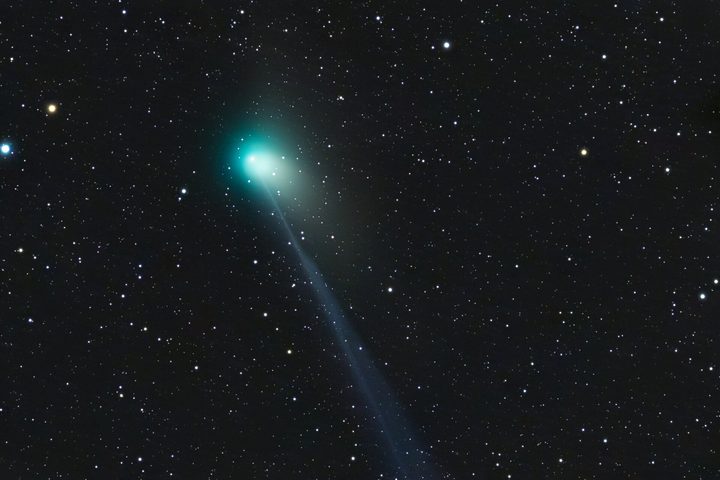
Comet ZTF stuns in this image taken two weeks before its Earth close approach, on 19 January 2023. Look closely, and you’ll spot that comets have two tails, one made of ionised gas and another of dust. As a comet approaches the inner Solar System, solar radiation causes volatile materials within the comet to vaporise into gas and stream out of the nucleus – the comet’s ‘head’ – carrying dust away with them.
Comet ZTF stuns in this image taken two weeks before its Earth close approach, on 19 January 2023.Look closely, and you’ll spot that comets have two tails, one made of ionized gas and another of dust. As a comet approaches the inner Solar System, solar radiation causes volatile materials within the comet to vaporize into gas and stream out of the nucleus – the comet’s ‘head’ – carrying dust away with them. Oscar Martín (startrails.es)

Looking at the image above, you can see the comet has one bright ion tail pointing downward plus a second more diffuse dust tail to the left.

Recommended Videos

“The two tails point in slightly different directions because the forces act on dust and ions in different ways. While the larger dust particles are pushed by pressure from sunlight, the ions are much lighter and electrically charged so are easily carried by the solar wind and its magnetic field,” explains Jorge Amaya from the European Space Agency’s Space Weather Office in a statement. “Recently, a strange phenomenon has occurred with comet ZTF as it appears to have a third tail. This is, in fact, an optical illusion, due to our point of view of the dust trail.”

This week will be the last chance to observe the comet, so if the skies are clear where you are then you can head out and try to spot it. You’ll have the best chance of viewing the comet if you get far away from light sources like street lights, and you’ll need to give your eyes 15 to 20 minutes to adjust to the darkness — so avoid looking at light sources like your phone during this period.

According to the SETI Institute, your best bet for seeing the comet is to use a pair of binoculars and look toward the celestial north pole, near the bright star Polaris.

The best views of the comet will be through this weekend and up until mid-next week, and it will get dimmer and harder to spot from then. So if you have a moment this weekend you might be able to spot it, visible as a fuzzy greenish blob in the sky.

Georgina Torbet
Georgina has been the space writer at Digital Trends space writer for six years, covering human space exploration, planetary…
China’s answer to SpaceX’s reusable rockets literally catches boosters in a net
SpaceX catches boosters on legs. China just used a net.
Ammunition, Missile, Weapon

SpaceX's playbook for recovering a rocket booster generally involves legs, a precisely controlled vertical landing, and either a concrete pad or a drone ship. 

China just managed to pull off something similar, but in a slightly different way, and on July 10, it tested the method as well.

Read more
Dimming the sun sounds unhinged, but this new study on El Niño makes a surprisingly good case for it
A natural test case, Australia's worst-ever wildfire season, suggests the idea deserves serious consideration.
Nature, Outdoors, Sky

When I first saw "scientists propose dimming the sun," I rolled my eyes. It sounds like a science fiction movie cooked up after watching many climate documentaries. But a new study, published on July 8, 2026, in the journal Science Advances, seems to have a genuinely compelling argument.

A Super El Niño is currently forming in the Pacific, feared to be the most intense in decades. It could escalate floods, wildfires, and extreme heat events worldwide. However, Researchers at UC San Diego's Scripps Institution of Oceanography, led by climate scientists Kate Ricke and Jessica Wan, are now proposing one of the most interesting solutions I’ve come across.

Read more
You can now walk through space and gaze into a black hole at this VR exhibit
Smithsonian Starstruck lets you drift past dying stars and see the origin point of the universe for as little as $18 a person.
Smithsonian Starstruck featured

Most planetarium shows ask you to sit still and look up. The Smithsonian's new VR exhibit takes a different approach, letting visitors walk through the vast expanse of the universe, drifting past stars, planets, and a black hole to get a physical sense of its true scale.

A $29 ticket to the edge of the galaxy

Read more