
For years, Sonos has relentlessly championed the benefits of Wi-Fi audio. The company even ran a cheeky (and hilarious) campaign showing how annoying it can be to use Bluetooth, featuring pinging notifications and phone calls routinely interrupting what should have otherwise been enjoyable music-listening sessions. Times have changed, however, and not only has Sonos added Bluetooth to its two portable speakers (the Move and the Roam), but recent leaks suggest that it’s considering expanding support for Bluetooth into its main portfolio of powered speakers too, starting with the new Sonos Era 100 and Sonos Era 300.
This amounts to a tacit acknowledgment that Sonos may have been too zealous in its past refusal to adopt Bluetooth audio, and I can’t help but think that it might be time for another company to rethink its rejection of Bluetooth: Apple.
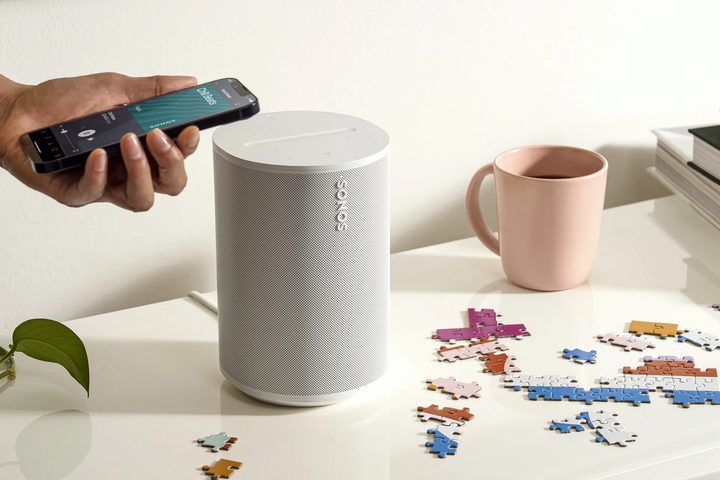
I’m talking specifically about the HomePod (gen 1, 2) and HomePod mini. All three versions of Apple’s smart speaker possess Bluetooth 5.0 radios, and yet none is compatible with Bluetooth audio when streamed from a phone or other device. There are only two ways to get a HomePod to play music: you can ask Siri to access one of the compatible music services, or you can use AirPlay.
Don’t get me wrong, I fully agree with the quality advantages of Wi-Fi (and thus AirPlay) when it comes to wireless audio. Even though it’s possible to do lossless CD-quality sound over Bluetooth (assuming you have a source and speaker that are compatible with the newest version of Qualcomm’s Snapdragon Sound), Wi-Fi can support up to 24-bit/192kHz lossless hi-res audio if you want, plus it’s the only way to do multiroom when you have multiple wireless speakers.
I also understand that Wi-Fi audio, with its app-based control architecture, gives companies like Apple and Sonos a much deeper connection to their customers’ listening habits. The Sonos app acts like an operating system of sorts. It’s superb in many ways (including its unrivaled universal search), and it just so happens to be the only way you can access Sonos Radio, the company’s in-house ad-supported or subscription-based streaming music service.
When you use a Sonos portable like the Move in Bluetooth mode, the Sonos app is entirely removed from the equation. And since the app is such a big part of the Sonos experience, you can see why the company would prefer to keep you on Wi-Fi whenever possible.

Apple’s approach is less app-centric — the HomePod family is controlled (partially) from the company’s Home app — but in some ways, it’s even more dependent on Wi-Fi. If a HomePod were to switch to Bluetooth mode for audio, it would cease to be available to Apple’s other products like the Apple TV, or any other AirPlay-capable Apple product in your home. More critically, from Apple’s point of view, the HomePod would cease to work as a smart speaker (voice assistants like Siri need a direct internet connection).
And yet, there’s just no denying that Bluetooth is way more convenient. There’s no app to install (or at the very least, if there is one, it’s optional), no Wi-Fi networks to join, and it lets you stream any audio your device can produce, from movies to phone calls. Plus, it’s inherently universal. If a friend wants to stream to your HomePod and their phone isn’t made by Apple, sorry, that just isn’t happening.
Apple has always prioritized its own ecosystem when it comes to its products, and I don’t expect that to change any time soon. But if Sonos — a company that has also jealously guarded its own ecosystem in the past — appears to be on the brink of allowing its customers to use their speakers over Bluetooth, I think Apple should too. No one has ever said, “I wish my Apple product could do less.”


