1. Home
  2. Space
  3. News

Hubble sees the changing seasons on Jupiter and Uranus

Add as a preferred source on Google

Our planet isn’t the only place in the solar system with dramatic weather changes. Other planets in the solar system also experience seasons, depending on their distance from the sun, and that affects their climates. One of the many jobs of the Hubble Space Telescope is to monitor the changing seasons on other planets, particularly the larger outer planets which aren’t so often observed. And this week, scientist have released their newest views of Jupiter and Uranus, taken by Hubble and showing seasonal changes on the two planets.

Jupiter is far from the sun, so most of its heat comes not from outside but from within. Jupiter is thought to have a very high core temperature, which may be a result of how it was formed but could also be topped up by processes inside the planet. As this heat escapes from the planet’s interior, it affects its atmosphere which contains multiple layers and has unusual features like geometric storms at its poles.
Recommended Videos

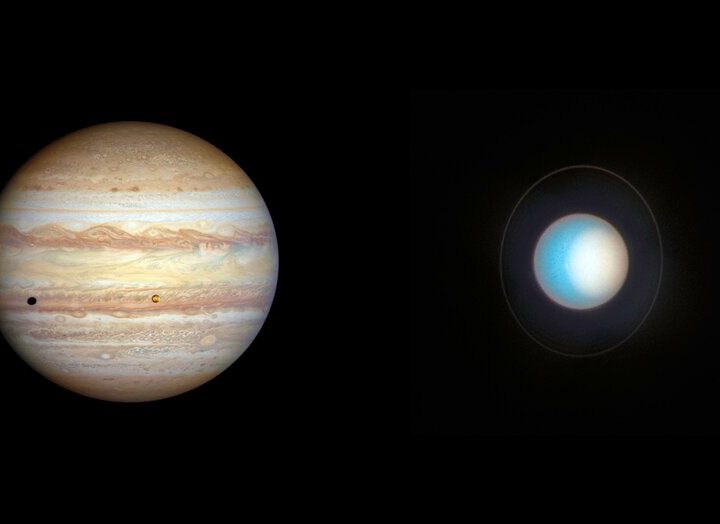
Jupiter and Uranus (not to scale).
[Jupiter: left] – The forecast for Jupiter is for stormy weather at low northern latitudes. A prominent string of alternating storms is visible, forming a ‘vortex street’ as some planetary astronomers call it.[Uranus: right] – Uranus’s north pole shows a thickened photochemical haze that looks similar to the smog over cities. Several little storms can be seen near the edge of the polar haze boundary.Note: The planets do not appear in this image to scale. NASA, ESA, STScI, A. Simon (NASA-GSFC), M. H. Wong (UC Berkeley), J. DePasquale (STScI)
In the recent Hubble image, Jupiter is experiencing storms across the part of the northern hemisphere near the equator, with a wave-like formation of cyclones and anticyclones crossing the planet. In the image you can also see the moon Io as a small orange circle, casting a black shadow toward the left of the planet.

As for Uranus, the image beautifully captures the planet’s rings and the white haze over the planet’s pole. Uranus is unusual in that it is tipped almost entirely over so it orbits on its side, unlike Earth and most other planets which orbit upright. That’s why the polar haze can be seen on the right-hand side of the planet.

The haze is thought to come from the polar cap, the appearance of which changes dramatically over the seasons. Astronomers are still learning about how this cap changes over time, and it is thought that it will get even brighter as the northern pole will be aimed toward Earth during the planet’s northern summer solstice in 2028.

If you head to the ESA Hubble website you can also see side-by-side comparisons of Jupiter in November 2022 and January 2023, and Uranus in November 2014 and November 2022, showing how the planets change in appearance over time.

Georgina Torbet
Georgina has been the space writer at Digital Trends space writer for six years, covering human space exploration, planetary…
China’s answer to SpaceX’s reusable rockets literally catches boosters in a net
SpaceX catches boosters on legs. China just used a net.
Ammunition, Missile, Weapon

SpaceX's playbook for recovering a rocket booster generally involves legs, a precisely controlled vertical landing, and either a concrete pad or a drone ship. 

China just managed to pull off something similar, but in a slightly different way, and on July 10, it tested the method as well.

Read more
Dimming the sun sounds unhinged, but this new study on El Niño makes a surprisingly good case for it
A natural test case, Australia's worst-ever wildfire season, suggests the idea deserves serious consideration.
Nature, Outdoors, Sky

When I first saw "scientists propose dimming the sun," I rolled my eyes. It sounds like a science fiction movie cooked up after watching many climate documentaries. But a new study, published on July 8, 2026, in the journal Science Advances, seems to have a genuinely compelling argument.

A Super El Niño is currently forming in the Pacific, feared to be the most intense in decades. It could escalate floods, wildfires, and extreme heat events worldwide. However, Researchers at UC San Diego's Scripps Institution of Oceanography, led by climate scientists Kate Ricke and Jessica Wan, are now proposing one of the most interesting solutions I’ve come across.

Read more
You can now walk through space and gaze into a black hole at this VR exhibit
Smithsonian Starstruck lets you drift past dying stars and see the origin point of the universe for as little as $18 a person.
Smithsonian Starstruck featured

Most planetarium shows ask you to sit still and look up. The Smithsonian's new VR exhibit takes a different approach, letting visitors walk through the vast expanse of the universe, drifting past stars, planets, and a black hole to get a physical sense of its true scale.

A $29 ticket to the edge of the galaxy

Read more