Foldable phones look primed to take an evolutionary step in 2023. Google, the lord of Android, is now in the game with the Pixel Fold. Samsung leaks suggest that its Galaxy Z Flip 5 will solve nagging woes by embracing a gapless design and finally making the secondary screen more usable. But it looks like Motorola will own the year with its upcoming clamshell-style foldable phone, the Moto Razr 40 Ultra.
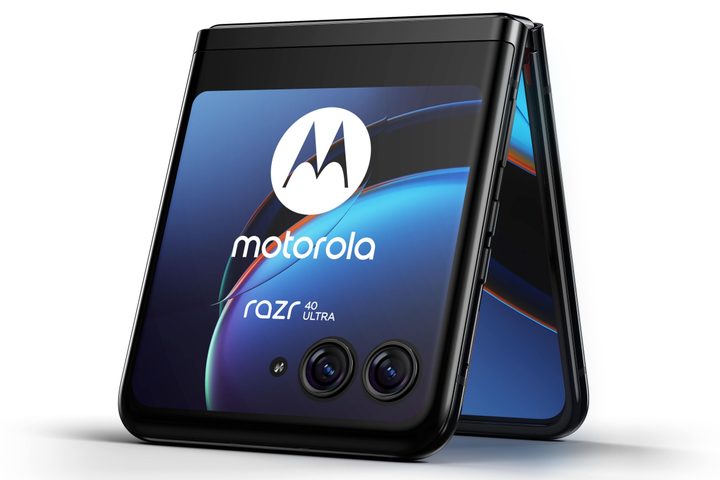
Industry insider Evan Blass (aka @evleaks) has shared a fresh batch of high-resolution renders depicting the phone in a trio of shades — including black, a peppy shade of magenta, and an understated teal green shade. Motorola’s next offering looks astoundingly different from the previous clamshell foldable in the Razr series, and we’re all for its aesthetic makeover.
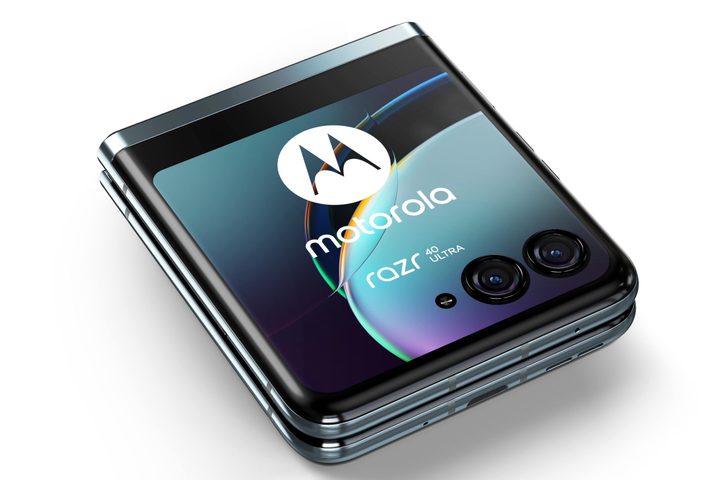
But what really stands out about the phone is the large secondary display at the back that also surrounds the camera lenses, plus the visibly gapless design when the two halves are shut closed. Ever since the first-gen Razr foldable arrived on the scene, Motorola has kept refining the design, paying special attention to the secondary display by stretching its screen real estate and making it more functional.
For the Razr 40 Ultra, the company has turned almost the entire top half into a cover display, giving the appearance of two camera lenses floating independently in a sea of pixels. It looks clean and geometrically sound, unlike the approach that Samsung appears to be taking with the Galaxy Z Flip 5, which has the cover display area avoiding the camera island and taking an odd shape.
Blass’ older leaks suggest that Motorola will be offering a healthy bunch of home and lock screen customization options for the cover display. Plus, it appears that these customization tricks will play to the tunes of Android’s Material You theming system. We dearly hope that Motorola also lets users run apps, or at least some of them, in their full functional glory, instead of just offering a rudimentary level of interactivity.

Next, we have the overall device profile. The Razr 40 Ultra renders paint the picture of an impressively thin phone with a beautiful dual-tone look at the back. But the truly impressive aspect is the hinge design and the gapless architecture of the phone’s two halves when they are closed. Now, Motorola won’t be the first brand to solve the eyesore wedge gap problem for foldable phones, but it’s reassuring to see that the Razr 40 Ultra is serving that luxury alongside a large cover display that seems to be fittingly functional as well.
While the gapless design looks good, the most notable benefit here is that liquid and dust particles will no longer be making their way inside. For the unaware, the gap opens the door for display damage and also poses mechanical risks for the delicate hinge assembly. Thankfully, it looks like Motorola will be complementing those good looks with some seriously powerful hardware under the hood.
According to XDA, the Razr 40 Ultra will draw power from Qualcomm’s Snapdragon 8 Gen 1 Plus chip, ticking alongside 12GB of RAM and up to 512GB of onboard storage. The cover display offers a resolution of 1056 x 1066 pixels, while the inner foldable OLED panel serves a resolution of 2640 x 1080 pixels and a 120Hz refresh rate.
The main camera at the back relies on a 12-megapixel sensor, while the ultrawide snapper shoots slightly higher with a 13-megapixel sensor. Notably, the phone is said to come equipped with a 32-megapixel selfie camera. According to MySmartPrice, a 3,640mAh battery keeps the lights on, complete with 33-watt fast charging convenience.
Overall, it looks like the Razr 40 Ultra will not only be decked out in sharp looks and tantalizing paint jobs, but will also go toe-to-toe with the most powerful flagship phones out there.