1. Home
  2. Space
  3. News

Researchers want to use gravitational waves to learn about dark matter

Add as a preferred source on Google

When two sufficiently massive objects collide — such as when two black holes merge — the forces can actually bend space-time, creating ripples called gravitational waves. These gravitational waves can be detected even from millions of light-years away, making them a way to learn about distant, dramatic events in far-off parts of the universe. And now, a team of astronomers has come up with a method for using gravitational waves to study the mysterious phenomenon of dark matter.

The idea of the research was to create different computer models of what gravitational waves from black hole mergers would look like in universes with different types of dark matter. By comparing the models to what is seen in the real world, we can learn more about what type of dark matter is most likely.
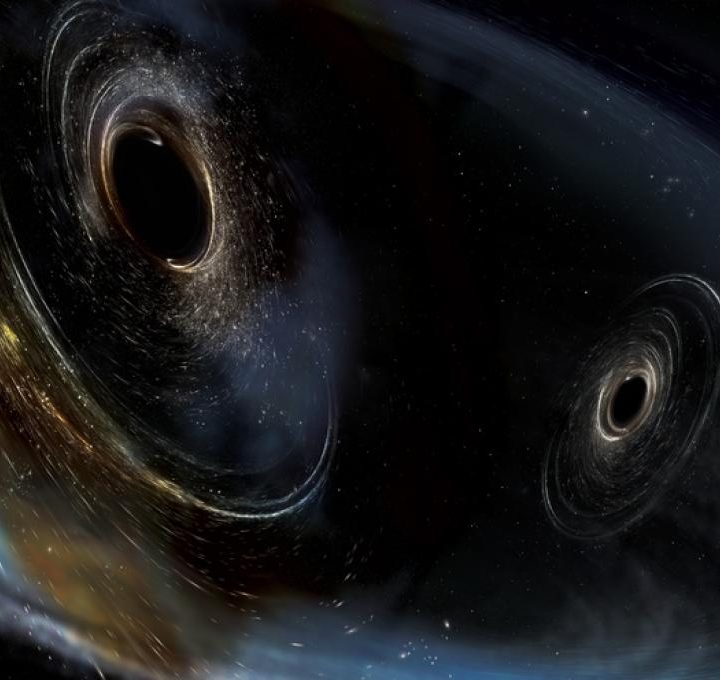
Artist's conception shows two merging black holes similar to those detected by LIGO.
Artist’s conception shows two merging black holes similar to those detected by LIGO. The black holes are spinning in a non-aligned fashion, which means they have different orientations relative to the overall orbital motion of the pair. LIGO found hints that at least one black hole in the system called GW170104 was non-aligned with its orbital motion before it merged with its partner. LIGO/Caltech/MIT

Scientists know that dark matter doesn’t interact with light, but some people think that it could interact with a type of particle called a neutrino. That means that neutrino collisions could prevent dark matter from forming into the structures which are the basis for galaxies, so these particles could stop galaxies from forming. If we could find these “missing” galaxies, that would support the idea that dark matter can be affected by neutrinos.

Recommended Videos

It’s hard to see a galaxy that didn’t form, though. That’s why the researchers suggest using gravitational waves created in black hole mergers as a measure instead. With fewer galaxies there are fewer mergers, and therefore fewer gravitational waves.

Simulations show that this could be an effective method for learning about dark matter. Current gravitational wave detectors aren’t powerful enough to detect these small effects, but the next generation of instruments could be used for this purpose.

“Dark matter remains one of the enduring mysteries in our understanding of the universe,” said one of the researchers, Sownak Bose of Durham University, in a statement. “This means it is especially important to continue identifying new ways to explore models of dark matter, combining both existing and new probes to test model predictions to the fullest. Gravitational wave astronomy offers a pathway to better understand not just dark matter, but the formation and evolution of galaxies more generally.”

The research was presented at the 2023 National Astronomy Meeting on 5 July.

Georgina Torbet
Georgina has been the space writer at Digital Trends space writer for six years, covering human space exploration, planetary…
China’s answer to SpaceX’s reusable rockets literally catches boosters in a net
SpaceX catches boosters on legs. China just used a net.
Ammunition, Missile, Weapon

SpaceX's playbook for recovering a rocket booster generally involves legs, a precisely controlled vertical landing, and either a concrete pad or a drone ship. 

China just managed to pull off something similar, but in a slightly different way, and on July 10, it tested the method as well.

Read more
Dimming the sun sounds unhinged, but this new study on El Niño makes a surprisingly good case for it
A natural test case, Australia's worst-ever wildfire season, suggests the idea deserves serious consideration.
Nature, Outdoors, Sky

When I first saw "scientists propose dimming the sun," I rolled my eyes. It sounds like a science fiction movie cooked up after watching many climate documentaries. But a new study, published on July 8, 2026, in the journal Science Advances, seems to have a genuinely compelling argument.

A Super El Niño is currently forming in the Pacific, feared to be the most intense in decades. It could escalate floods, wildfires, and extreme heat events worldwide. However, Researchers at UC San Diego's Scripps Institution of Oceanography, led by climate scientists Kate Ricke and Jessica Wan, are now proposing one of the most interesting solutions I’ve come across.

Read more
You can now walk through space and gaze into a black hole at this VR exhibit
Smithsonian Starstruck lets you drift past dying stars and see the origin point of the universe for as little as $18 a person.
Smithsonian Starstruck featured

Most planetarium shows ask you to sit still and look up. The Smithsonian's new VR exhibit takes a different approach, letting visitors walk through the vast expanse of the universe, drifting past stars, planets, and a black hole to get a physical sense of its true scale.

A $29 ticket to the edge of the galaxy

Read more