  1. Home
  2. Computing
  3. News

AMD is taking the gloves off in the AI arms race

Add as a preferred source on Google
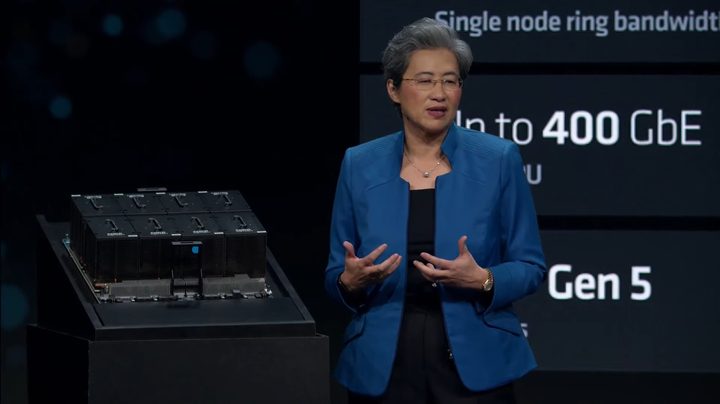
AMD's CEO presenting the MI300X AI GPU.
AMD

AMD looks ready to fight. At its Advancing AI event, the company finally launched its Instinct MI300X AI GPU, which we first heard about first a few months ago. The exciting development is the performance AMD is claiming compared to the green AI elephant in the room: Nvidia.

Spec-for-spec, AMD claims the MI300X beats Nvidia’s H100 AI GPU in memory capacity and memory bandwidth, and it’s capable of 1.3 times the theoretical performance of H100 in FP8 and FP16 operations. AMD showed this off with two Large Language Models (LLMs) using a medium and large kernel. The MI300X showed between a 1.1x and 1.2x improvement compared to the H100.
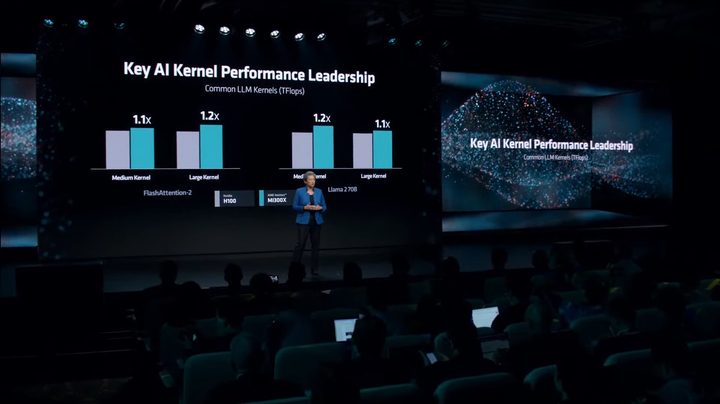
AMD's CEO presenting the performance of MI300X AI GPU.
AMD

In a moment that looks ripped straight out of an Nvidia conference, AMD’s CEO Lisa Su introduced the MI300X Platform, which combines eight of the GPUs on a single board. AMD says these boards offer the same training performance as Nvidia’s H100 HGX and 1.6 times the inference performance. In addition, AMD says you’re able to run two LLMs per system, while H100 HGX can only handle one.

Recommended Videos

To illustrate how big of a deal this is, AMD brought out Microsoft’s Chief Technology Officer Kevin Scott to talk about how AMD and Microsoft are working together on AI. It’s important to highlight that the wildly popular ChatGPT is run on Microsoft servers, and it was originally trained on thousands of Nvidia GPUs.
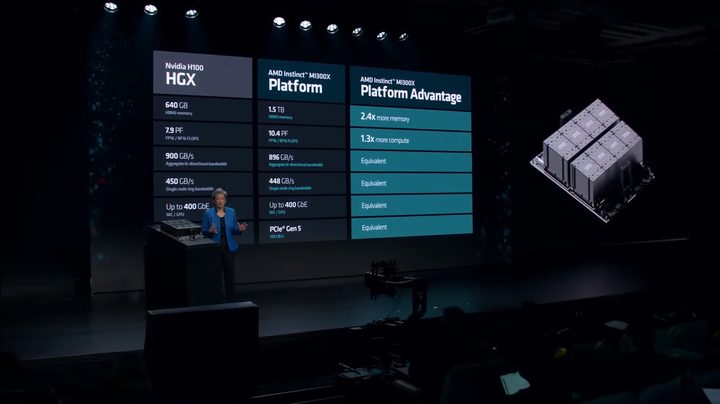
A comparison between AMD's MI300X and Nvidia's H100.
AMD

In addition to the MI300X, AMD announced the MI300A, which is the first APU for AI, according to AMD. This combines AMD’s CDNA 3 AI GPU architecture with 24 Zen 4 CPU cores, along with 128GB of HBM3 memory. AMD says this is a balance between AI performance and high-performance computing, offering the CPU prowess that we recently saw on Threadripper 7000 to data centers.

Despite jumping on the AI bandwagon with the rest of the tech world, AMD has taken a deep backseat to Nvidia up to this point. Nvidia started investing big in AI years ago, giving it a massive head start over AMD and Intel. That early investment has catapulted Nvidia into becoming a trillion-dollar company this year.

With a GPU cluster that’s positioned to challenge Nvidia’s H100, as well as partnerships with Meta and Microsoft, AMD is finally entering the ring. AMD may exit bruised and bloodied, but it still looks like AMD is ready to put up a fight.


Jacob Roach
Former Lead Reporter, PC Hardware
Jacob Roach is the lead reporter for PC hardware at Digital Trends. In addition to covering the latest PC components, from…
How Claude helped my 65-year-old dad finally ditch his handwritten ledgers
AI has a lot to answer for, but this one small win is hard to argue with, at least for me.
Claude app on iPhone

My dad has owned a small business for as long as I can remember, and for just as long, he's kept his books the old-fashioned way. Every sale gets written down by hand so he can file his taxes later. The problem is that his accountant needs this data in Excel, and my dad, who didn’t grow up around computers, has never learned how to use it.

For years, his workaround was paying someone to manually type his handwritten entries into a spreadsheet. It worked, but it was adding additional cost to his business, which he wanted to avoid, but couldn't.

Read more
AI’s energy tax was already concerning. Research says AI agents are over hundred times worse
AI agents could consume 136 times more energy than today's AI, study finds
AI agents

The AI industry's soaring electricity demand has already become a growing concern for governments, utilities, and technology companies. But a new study suggests the next generation of artificial intelligence could make that problem significantly worse.

Researchers from the Korea Advanced Institute of Science and Technology (KAIST) have published what they describe as the first comprehensive analysis of the energy cost of AI agents - AI systems capable of reasoning, planning, and completing tasks autonomously. Their findings show that these systems can consume up to 136.5 times as much energy per query as conventional generative AI models, raising fresh questions about whether the infrastructure supporting tomorrow's AI is ready for what's coming.

Read more
I hope Apple keeps the MacBook Neo away from the AI hype and preserves its true identity
The cheapest MacBook beats the cheapest AI MacBook.
Computer, Electronics, Laptop

If there's one thing that has disrupted consumer tech economics over the last year while changing how we understand and recommend products, it's the ever-rising cost of memory and chips. 

The desperate need to scale up AI infrastructure has pushed major manufacturers to prioritize enterprise demand, leaving everyday consumers with far fewer choices. Those available cost significantly more than they did a year ago.

Read more