1. Home
  2. Space
  3. News

Hubble gets festive with a string of cosmic Christmas lights

Add as a preferred source on Google

Researchers using the Hubble Space Telescope are getting into the festive spirit with a holiday image showing a dwarf irregular galaxy called UGC 8091. Located 7 million light-years away in the constellation of Virgo, this region is a hotbed of star formation, with bright young stars illuminating the gas around them to create a sparkling mass reminiscent of Christmas lights.

It is designated an irregular galaxy because of its nonuniform shape, and a dwarf galaxy because of its small size. Unlike spiral galaxies, such as our Milky Way, or elliptical galaxies, which are smooth and have a elliptical shape, irregular galaxies can come in a variety of shapes. Often, these galaxies have been pulled into odd shapes due to gravitational forces, such as when two galaxies come close to each other and interact.
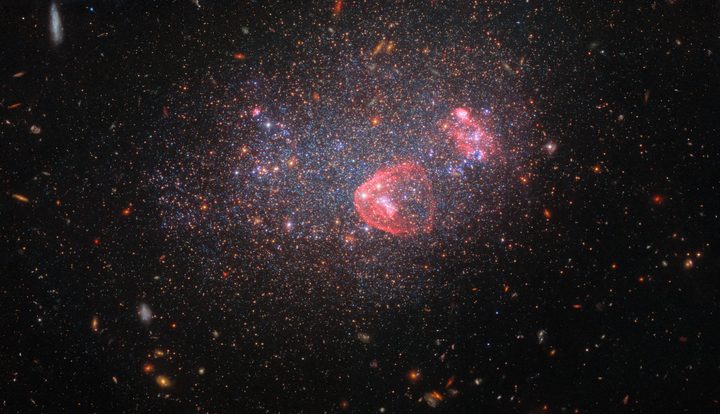
The billion stars in galaxy UGC 8091 resemble a sparkling snow globe in this festive Hubble Space Telescope image from NASA and ESA (European Space Agency).The dwarf galaxy is approximately 7 million light-years from Earth in the constellation Virgo. It is considered an "irregular galaxy" because it does not have an orderly spiral or elliptical appearance. Instead, the stars that make up this celestial gathering look more like a brightly shining tangle of string lights than a galaxy.
The billion stars in galaxy UGC 8091 resemble a sparkling snow globe in this festive Hubble Space Telescope image from NASA and the ESA (European Space Agency). The dwarf galaxy is approximately 7 million light-years from Earth in the constellation Virgo. ESA/Hubble, NASA, ESA, Yumi Choi (NSF's NOIRLab), Karoline Gilbert (STScI), Julianne Dalcanton (Center for Computational Astrophysics/Flatiron Inst., UWashington)

This particular image was taken using Hubble’s two cameras, the Wide Field Camera 3 and the Advanced Camera for Surveys, and combines data taken over many years. Hubble’s instruments primarily look in the visible light wavelength, like the human eye, but they can also look in a small portion of the ultraviolet and infrared wavelengths.

Recommended Videos

Now, astronomers who wish to investigate objects in the infrared portion of the spectrum have the option of using the James Webb Space Telescope, which has three instruments that operate in the near-infrared and one that operates in the mid-infrared. But Hubble remains one of the premier tools of astronomy for visible light observations.

At over 30 years old, Hubble has experienced a variety of hardware errors in its time, including a recent issue with one of its gyros going down, but it continues to operate and provide data for projects like this one, which Hubble scientists say, “sought to investigate the role that dwarf galaxies many billions of years ago had in reheating the hydrogen that had cooled as the universe expanded after the big bang.”

Georgina Torbet
Georgina has been the space writer at Digital Trends space writer for six years, covering human space exploration, planetary…
China’s answer to SpaceX’s reusable rockets literally catches boosters in a net
SpaceX catches boosters on legs. China just used a net.
Ammunition, Missile, Weapon

SpaceX's playbook for recovering a rocket booster generally involves legs, a precisely controlled vertical landing, and either a concrete pad or a drone ship. 

China just managed to pull off something similar, but in a slightly different way, and on July 10, it tested the method as well.

Read more
Dimming the sun sounds unhinged, but this new study on El Niño makes a surprisingly good case for it
A natural test case, Australia's worst-ever wildfire season, suggests the idea deserves serious consideration.
Nature, Outdoors, Sky

When I first saw "scientists propose dimming the sun," I rolled my eyes. It sounds like a science fiction movie cooked up after watching many climate documentaries. But a new study, published on July 8, 2026, in the journal Science Advances, seems to have a genuinely compelling argument.

A Super El Niño is currently forming in the Pacific, feared to be the most intense in decades. It could escalate floods, wildfires, and extreme heat events worldwide. However, Researchers at UC San Diego's Scripps Institution of Oceanography, led by climate scientists Kate Ricke and Jessica Wan, are now proposing one of the most interesting solutions I’ve come across.

Read more
You can now walk through space and gaze into a black hole at this VR exhibit
Smithsonian Starstruck lets you drift past dying stars and see the origin point of the universe for as little as $18 a person.
Smithsonian Starstruck featured

Most planetarium shows ask you to sit still and look up. The Smithsonian's new VR exhibit takes a different approach, letting visitors walk through the vast expanse of the universe, drifting past stars, planets, and a black hole to get a physical sense of its true scale.

A $29 ticket to the edge of the galaxy

Read more