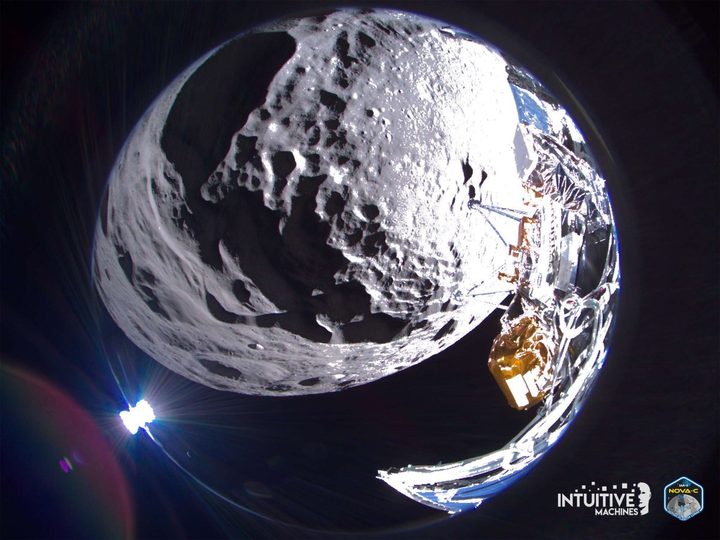
NASA has shared more details about yesterday’s historic moon landing, when Intuitive Machines became the first commercial company to successfully touch down on the moon’s surface. The company shared an image taken by its Odysseus lander of its view of the Schomberger crater on the moon’s southern hemisphere as it came in to land, taken at an altitude of around 6 miles from the surface.
The lander is stable, however, when it was coming in to land, it caught a foot on the surface which caused it to tip. The team believes that the lander is now on its side on the surface, but is optimistic that its science payloads will still be able to operate as the majority of these are within view and some are already collecting science data. Further, the solar panels are able to take energy from the sun so power generation doesn’t look like it is going to be an issue.
It took until today for the team to realize that the lander was on its side because the fill levels of the fuel tank showed the expected reading yesterday due to the moon’s gravity. But that was older data, and when the new data came, it showed the vehicle’s orientation “in fairly certain terms,” according to Steve Altemus, chief executive officer and co-founder of Intuitive Machines.
The aim is to get a picture from the lander within the next few days, as well as collect science data from the 12 payloads on board. These include six payloads from NASA. Among them is a guidance system for the lander called the Navigation Doppler Lidar for Precise Velocity and Range Sensing (NDL), which uses radar-like pulses of laser to measure speed and direction during the landing process.
“We are thrilled to have NASA on the moon again, and proud of the agency’s contribution to the successful landing with our NDL technology. Congratulations for completing this first lunar delivery for NASA, paving the way for a bright future for our CLPS initiative,” said Nicky Fox of NASA’s Science Mission Directorate in a statement. “Some of the NASA science instruments on this mission will bring us insight on lunar plume interactions and conduct radio astronomy. The valiant efforts and innovation demonstrated by Intuitive Machines is exemplary and we are excited for the upcoming lunar deliveries that will follow this first mission.”
The landing has been hailed as a success for NASA’s CLPS (Commercial Lunar Payload Services) program, which contracts commercial companies to provide lunar services and is a key part of NASA’s future plans for lunar exploration.
“In daring to confront one of humanity’s greatest challenges, Intuitive Machines created an entire lunar program that has ventured farther than any American mission to land on the moon in over 50 years,” said Altemus in a statement. “This humbling moment reminds us that pursuing the extraordinary requires both boldness and resilience.”