
Paris-based Prophesee made waves last year when it showcased its in-house event-based Metavision sensor tech for smartphone cameras. The core idea behind the stack was to make blurry images a thing of the past, demonstrating some impressive results during the development phase.
At MWC 2024, it has achieved another major breakthrough in partnership with Qualcomm. The company, which is doing some serious work in the field of neuromorphic vision systems, has announced that its Metavision sensor tech has now reached the production stage.
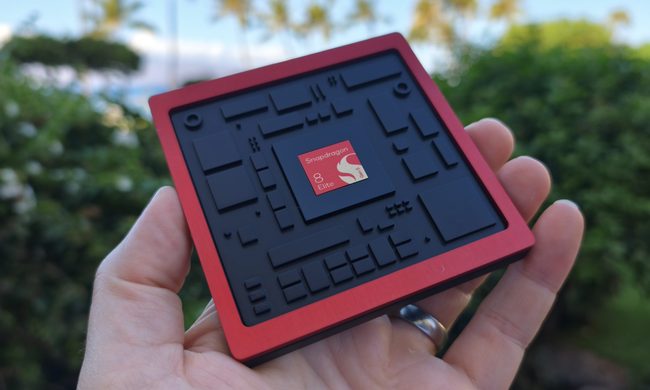
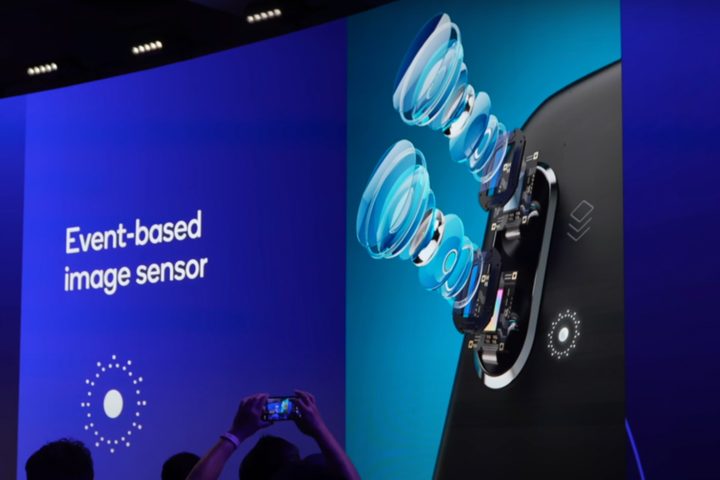
Prophesee tells Digital Trends that it has developed a sensor in collaboration with Sony that leverages custom software tuning and firepower provided by Qualcomm’s top-of-the-line Snapdragon 8 Gen 3 chipset. At a fundamental level, the Metavision sensor fills the visual data gap at a microsecond pace in tandem with an image sensor, opening the doors for blur-free images in both pitch-dark and extremely bright scenarios.
“Prophesee’s patented Metavision sensors and AI mimic how the human eye and brain work,” says the company. The event-based approach of the MetaVision sensor tech deploys motion blur cancellation to ensure that the final results don’t show any signs of movement-triggered fuzziness.
How Prophesee is trying to kill blurry photos
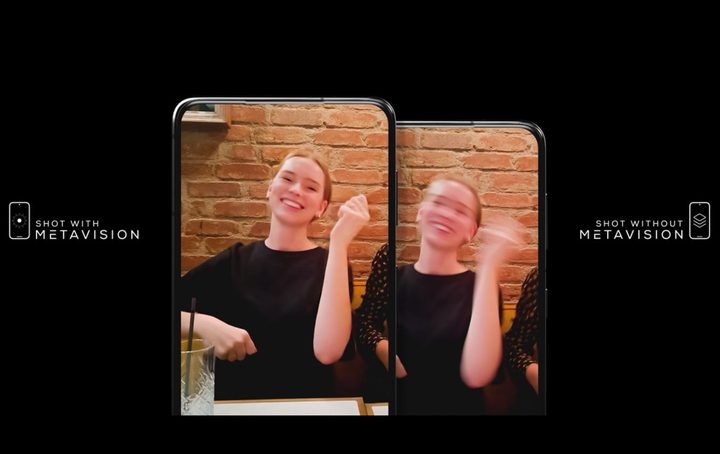
Most smartphone cameras, even the top-tier flagships, struggle with fast-moving objects — failing to maintain a proper focus lock. As a result, images not only look out of place, but the motion artifacts render them nearly useless.
Motion blur becomes especially apparent under challenging light situations or at night when solutions like multiframe noise reduction don’t live up to their true potential. Prophesee claims to deliver “unprecedented levels” of picture quality in “fast-moving and low-light scenes.”
Unlike a typical smartphone camera sensor on which the amount of light varies over the course of the exposure window, the Metavision sensor facilitates a “perpetual exposure time” to capture motion continuously. “It is as if you had a 10,000 images per second camera in your phone,” claims the company.
In addition to offering a custom sensor co-developed with Sony, Prophesee is also paying equal attention to the software stack and accompanying integration services. “The Metavision Deblur Software is now reaching the production stage. We are integrating both HW & SW in mobile phones,” the company tells Digital Trends.
The idea is to offer a seamless experience to players in the smartphone industry so that they deploy the entire Metavision hardware and software kit on their respective Snapdragon-driven devices. Notably, the baseline has been set at the flagship Snapdragon 8 Gen 3 silicon, apparently owing to its raw firepower, advanced ISP, and next-gen AI chops.
An exciting future for smartphone cameras
Prophesee’s solution is in a fully functional state on the Sony IMX636 mobile camera sensor. Currently, the tech has only been tested for a phone’s primary camera. The company, however, tells Digital Trends that future iterations of the Metavision sensor are eyeing support for multiple sensors, including ultra-wide and telephoto-type sensors.
In its present state, Prophesee’s event-based sensor can only work its magic to produce blur-free still images. But the company tells us that support for videos is also on the future roadmap.
“It is primarily a video sensing platform – used to capture and process motion in a variety of use cases,” a Prophesee spokesperson tells Digital Trends. The company didn’t specify when exactly we are going to see a Metavision sensor in action on a commercially available smartphone. On a positive note, phones powered by Qualcomm Snapdragon 8 Gen 3 are already in the market, and with the Metavision portfolio now at the production-ready stage, it shouldn’t be a long wait.
From what Prophesee has shown in demos so far, if the Metavision sensor delivers on those promises, it could open a whole new chapter for smartphone photography where an average user won’t be burdened with adjusting shutter speed and other parameters to get blur-free pictures. And that’s a pretty exciting future to think about.