Anker’s Nebula brand of projectors has a new option for those who crave the ultimate in portability and flexibility: the Capsule Air, which Nebula claims is the smallest and most portable Google TV-equipped projector on the market. Nebula also has a new premium 4K Google TV portable projector — the Cosmos 4K SE — with 1,800 ANSI lumens of brightness and Dolby Vision.
Both new models have Netflix built-in and will be available on Amazon starting August 29, with the Capsule Air priced at $350 and the Cosmos 4K SE at $1,300.
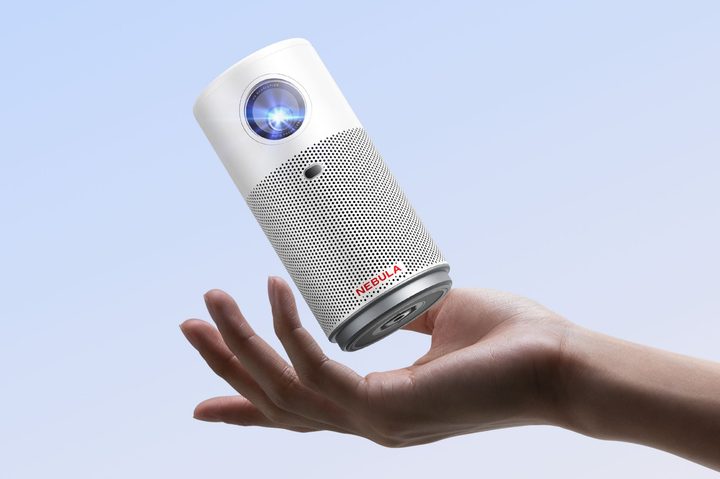
Just a hair taller than a can of soda and weighing in at 23 ounces, the Capsule Air (available in white or black) can nonetheless project a 60-inch image at 720p resolution for up to two hours, with audio provided by its 5-watt speaker. With 150 ANSI lumens, it’s not going to be a super-bright image, but Nebula says that in a darkened room, you should be able to enjoy up to a 100-inch image.


- 1. Nebula Snap-On mount.
- 2. Nebula Power Bank Tripod.
- 3. Nebula Gimbal mount.
While its size and weight are reasons on their own to consider Capsule Air, Nebula has also created a new line of accessories that greatly expand what you can do with the tiny projector. The Snap-On Base, a $19 Capsule Air-only magnetic mount, lets you easily stick the Capsule Air in a variety of locations (even a wall using the Base’s mounting holes) with an up-to-90-degree tilt depending on where you put it. As a wall mount, you can use it to project an image downward onto a work surface.
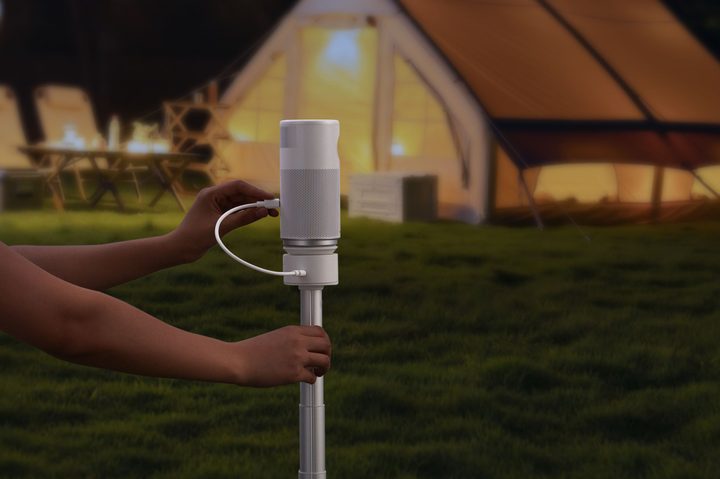
Nebula has two other accessories that are compatible with all of its Capsule models. The Power Bank Tripod ($130) can extend from 8.5 to 33.1 inches in height and has a built-in 34Wh battery. Nebula says this can roughly double the battery life of an attached Capsule projector. The telescoping and collapsible tripod has a tilt function on the charging head that can adjust between 0-90 degrees. Meanwhile, the Gimbal Stand ($50) will give any Capsule projector a full 360 degrees of adjustment.
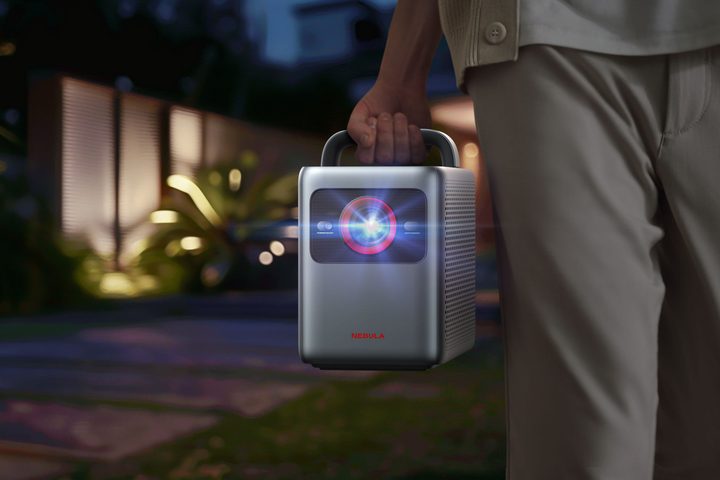
The Cosmos 4K SE can blast 1,800 ANSI lumens at a wall or screen for an up-to-120-inch 4K Ultra HD image. However, under darkened conditions, that image might be able to get as large as 200 inches.
The new model boasts a variety of image processing and display technologies including the NebulaMaster Image Processing Engine with HybridBeam, which Nebula says combines an LED and laser light source for a brighter display with enriched colors. There’s also built-in support for Dolby Vision and Nebula has included a de-contour reduction algorithm, which it claim provides smoother image transitions and preserves edge details of the image.
It has several convenient features like real-time autofocus, keystone correction, auto obstacle avoidance, auto screen tit, ambient light adaptation, and wall color adaptation. It’s Eye Guard technology protects users’ eyes if someone walks in front of the projector.
Rounding out the Cosmos 4K SE’s capabilities are dual 15-watt full-range drivers located on both sides, with support for Dolby Audio.
Nebula is keen to drive sales of these new products and has two promotional offers for those who get in early. If you sign up at seenebula.com between August 1 and August 28, you’ll get triple Nebula membership credits on Nebula’s website, plus these free add-ons with purchase: Cosmos 4K SE buyers are eligible for a $300 discount and an extra year of warranty. Capsule Air buyers can claim a free Power Bank Tripod when purchasing the projector from August 29 to September 29.