1. Home
  2. Space
  3. News

James Webb is explaining the puzzle of some of the earliest galaxies

Add as a preferred source on Google
This image shows a small portion of the field observed by NASA’s James Webb Space Telescope’s NIRCam (Near-Infrared Camera) for the Cosmic Evolution Early Release Science (CEERS) survey. It is filled with galaxies. The light from some of them has traveled for over 13 billion years to reach the telescope.
This image shows a small portion of the field observed by NASA’s James Webb Space Telescope’s NIRCam (Near-Infrared Camera) for the Cosmic Evolution Early Release Science (CEERS) survey. It is filled with galaxies. The light from some of them has traveled for over 13 billion years to reach the telescope. NASA, ESA, CSA, Steve Finkelstein (UT Austin)

From practically the moment it was turned on, the James Webb Space Telescope has been shaking cosmology. In some of its very earliest observations, the telescope was able to look back at some of the earliest galaxies ever observed, and it found something odd: These galaxies were much brighter than anyone had predicted. Even when the telescope’s instruments were carefully calibrated over the few weeks after beginning operations, the discrepancy remained. It seemed like the early universe was a much busier, brighter place than expected, and no one knew why.

This wasn’t a minor issue. The fact early galaxies appeared to be bigger or brighter than model predicted meant that something was off about the way we understood the early universe. The findings were even considered “universe breaking.” Now, though, new research suggests that the universe isn’t broken — it’s just that there were early black holes playing tricks.
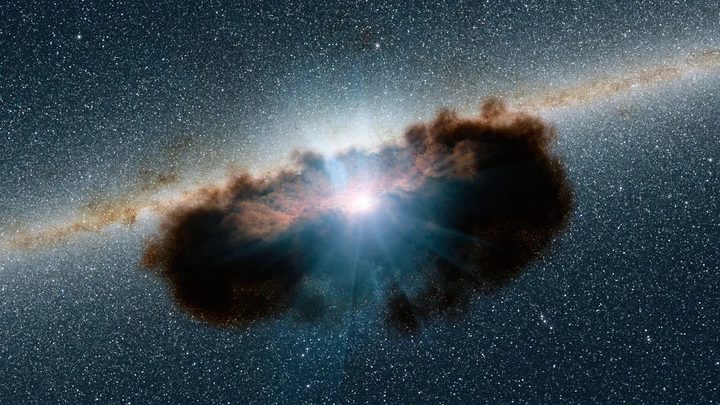
In the blackness of space, a bright object in the center of view is surrounded and partly obscured by a dark cloudArtist illustration of a black hole surrounded by extremely thick clouds of gas and dust
Artist illustration of a black hole surrounded by extremely thick clouds of gas and dust NASA/JPL-Caltech

The reason bright galaxies were surprising was that the obvious explanation would we that there were more stars, or brighter stars, in each galaxy. But stars can only appear and grow so fast, depending on the amount of matter around them. Trying to explain how galaxies could have grown to gargantuan proportions was difficult. Now, it seems that some of this extra brightness was caused by black holes, which gobble up nearby material. As they feed, that nearby material heats up and glows, giving off light that makes the galaxies brighter.

Recommended Videos

According to a new paper in The Astronomical Journal, this explains some — but not all — of that extra brightness. “We are still seeing more galaxies than predicted, although none of them are so massive that they ‘break’ the universe,” explained lead researcher Katherine Chworowsky of the University of Texas at Austin.

The research used data from the James Webb CEERS Survey, which identified some of these earliest galaxies. When researchers removed galaxies that were very red and compact from the analysis, based on the fact the redness could indicate black holes at work, the galaxies that are left behind fit more into what was expected.

“So, the bottom line is there is no crisis in terms of the standard model of cosmology,” said Steven Finkelstein, leader of CEERS. “Any time you have a theory that has stood the test of time for so long, you have to have overwhelming evidence to really throw it out. And that’s simply not the case.”

It isn’t a matter of case closed though. Even though the remaining galaxies aren’t wildly bright any more, they are still much more numerous than expected. There are roughly twice as many massive galaxies found as had been predicted. That does still suggest that early stars were forming faster than they do today, for reasons we don’t understand yet.

“And so there is still that sense of intrigue,” Chworowsky said. “Not everything is fully understood. That’s what makes doing this kind of science fun, because it’d be a terribly boring field if one paper figured everything out, or there were no more questions to answer.”

Georgina Torbet
Georgina has been the space writer at Digital Trends space writer for six years, covering human space exploration, planetary…
China’s answer to SpaceX’s reusable rockets literally catches boosters in a net
SpaceX catches boosters on legs. China just used a net.
Ammunition, Missile, Weapon

SpaceX's playbook for recovering a rocket booster generally involves legs, a precisely controlled vertical landing, and either a concrete pad or a drone ship. 

China just managed to pull off something similar, but in a slightly different way, and on July 10, it tested the method as well.

Read more
Dimming the sun sounds unhinged, but this new study on El Niño makes a surprisingly good case for it
A natural test case, Australia's worst-ever wildfire season, suggests the idea deserves serious consideration.
Nature, Outdoors, Sky

When I first saw "scientists propose dimming the sun," I rolled my eyes. It sounds like a science fiction movie cooked up after watching many climate documentaries. But a new study, published on July 8, 2026, in the journal Science Advances, seems to have a genuinely compelling argument.

A Super El Niño is currently forming in the Pacific, feared to be the most intense in decades. It could escalate floods, wildfires, and extreme heat events worldwide. However, Researchers at UC San Diego's Scripps Institution of Oceanography, led by climate scientists Kate Ricke and Jessica Wan, are now proposing one of the most interesting solutions I’ve come across.

Read more
You can now walk through space and gaze into a black hole at this VR exhibit
Smithsonian Starstruck lets you drift past dying stars and see the origin point of the universe for as little as $18 a person.
Smithsonian Starstruck featured

Most planetarium shows ask you to sit still and look up. The Smithsonian's new VR exhibit takes a different approach, letting visitors walk through the vast expanse of the universe, drifting past stars, planets, and a black hole to get a physical sense of its true scale.

A $29 ticket to the edge of the galaxy

Read more