A new video shows what it would be like to cruise over the surface of Mars, zooming in to the planet from orbit and into a channel called the Ares Vallis. Created from data taken by the European Space Agency’s (ESA) Mars Express mission, it shows the region where NASA’s Pathfinder mission landed in 1997.
Credit: ESA/DLR/FU Berlin and NASA/JPL-Caltech/MSSS. Data processing/animation: Björn Schreiner, Image Processing Group (FU Berlin)
The important stops along the journey are labeled in the video so you can see the sights of Mars as the camera passes over them. The flight is across a region called Oxia Palus, which covers a huge area of over 300,000 square miles, which hosts the famous Ares Vallis channel.
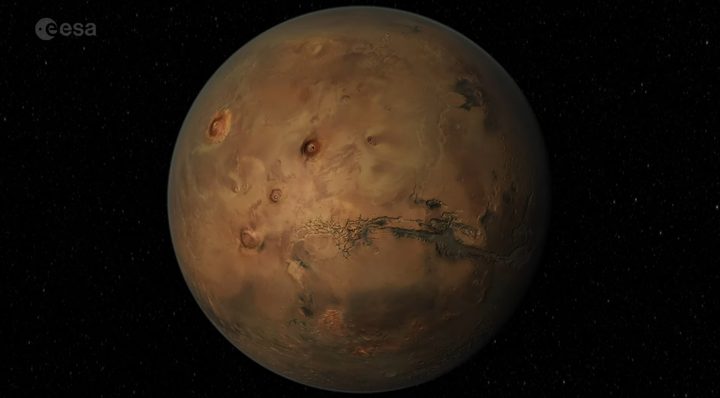
The tour begins with Mars as seen from orbit, with a rectangle indicating the area where the tour will be focused. On zooming in to the region, you can see the varied terrain of the Mars surface, beginning with the Pathfinder landing site where the Sojourner rover explored. Then the channel of the Ares Vallis comes into view — stretching over 1,000 miles in length, it is one of Mars’s longest outflow channels.
Channels like this are important for scientists to study as they show where water once flowed on the planet’s surface, allowing researchers to build up a picture of which regions were rich in water — and where life could possibly have evolved.
As the tour continues, two craters come into view. Named Masursky and Sagan, there is also evidence that water was here, too, as the rim of the Masursky crater shows erosion likely caused by water from the Tiu Valles system located nearby.
Another notable feature of the crater is the jagged, jumbled rocks located within it. Known, rather dramatically, as chaos terrain, these ridges and plains are often seen on Mars and are related to the historical presence of water as well. “Its distinctive muddled appearance is thought to arise when subsurface water is suddenly released from underground to the surface,” ESA explains. “The resulting loss of support from below causes the surface to slump and break into blocks of various sizes and shapes.”
Further craters are visible along the tour, many of which also have evidence of once being filled with water. You can see the direction in which the water once flowed from the tail shapes left on the surface.
Finally, the channel comes to an end in the smooth Oxia Planum region, where ESA’s Rosalind Franklin rover will land following its launch in 2028, before the camera zooms out to show the whole region in all its fascinating glory.