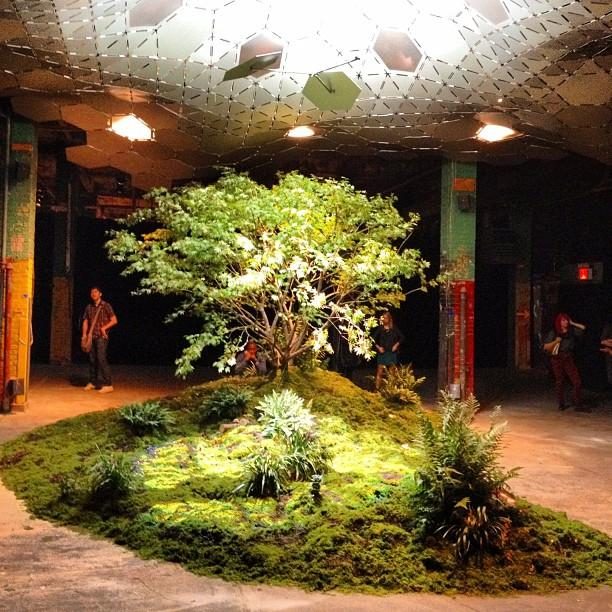
When the Delancey Underground first unveiled the proposed project that would create the world’s first underground park, many people were excited by the idea. After all, New York’s the High Line, an elevated park built atop an abandoned railroad, has gained a huge following and quickly became one of the famed tourist attractions in the city since opening in 2009. Could the complete opposite approach bring in as much traffic?
 A hit on Kickstarter, the Lowline seemed like it would be long before supporters ever saw a glimpse of what the park will look like. Apparently, not so. This past week, exhibitors were able to obtain a space in the Lower East Side neighborhood of New York where the proposed Lowline would be and set up a preview of the park. We stopped by for an inside look, and while the exhibit was small, the result seemed promising.
When you first enter the warehouse space on Broome and Essex street, you are greeted by volunteers surrounded in black curtains, giving the area an ominous, dark feel. A quick walk inside reveals the “Imagining the Lowline” exhibit in bright lights along with boards of information, stating the Lowline’s mission, use of space, the space’s history, and how the team intends to bring light underground to keep plants growing. The project, envisioned by students from Columbia University School of Architecture and sponsored by Audi, makes a good attempt at replicating an underground atmosphere. It’s misty, slightly humid, there’s a faint smell of fertilizer and an after-rain scent. A stereo speaker is also attached at the corner of the ceiling, looping sounds of children playing. That’s where things got a bit creepy.
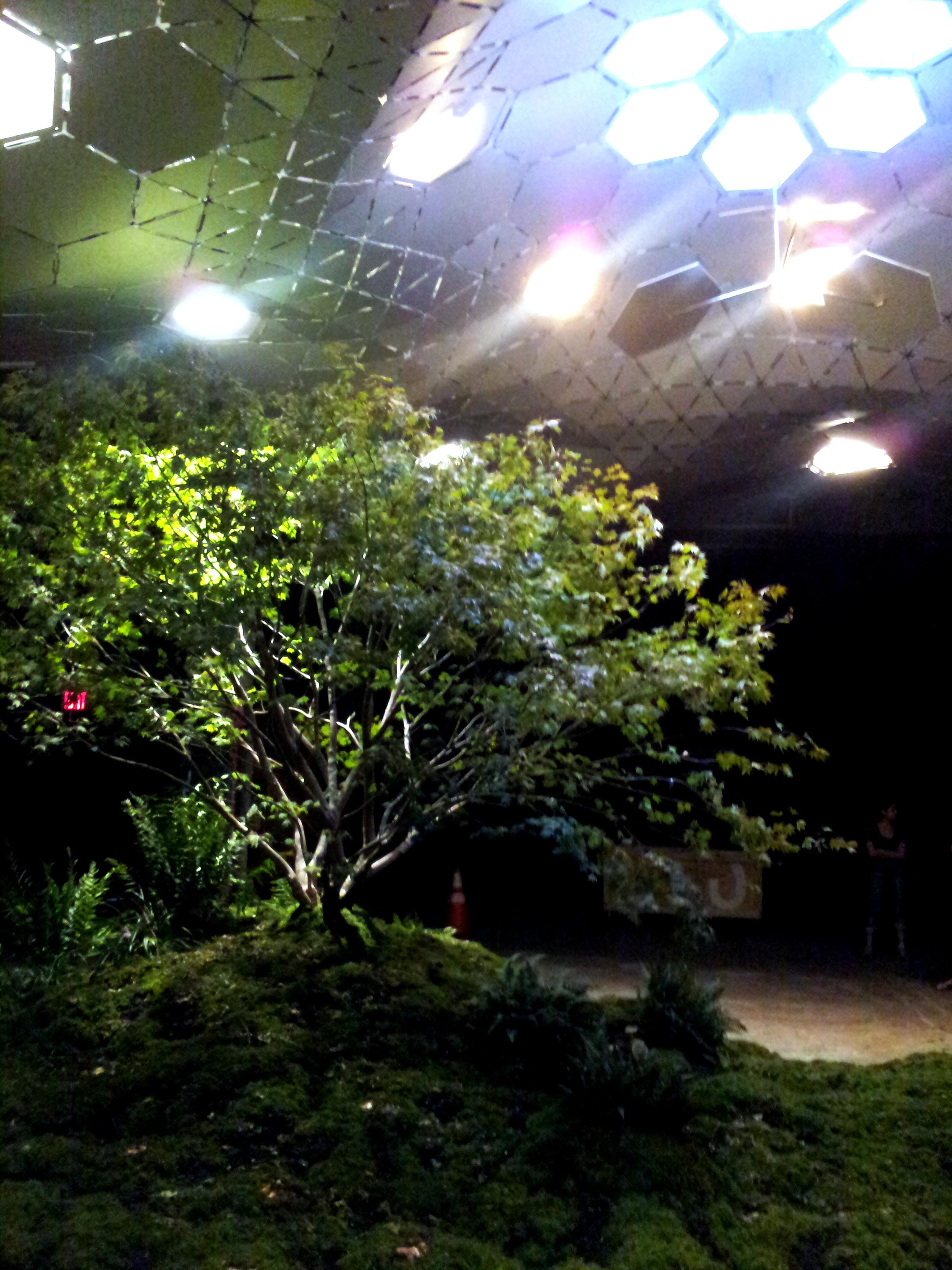 A walk over on the other side of the black curtain reveals a strong beam of light. There, a Japanese maple, moss, fern, and several other plant species sit under a hexagonal light panel that can theoretically capture sunlight and funnel it downward to the plants underneath. With this process, the Lowline calculates that the technology would do enough to generate the light needed to support photosynthesis.
It’s an undoubtedly cool exhibit, and an interesting glimpse of the world’s first underground park. Still, the fact that the “remote skylights” weren’t actually used in an underground space makes us wonder how well the concentrated light would travel several feet under. Such a dark space for a park and playground would also raise some security issues. You just never know what could happen with public spaces in New York City, especially when the space is so encapsulated.
If the Lowline ever becomes approved by the city, it would still be long before residents and tourists alike could enjoy a full, completed park. The project continues to excite, but until then, we’ll always have the High Line.
[Top image credit: @wtbryce]