

The RTX 5080 arrived with a bit of a thud. As you can read in my RTX 5080 review, the card probably won’t be making among the best graphics cards any time soon. It falls short of Nvidia’s last-gen flagship, and in the vast majority of games, it doesn’t even crack a 20% lead over the RTX 4080 Super.
It’s not the only GPU in town, though. Although AMD is sitting out the flagship battle this generation, there are still some excellent last-gen options to keep in mind. Here are three alternatives to the RTX 5080 and why you should consider picking them up over Nvidia’s latest.
Nvidia RTX 4090 (used)

Perhaps the biggest loss for the RTX 5080 is Nvidia’s last-gen RTX 4090. With each new generation, Nvidia can deliver the performance of one step up in its range, essentially lowering the price. The RTX 4080, for example, is faster than the RTX 3090 Ti, and the RTX 3080 is faster than the RTX 2080 Ti. This generation, Nvidia is breaking with tradition. Based on my testing, the RTX 5080 is around 9% slower than the RTX 4090.
That makes the RTX 4090 a compelling alternative, assuming you can find one at a reasonable price. Nvidia has carefully controlled the stock of its RTX 40-series GPUs, particularly at the high end, so you’ll have a tough time finding an RTX 4090 in stock at all, let alone for anywhere near list price. There are plenty of secondhand models available, though.
Prices on the secondhand market are all over the place, especially right now when Nvidia’s latest GPUs are just rolling out. I’ve seen models sell for up to $2,200 and down to $1,100, so you’ll have to be diligent to find a deal. If you can find one, however, you’re in for a treat. The RTX 4090 cleanly beats the RTX 5080, so if you can score one for around $1,200, it’s absolutely worth the price.
The main thing you’re missing — which is true of all of the graphics cards on this list — is DLSS Multi-Frame Generation. The RTX 4090 still benefits from DLSS 4, but it’s only capable of generating a single extra frame with AI; the RTX 5080 can generate up to three in supported games. Thankfully, third-party tools like Lossless Scaling can generate additional frames, and the RTX 4090 still comes with a raw performance advantage over the RTX 5080 — plus a bump in VRAM capacity.
It’s still an open question if the RTX 4090 is worth it over the RTX 5080, and the answer hangs on the secondhand market. Keep a close eye on how prices shift over the next couple of weeks. They’re rising now in response to the RTX 5080, but I suspect they’ll drop shortly.
AMD RX 7900 XTX
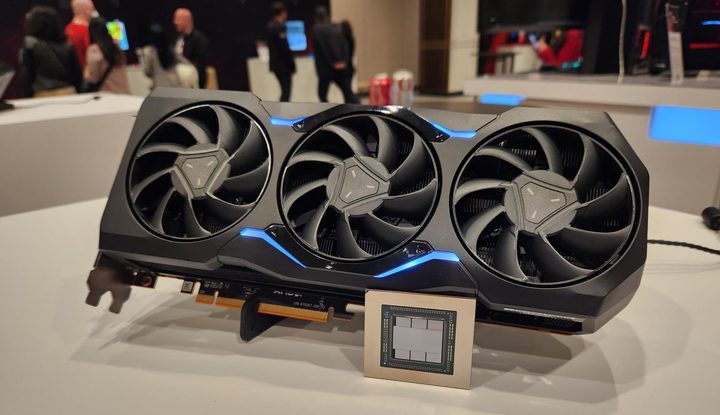
AMD’s RX 7900 XTX is a clear step below the RTX 5080; I don’t want to mince words here. On average, the RTX 5080 is around 47% faster than the RX 7900 XTX at 4K. However, that average factors in games that include ray tracing, and it ignores how much less you’ll spend on AMD’s last-gen flagship compared to the RTX 5080.
Short of Call of Duty Modern Warfare 2, there aren’t any games I tested where the RX 7900 XTX wins over the RTX 5080. In a lot of titles, however, it’s a stone’s throw away. In Horizon Zero Dawn Remastered, for example, the RTX 5080 is just 12% faster. The same is true in Assassin’s Creed Mirage. And in Red Dead Redemption 2, the RTX 5080 claims a lead of only 8%. That should put into context how much weight titles with ray tracing are pulling in the average.
Pricing is what really matters here, though. You can pick up a new RX 7900 XTX for around $900 right now, and if you browse on the secondhand market, you can find one for as low as $720. The RTX 5080 is technically $1,000, but I have a hard time believing it will sell for that price. The RTX 4080 Super was priced at $1,000, as well, and I rarely saw it drop below $1,200 during its short lifespan.
The value of the RX 7900 XTX comes down to what prices for the RTX 5080 look like a few weeks down the road. Still, it’s already available for hundreds of dollars less in some cases, so I suspect AMD will come out ahead on value. The RX 7900 XTX isn’t as powerful, but you’ll be kicking yourself if you ignore it when going to upgrade your GPU.
Buy NowNvidia RTX 4080 Super
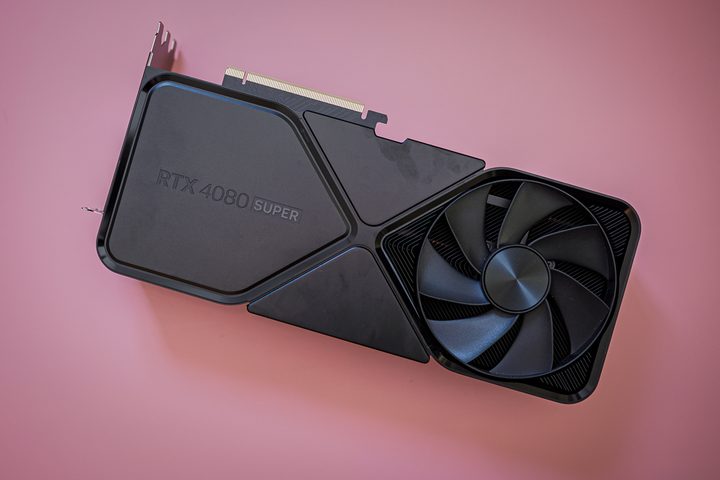
The RTX 5080 is 18% faster than the RTX 4080 Super on average at 4K, so if you can score the last-gen card for 20% less — $800, compared to the list price of the RTX 5080 — you’re getting better bang for your buck. It’s a pretty simple calculation that you can apply regardless of where prices end up. If the RTX 5080 is at $1,200, you’d need to find an RTX 4080 Super at $960. And if it’s at $1,500, you’d need to find the last-gen model at $1,200.
We normally see generational improvements north of 30%, especially at the high end. At that level, it’s usually not worth it to seek out a last-gen graphics card. You might be able to score a deal, but you’re leaving a lot of performance on the table. That’s not exactly the case with the RTX 5080 and RTX 4080 Super. Yes, the new card is 18% faster, but that doesn’t equate to a meaningful difference in your experience in a lot of games.
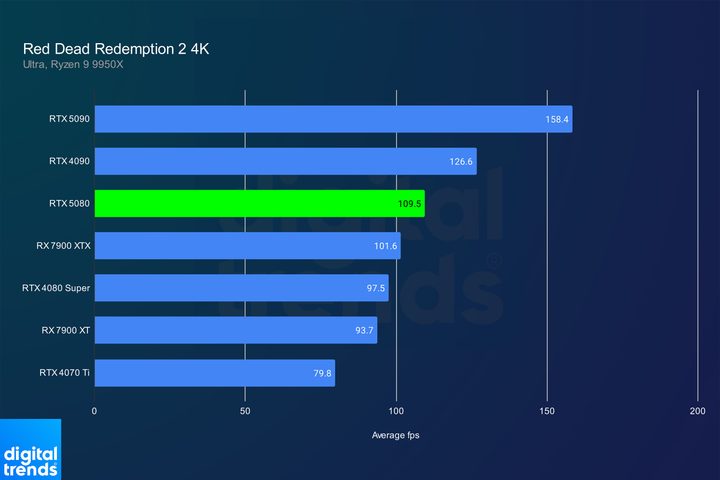
In Red Dead Redemption 2, for example, I clocked the RTX 5080 12% ahead of the RTX 4080 Super. Looking at the actual frame rates, however, there’s not a huge difference in the experience of playing. You’re either getting just shy of 100 fps with the RTX 4080 Super or just over 100 fps with the RTX 5080. You’d have a hard time telling the difference between the two frame rates without constantly eyeing a frame rate counter.
Just like the RTX 4090, the RTX 4080 Super doesn’t have access to DLSS Multi-Frame Generation, so it can’t easily saturate a 4K display running at 240Hz as the RTX 5080 can. Lossless Scaling can help make up the difference, and depending on the games you play, you might not even need to resort to frame generation.
Although the RTX 5080 is 18% faster overall, the performance increase is lower in demanding ray tracing games like Black Myth: Wukong. In these games, where you’d want to resort to tools like Multi-Frame Generation, the RTX 4080 Super is much closer in raw performance, and therefore, it’s easier to make up the performance deficit with third-party tools.


