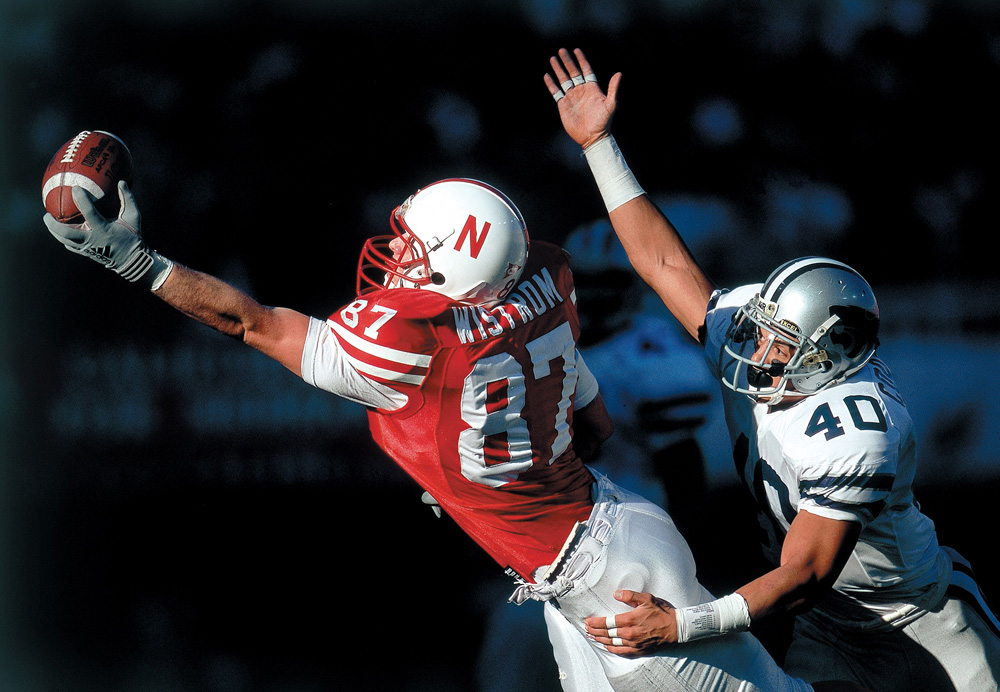
As one of the elite photojournalists in sports, Peter Read Miller has been photographing athletes for more than 30 years – 20 of them at Sports Illustrated. His portfolio includes 34 Super Bowls, eight Olympic games, and 14 NBA Finals, to name a few. Based in the Los Angeles area, Miller was awarded the Dave Boss Award of Excellence Photographer of the Year by the Pro Football Hall of Fame in 2006. Besides sports, Miller also shoots a variety of subject matters for high-profile commercial and editorial clients.
To capture sport’s greatest moments, Miller needs to carry some essential equipment, which includes four DSLR bodies and lots of lenses (all adding up to tens of thousands of dollars). Miller recently opened up his bags for us, and tells us why he uses what he does:
For better or worse, I’m not the kind of shooter who grabs the same kit of gear everyday and heads out to photograph whatever is on the schedule, although there are times when I wish I were – then I could store my gear in a closet instead of the room that was formerly my guest bedroom (but I do still have a very comfortable couch).
Most of my shooting over the past 30-plus years can be broken down into three basic types of shoots: pure game action coverage (mainly football), game/event coverage with remotes (think everything from baseball to the Olympics), and portraits (from tight head shots and groups to action in the studio and large format film portraits).
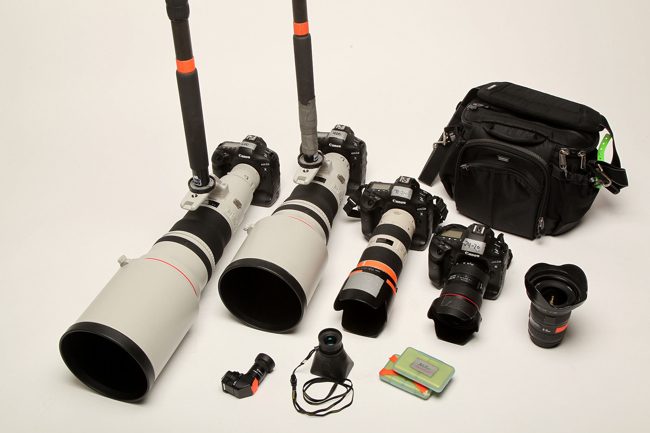
[The gear here is what] I use to shoot football and other action sports. Since I live in a town with no NFL team, I often have to fly somewhere to shoot football. Here’s what I take into a game (shown above):
- Four Canon EOS-1D X cameras
In my opinion the “X” is the best pro DSLR on the market today. The autofocus, image quality, and high ISO performance can not be beat.
- Canon EF 600mm f/4L IS II USM super telephoto lens
The combination of this lens on an EOS-1D X full-frame camera has been a joy to shoot with this season. After 10 years of crop cameras it is so nice to use the 600 as it was intended.
- Canon EF 400mm f/2.8L IS II USM super telephoto lens
This new Series II Canon lens is the sharpest, fastest focusing, and lightest long lens I have ever used.
- Canon EF 70-200mm f/2.8L IS II USM telephoto lens
The 70-200 is a great go-to lens for almost any sport. I never leave home without it.
- Canon EF 24-70mm f/2.8L II USM zoom lens
The new version of this lens is possibly the sharpest mid-range zoon ever made.
- Canon EF 16-35mm f/2.8L II USM ultra-wide zoom lens
I always carry this super wide-angle for overall shots or shooting after the game.
- The 400 and 600 lenses are on Gitzo Carbon Fiber Monopods; the 70-200 over my shoulder; the 24-70 around my neck; and the 16-35 is in a Think Tank “Speed Freak” belt/shoulder pouch. As you can see, I’m a big fan of Think Tank products. They are designed by pros for pros.
Also, around my neck is a Hoodman HoodLoupe (very helpful for checking critical focus, especially on a bright sunny day). In addition, I carry a Canon “Angle Finder C” in my pocket for low angle shots. I shoot with Hoodman and Lexar 1000X 16GB and 32GB cards.
On the plane I carry a Think Tank Urban Disguise 60 and the Think Tank Airport Security Roller. The computer gear I travel with includes a MacBook Air, Lexar and Hoodman USB 3.0 card readers, and a Western Digital Passport external hard drive that I use to back up all my shoots.

I pack everything in two Versaflex cases. I like Versaflex because they have a metal frame and are pretty much indestructible. If possible, I will FedEx the gear ahead to a local assistant or friend, or send it to be held for pick up at a FedEx office. This saves me time and hassle at the airport.
I pack the cameras and lenses in individual cases such as the Think Tank Photo Glass Taxi. I then pad everything with rain covers (I use the Think Tank Hydrophobias) and an extra rain jacket or sweatshirt. When I get to the game I unpack in the car and leave all the cases behind. I don’t like to take anything into the game I’m not actually using for the shoot.

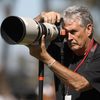 Peter Read Miller will be teaching his sports photography workshop in Denver April 8-14 for the eleventh year. “Students will be shooting sports every afternoon and evening,” Miller said. “In past workshops, shoots have included mountain biking, baseball, lacrosse, track and field, roller derby, boxing, soccer, and football. The mornings will feature evaluation of student work and guest lecturers including Steve Fine, former director of photography at Sports Illustrated; Shawn Cullen, Sports Illustrated’s Master Photo Tech; and Syl Arena, best-selling author of the ‘Speedliter’s Handbook’.” More information can be found at his website at www.peterreadmiller.com
(Copyright images via Peter Read Miller)