At first, DeadSocial seems a lot like BangWithFriends: It sounds both tantalizing, and takes advantage of our good-natured love of social media. It’s an app created to shock and awe. But as unbelievable as it sounds, a network giving a virtual voice to the dearly departed makes a scary amount of sense.
Think about how much time a day you spend using Tumblr, Twitter, Instagram, and even Facebook. It’s probably a lot more than you care to admit. When you think about how much you’ve invested in social networks, you can start to appreciate their value. These are the digital ways you’ve chosen to collect your memories and interact with your friends and family. They are how you post photos, plans events, and send messages.
These profiles are years in the making. There’s a generation of people who have used Facebook since the day it launched – and most of them are under 30. We’ve become accustomed to announcing engagements, congratulating colleagues, and wishing people happy birthdays using these platforms. We are cataloging our entire lives.
So why should it have to stop when we die?
That is precisely the question that the SXSW-launched startup wants to answer – with a resounding “it shouldn’t.” Even after you die, your digital self should live on.
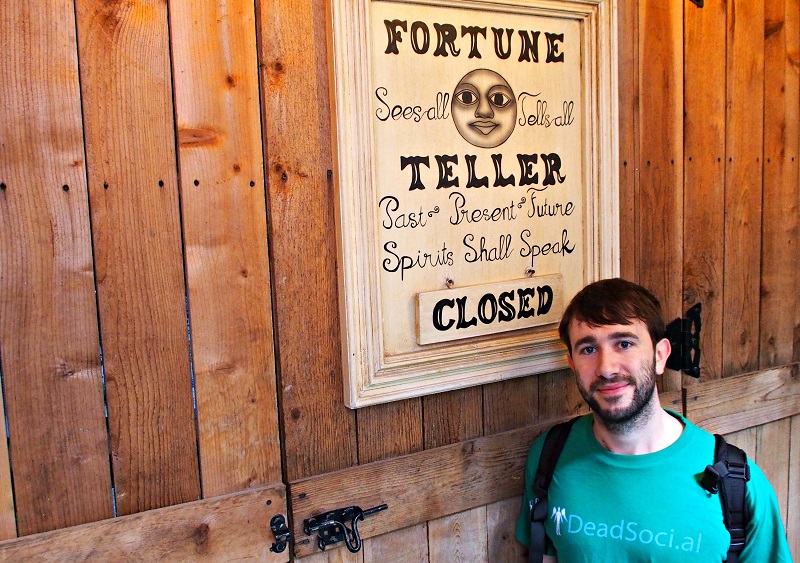 “We create this digital footprint when we’re alive and it’s just a logical next step that some people will want to utilize something that makes it so that footprint doesn’t abruptly end,” says DeadSocial founder James Norris. “We spend so much time pruning our social profiles, it’s down to individuals to decide whether they want their accounts to die when they do.”
What happens to our social profiles has become a point of contention. Some families have wrestled with networks to regain the deceased’s account, and others have been disturbingly active from the grave thanks to system errors. And anyone who knows someone deceased wonders what to do: Do you post on her Timeline? Do you send a DM to aid the grieving process? Or do you just stare at their page, frozen in time?
DeadSocial wants to solve that by giving users, while alive, the ability to dictate what happens to their accounts after death. The idea came to Norris after U.K. comedian Bob Monkhouse, who’d past away, was broadcast from beyond the grave, giving viewers a glimpse of the man who’d died some years back.
“He was able to keep the jovial personality he was known for,” says Norris.
Using DeadSocial is dead simple (no apologies for the pun). You sign up for the service, and choose up to six administrators – six people that you intensely trust. Norris can’t stress that enough. Then, you can create and schedule content that will be pushed to Twitter and Facebook (and soon Google+) when you want it to be. You can post videos, text, photos – the only caveat being that it all has to be public.

“The reason being,” Norris explains, “is that this is about extending your digital legacy and being able to create content for your social networks and add value to others and also help them in the grieving process – it’s so everyone can remember and interact with you.”
He also mentions that private messages bring up an ethical quandary. “Say you’re a wife, and you’re recieving these private messages from your dead husband for years…” he trails off. It’s a valid point: There’s nothing like a Twitter DM from your long-deceased spouse to completely derail your emotional state.
Norris says, however, that the team (which consists of him and two other developers) will consider private messages, as well as Instagram and Tumblr integration. The platform he’d really like to tie in though, is LinkedIn.
“Everyone laughs when I say that!” he says, in reaction to my anticipated “Wha…?”. “We have strong relationships in our business life. I’ve had some mentors I’d love to see messages from, and there are people I’d like to be able to do the same for.”
The DeadSocial team has been working with charities and doctors in the U.K. over the last year to fine tune certain details, bringing the launch appropriately to SXSW. Norris says that thanks to recent publicity, the service has amassed thousands of users, the majority of which are in the United States. He tells me that the general age demographic is – unsurprisingly – 18-35 year olds. You will see no double-takes here: It makes all too much sense that the Facebook generation is interested not only in living forever, but living forever online.
While no one has yet to die and see his or her DeadSocial content sent out into the ether, in 40 or 50 years, a flurry of these messages are going to hit whatever social networks exist then. The first DeadSocial post will hit much sooner than that, though, Norris tells me, as there are plenty of older users who have signed up in addition to the majority of Gen Yers. (And yes, in case you were wondering, Norris has a profile.)
At the moment, you can set it up so that your DeadSocial content is posted for hundreds of years. “We are looking to add features so that they will go out for thousands and that we can guarantee that,” says Norris. A hosting system that can 100 percent assure DeadSocial that’s possible is necessary, however – because even though the users may be dead, an application must deliver on promises. Given how angry live users get when a social app breaks, imagine the consequences of outraging someone on the other side.
In one last plea to the doubters, Norris likens DeadSocial to a custom in the U.K. called Memory Boxes. “Say, if a parent knows they are going to die, they’ll leave a box with different items for their children,” he explains. “Things they can smell, or look at, or touch that remind them.” And in today’s world, where so many of our experiences are happening online, DeadSocial wants to trigger those remaining, intangible feelings.