  1. Home
  2. Computing
  3. Legacy Archives

IBM’s Roadrunner supercomputer hits early retirement due to power usage

Add as a preferred source on Google
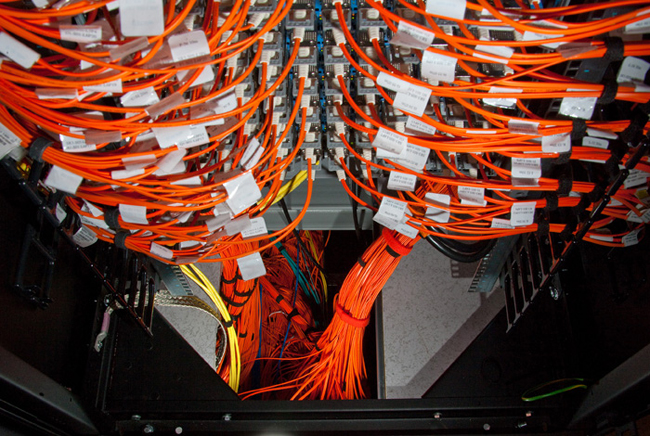
IBM Roadrunner Supercomputer
Image used with permission by copyright holder

The Los Alamos National Laboratory has pulled the plug on the IBM-built supercomputer Roadrunner after just five years of service as it has become too much of a power hog. 

The Roadrunner was the first supercomputer in the world to be able to handle one million billion calculations per second (petaflop). Back in June 2008, it was the fastest supercomputer. Five years later, it still held the number 22 spot on March 31, 2013, the day it was taken offline.

Recommended Videos

To achieve petaflop computing speeds, IBM combined two kinds of processors into one machine – a strategy that was unheard of at the time. The Roadrunner was powered by 6,563 dual-core processors from AMD, each of which were linked to a special graphics processor (PowerXCell 8i) that was originally designed for the Sony PlayStation 3, but tweaked for scientific computing.

The Roadrunner’s hybrid architecture was revolutionary. “[It] got everyone thinking in new ways about how to build and use a supercomputer,” said Gary Grider from the laboratory’s High Performance Computing Division. “Specialized processors are being included in new ways on new systems, and being used in novel ways. Our demonstration with Roadrunner caused everyone to pay attention.”

Unfortunately, the Roadrunner has become too power inefficient for the lab to keep in commission, especially as newer supercomputers with more computing prowess – and that also require less energy to power – become available. According to Ars Technica, the Roadrunner required 2,345 kilowatts to hit 1.042 petaflops. To give you a sense of how power hungry the Roadrunner has become next to its contemporaries, the supercomputer occupying the twenty-first spot needs just 1,177 kilowatts of power, while the supercomputer ranking in the twenty-third spot has a clock speed of 1.035 petaflops using just 493 kilowatts of power. 

Just because the Roadrunner will no longer run nuclear weapons simulations for national security doesn’t mean that it has become completely useless. Scientists at the lab will be studying how the Roadrunner works to inform future supercomputer designs before it is dismantled in about a month. IBM’s Roadrunner will go down in supercomputer history for being the first to reach petaflop speeds and for being a pioneer in processor design. You won’t be forgotten, Roadrunner!

[Image via Los Almos National Laboratory]

Gloria Sin
Former Contributor
Gloria’s tech journey really began when she was studying user centered design in university, and developed a love for…
Gemini Notebook’s new Collections arrive just as Google turns it into a bigger workspace
Google is cleaning up notebook organization as the former NotebookLM expands across Gemini and Search
Gemini Notebook branding on a MacBook

Google has barely finished renaming NotebookLM, and it’s already addressing one of the headaches that comes with building a large research library.

Collections are rolling out to all Gemini Notebook users, giving them a way to group related notebooks while keeping everything visible under My Notebooks. The dashboard gets some structure without asking users to rearrange the library they’ve already built.

Read more
Samsung’s humanoid robot ambitions are real, but factories come first
Samsung’s new robotics division has humanoids in its sights, although its immediate business is far more practical factory automation
Robot Touch Human Finger

Samsung wants a place in the humanoid race, but its new robotics push begins with machines built for factories rather than homes.

The CEO-led RX robotics division will initially focus on manufacturing robots. Samsung has separately identified humanoids as a priority, although it hasn’t announced a commercial model or explained where one fits into the division’s immediate plans.

Read more
WhatsApp’s Liquid Glass redesign is finally coming to Mac after months of waiting
WhatsApp's Mac app is getting Apple's Liquid Glass-inspired makeover
WhatsApp

WhatsApp has been steadily adopting Apple's new design language across its apps, but Mac users have largely been left watching from the sidelines. That is finally beginning to change.

The messaging platform has started rolling out its Liquid Glass redesign for the WhatsApp Mac app, bringing the desktop experience much closer to what iPhone and iPad users have been seeing over the past few months. The update introduces a refreshed interface with redesigned navigation elements, updated menus, and a cleaner layout that aligns with Apple's latest software aesthetic. According to WABetaInfo, the rollout has begun through the latest Mac App Store update and is currently reaching a limited number of users.

Read more