Twitter held its hush-hush, no press, developer event yesterday, but now we know that the subject of all the quiet hype were new Twitter Cards. While the news is exciting, it’s what was wasn’t announced but much-discussed that might pique more interest: Twitter is setting its sights on the Asian market, according to a developer who attended the event. So let’s dive into everything Twitter touched on yesterday, starting with the new Twitter Cards capabilities.
Mobile deep-linking
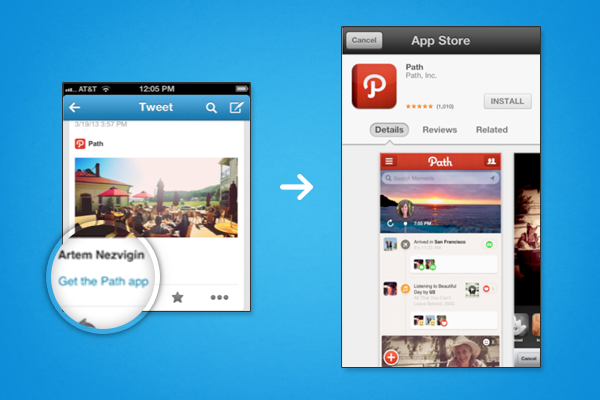
Twitter is introducing what it calls “mobile deep-linking” in Cards. Should a user share a photo on Twitter from a third-party app, like Path for instance, users can click on the link to open up and view the photo inside of Path on their mobile devices. On the other hand, if the user doesn’t have Path, Twitter will instead open up Path inside of the respective app store and encourage them to download the app. This should make outside developers quite pleased, especially that Twitter has been known for doing anything and everything to keep eyes on its platform and to not bump users outside of it. A prompt to download the app is an especially large concession and is probably meant to motivate developers to support Twitter Cards.
Product Card
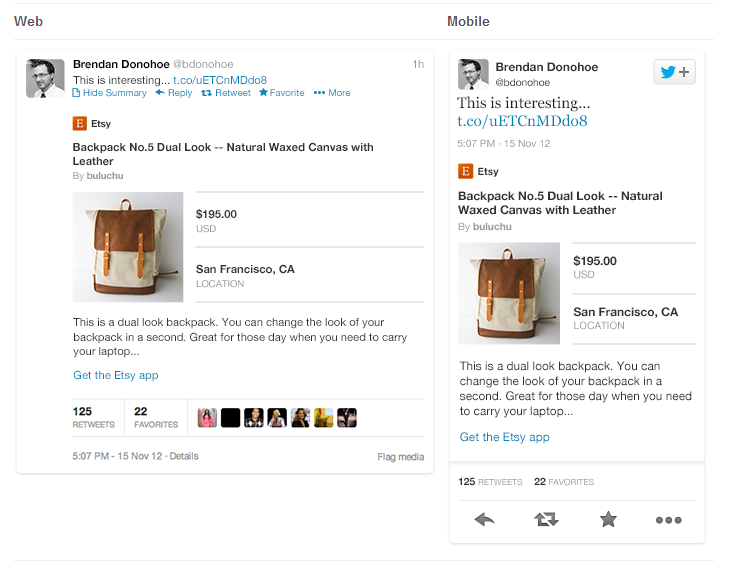
Twitter’s Product Card is a feature specifically targeting retailers. Photos are an important part of selling any product or service, so the social network wants to help its third-party developers “drive sales” with images and information. Every time a user shares a product, the card will display the product in an image accompanied by a description, and the developers can highlight “other two key details about the product.” Developers have a choice between displaying price, items in stock, sizes, country, or generally whatever else they’d like to use to sell their items.
This card is available on both mobile and Web. The previously mentioned deep-linking feature is available as well.
App Card

The App Card displays the developer’s app on Twitter that the user has linked to. The Twitter card will pull the app’s information from the respective app store and display information inside of the card including the name, description of the app, and the icon. Ratings and the app’s price are other features included in this card.
While the other types of Twitter cards are available instantly when the developer uses the API, who is able to use App Cards will be policed by Twitter. There’s a “special” approval process in place and App Cards aren’t “available for auto-approval” at this time. This card will also only be available on iOS and Android initially.
Gallery Card
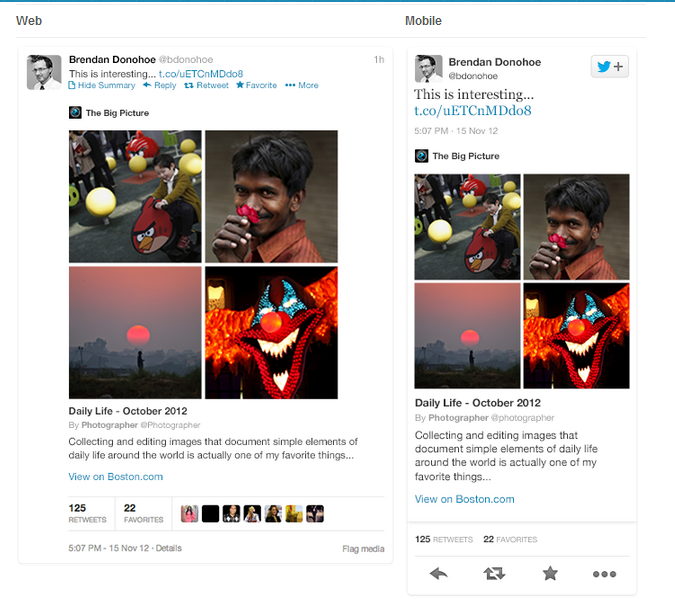
Twitter is paying attention to images since photographs tend to be captivating for viewers. With the Gallery Card developers can select up to four photos to display embedded within a Twitter card. So let’s say you’ve shared an article and it has a gallery embedded inside of it: If the publication responsible for that article has enabled the gallery card, you’ll be able to see up to four images. In addition, a nice touch that Twitter has added is the ability to attribute the photographer of the gallery.
This card will be available on both mobile and Web.
Patching developers’ wounds
Twitter, not having a great track record since it cut off access to its firehose for many developers to third-party data providers like Gnip and DataSift, is making a significant move to make nice with developers. More power is being put back into their hands, or so we’re being led to believe.
“With this update to Cards, we’ve fundamentally re-architected the way Cards are created and delivered. The new Cards system lays a foundation that will make it easier for us to develop more types of Cards in the future and allow for greater customization by publishers and developers,” says Twitter engineer Jason Costa.
Of course, you shouldn’t ignore the fact that Twitter is dictating who is able to promote their apps on Twitter; they still hold the cards, but we’re seeing something of a compromise here. They’re also making Cards more valuable, so the players that have chosen not to support them (cough, Instagram, cough) are losing out on more.The firehose access was cut to keep users on Twitter for as long as possible and “create a consistent Twitter experience.” After all, Twitter had a habit of shutting developers down and access to Twitter’s data making developing for Twitter a frustrating experience. You might remember how Twitpics, YFrogs, and other apps were ousted. Twitter doing what it wants with competing apps probably won’t change. Assuming this, we have an inkling about why App Cards are exclusive to certain developers. Twitter wants to control who sees what on Twitter, and if there’s a competing app out there, it’s not in Twitter’s best interest to help that app outshine Twitter’s own. In other words, Twitter wouldn’t want a Vine competitor being paraded around on the very company that owns Vine.
But it’s in Twitter’s best interest to promote itself as a developer-friendly company with these new Twitter Cards, despite its history. And at least for the time being, developers who are on Twitter’s good side have every reason to be happy. “This provides better monetization for app developers, better data collection and more direct commerce,” our source noted.
Twitter is looking East
While Twitter didn’t elaborate during the developer event, the social network has its sights set on the East. Twitter has noticed that 50 percent of social media is consumed on mobile devices in Asia, which offers the network an opportunity to expand into markets that have a good chance of boosting engagement and therefore revenue in these areas. However Twitter is giving up on China, which makes sense. The social network isn’t accessible on Web and mobile devices without the help of a VPN to bypass “The Great Firewall.” And not many Chinese citizens have a VPN anyway, nor do they need it when WeChat and Weibo are just a couple of the social networks that dominate the market for social media in China. With this in mind, countries like India and Indonesia is on Twitter’s mind. And our source points out that Twitter is scooping up key hires like the former Google VP Shailesh Rao, who helped build up Google’s presence in India and the Asia-Pacific and jumped ship in February 2012 to head up Twitter as its VP of International Operations.