People really, really like getting new Twitter followers. Sometimes it’s just about stroking egos addled with some instant gratification social media affords, but other times it’s at least a semi-practical aspiration – as insane as it sounds, people get jobs thanks to their Twitter acumen. So it makes sense that a cottage industry for boosting Twitter influence is booming, even if it’s not as helpful as the people plunking down their cards to buy followers think it is. 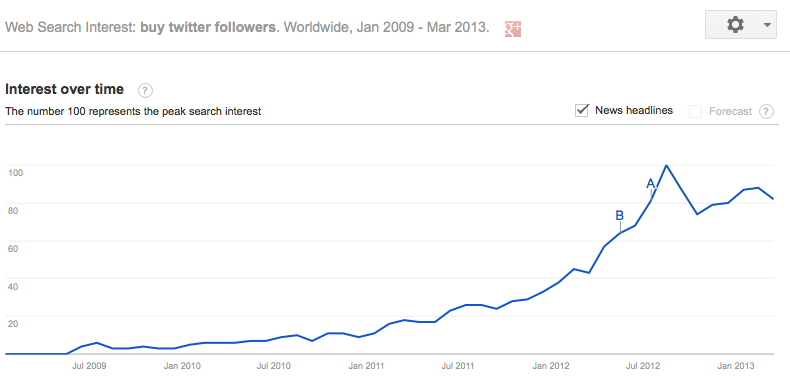
You can’t go from zero to Justin Bieber on Twitter overnight without a little black magic, and in the Twitter follower business, this means resorting to some underhanded tricks to pump up numbers.
Bots for sale
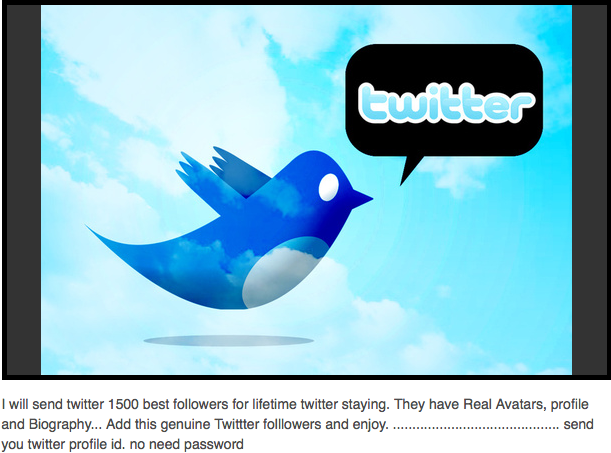
Just do a simple “buy Twitter followers” Google search and you’ll see an overwhelming number of options for purchasing your way to bigger numbers. If you don’t have time to grow your audience organically, throwing down your plastic to buy a bundle of followers is now an easy option. While most of these websites offer fake followers, not all of the followers are obvious bots. You can still generally tell by looking at how often they re-tweet and how many followers they have (bots tend to have a weird follower to following ratio, unless they end up spewing comedy cold like @horse_ebooks). But some of the more sophisticated rackets are getting profile pictures and proactively dressing up their bots in real-people Twitter behavior. Those remain in a minority, however, so it’s usually really obvious when your follower is just a spam-hurling fake. Take Hollie Adkin, for example. This is not a real person: 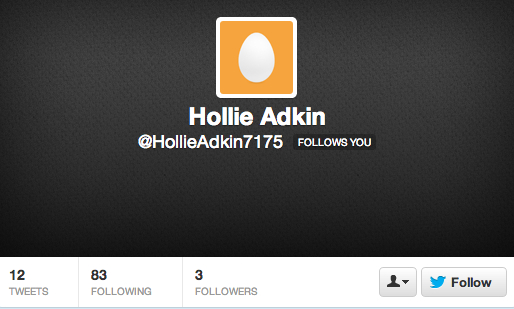
Italian security researchers Andrea Stroppa and Carlo De Micheli investigated the practice of buying Twitter followers, learning that the robust underground economy features over two dozen sites, and they generally sell followers in batches greater than a thousand (sometimes up to a million).
Sites like Twitter Technology and Fiverr peddle inflated Twitter follower figures for low prices, and many aspiring “social media ninjas” (oof) shell out to boost their user numbers, even though artificially bloated follower counts often have little impact on stuff like Klout scores, since they’re based on interaction and engagement, not sheer volume.
Stroppa explained to Digital Trends how well some of these bots blend in with real followers. “Complete profiles are astonishing, the fact that some may actually be real people who ‘sold’ their account through specific apps makes it nearly impossible to tell if they are authentic or not.”
And Stroppa doesn’t expect Twitter to successfully clamp down on the practice anytime soon, noting “It’s like the battle between viruses and antiviruses – viruses come first.”
Barracuda Networks also conducted several studies about how these bots do their dirty work, and their research scientist Jason Ding told Digital Trends just how smart these follower services are becoming, citing a website called Fast Followerz as an especially sneaky new business. Ding explained the site’s savvy practice, noting it “allows customers to control the speed of followers to be added daily, with a monthly subscription. Meanwhile, they claimed that the followers’ quality is so good that they can be guaranteed to pass the ‘Fakers Test’ by StatusPeople. Hence, they can offer the ‘Followerz Protection’ five year warranty.This example will become a popular/standard trend for providing and consuming ‘fake’ accounts.”
There’s gotta be a better way
The practice of buying Twitter followers to gain legitimacy is somewhat foolhardy – if someone cares enough about your Twitter acumen to use your social media profile as a benchmark for hiring or promoting you, they’re probably savvy enough to use something like Socialbakers’ tool to determine how many of your followers are authentic or not.
Digital Trends asked Socialbakers CEO Jan Rezab what he thought Twitter would do about the fake follower scourge in the future. “I think Twitter will essentially start cleaning up; just like Facebook has quite successfully recently. However, the social media environment and Twitter especially seems to be ‘self-policing;’ influential users and bloggers do use tools like ours quite often to flag fake users or users who attempt to boost up their presences by being followed by fake accounts. We hope Twitter will start fighting spam a bit more proactively than it has to date.”
Despite the fact that these fake followers are fairly easy to expose and don’t really add much to your social media experience, demand is growing. Instagram’s underbelly is growing seedier and more spambot-filled every day, with people paying for follows and Likes. And Stroppa says this trend is near-universal across social networks that reach a certain level of importance. “It’s already going on on other social networks like Facebook. Smaller markets aren’t economically interesting to the fake account sellers and not so important to companies or social media managers. As soon as a social network gets to a certain level, the black market blooms with it.”
Some of the websites that sell followers insist that they don’t send bots, just real followers. One of these sites is called FollowerSale. Digital Trends asked how they ensure they’re not selling bots and they explained their method: “We add our customers’ profiles to the top on our websites as a sponsor so when users follow our customers’ profiles they earn credits, users get able to gain more followers for free with this credits and our customers gain new followers.” So basically, they give real people an incentive to follow their customers. “Our websites has some rules. For example if you are a new user on Twitter or if you do not have a profile picture, tweets or followers, you are not able to sign in to our system so our customers always get quality followers.”
So maybe not every single site sells bots, but most of them do. And Rezab believes the fake follower trend can’t last forever, and stressed the importance of engagement as a more useful metric than simply amassing as many followers as you can. “We believe that fake profiles are a phenomenon which will not exist for long; at least to the extent that it exists now. First, brands will mature and gradually understand where the real benefits of social media interactions are. Second, users will start cleaning up their profiles and will be much more wary of who’s following them because only real human interaction can function credibly in the world of social media. And last but not least, social media platforms will start cleaning up their own turf because fake profiles dilute the user experience, ignoring advertising efficiency where only real users count.”