
Of course we’re generally happier when we take vacations than when we have our noses to that soul-crushingly banal grindstone, but a new study of Twitter geo-location data suggests we get happier after journeys of many varieties; you don’t need to go to Hawaii to start tweeting jubilantly (although, it helps).
The study, authored by researchers at the University of Vermont, looked at 180,000 Twitter users’ tweets in 2011 and pinpointed words to determine when they expressed happiness the most. They called the instrument they used to measure sentiment the “hedometer” and analyzed 37 million geolocated tweets with it. What’d they find? There’s a clear correlation between the farther away people get from their normal home or work modes and how happy their tweets are
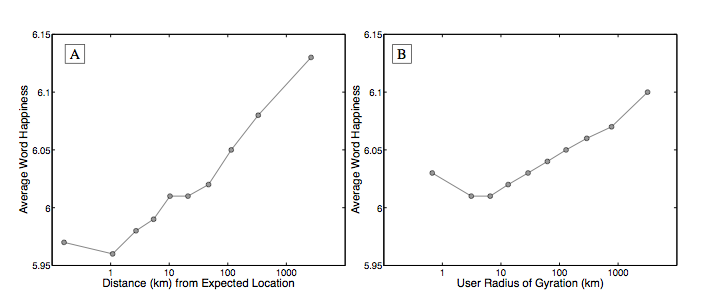 For example, the graph above shows how expressed happiness increases based on the kilometer reading for how far away users are from their normal locations, and how the same expressed happiness increase holds firm when measured by “user radius of gyration,” which basically means how large the sphere they move around in is. So if you live in New York but you never leave Williamsburg, your “radius of gyration” will be smaller than someone who lives in Astoria but wanders all over the boroughs.
In other words, the chart on the right speaks more to how people show that they are happy on Twitter when they go on vacation or out of town, and the one on the left shows how people who just tend to move around and frequent a wider variety of locales also tend to express happiness on Twitter more than their more stagnant counterparts.
Now, the tweets from far away places aren’t simply happier for the sake of geographic novelty. As the authors note, “Indeed, we expect that individuals capable of tweeting at a great distance from their expected location are more likely to benefit from an advantaged socioeconomic status, which they happily update frequently. Previous work has demonstrated that expressed happiness correlates strongly with many socioeconomic indicators.” Basically, if you can afford a trip somewhere far-flung, you’re probably not having money problems, so you have more reasons to tweet happily and not take to the micro-blogging platform to bemoan your unemployment issues or other financial problems.
Anyone taking to Twitter joyfully around tax reason from somewhere exotic is probably not a freelance writer, for example.
And what words did the researchers use to measure happiness? Included on the list of happy words: “beach,” “new,” “great,” “resort,” “coffee,” “cafe,” “lunch.” The unhappy words: “damn,” “never,” “hate,” “can’t.”
Of course, they added a caveat: “Regarding word usage as a proxy for happiness, accessing the internal emotional state of individuals is beyond the scope of our instrument.” Translation, our robot can’t interpret sentiment and sarcasm.
Now, this doesn’t mean that everyone hanging around home is a sourpuss on Twitter. In fact, they found that a number of positive words were also associated with staying closer to home: “lol,” “love,” “haha,” and “good’ all made the close-to-home-but-lovin’-it list.
There are plenty of reasons why this research may exaggerate the influence of location on how happy you are, primary among them being that people tend to use Twitter to show their best face to the world, so if you do have the opportunity to travel, you’re probably going to write positively about it. Even someone having a hungover horror-show in Hawaii may think twice before complaining about Maui to the Twitterverse, since it makes you look like an entitled jerk. They’re more likely to emphasize the positive. Which is a healthy life philosophy but may throw the results out of whack.
If this study teaches us anything, it’s that having new experiences and leaving your bedroom generally makes you a happier person (outwardly, at least), so even if you can’t hop over to the Big Island this Memorial Day, schlepping to a barbeque across town might change your mood.