There’s plenty of planetary action to be enjoyed in August, according to NASA’s latest rundown of what to look out for in the sky this month.
Highlights include a morning meetup between Jupiter and Venus, a chance to see the Perseid meteor shower, and a glimpse into the destiny of our own sun.
Mars
Mars is also viewable this month, in fact, it’s the only planet that’s visible in the early evening sky in August. You’ll be able to spot it low in the west for about an hour after daylight starts to fade, though you’ll have to look hard, as the glow of its characteristic salmon-pink color is now only about 60% as bright as it was in May.
Saturn
Later in the evening, at around 10 p.m., you’ll be able to spot Saturn, and as the month goes on it’ll appear a little earlier each evening. Look out for Saturn in the east after dark with the constellations Cassiopeia and Andromeda. The planet will appear to move toward the western part of the sky by dawn, so if you’re an early riser, it’s the perfect time to take a look.
Jupiter and Venus
“The real highlight of August is the close approach of Jupiter and Venus,” NASA says. “They shine brightly in the east before sunrise throughout the month.” The two planets appear far apart at the start of August, but as the days pass, they’ll move closer together. “They appear at their closest on the 11th and 12th — only about a degree apart. Their rendezvous happens against a backdrop of bright stars including Orion, Taurus, Gemini, and Sirius. A slim crescent moon joins the pair of planets after they separate again, on the mornings of the 19th and 20th,” NASA says.
Perseids meteor shower
The Perseids meteor shower is back again, and peaks overnight on August 12 and 13. But this year the moon is nearly full on the peak night, and so its brightness will impact the ability to see the meteors, except for the brightest ones. NASA says that while this is obviously disappointing, another meteor shower, the Geminids, will offer an excellent viewing opportunity — free of any moonlight — in December.
Dumbbell Nebula
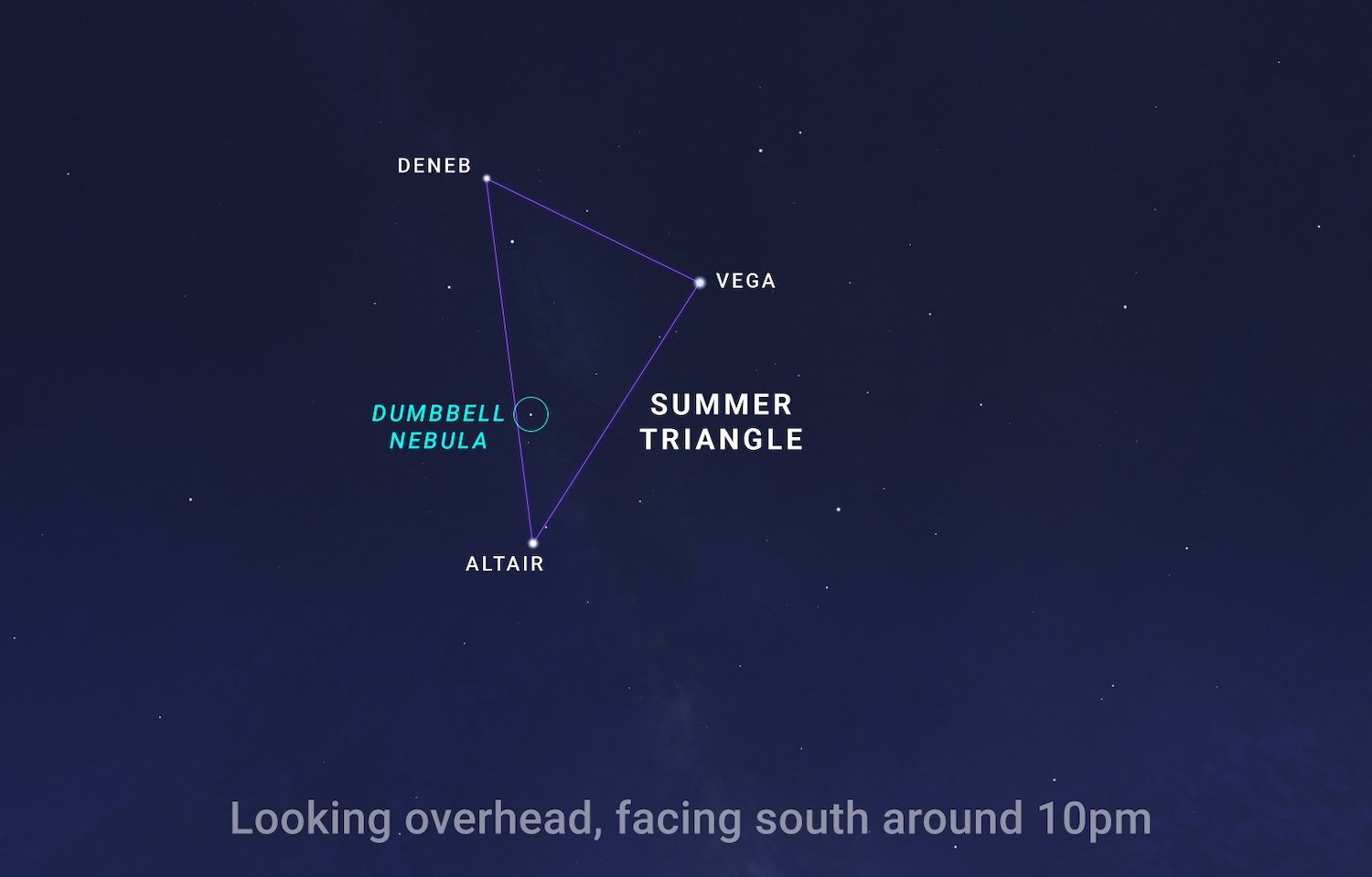
This month is also a wonderful chance to view the Dumbbell Nebula, also known as M27, which is a type known as a “planetary nebula.”
“A nebula is a giant cloud of gas and dust in space, and planetary nebulas are produced by stars like our sun when they become old and nuclear fusion ceases inside them,” NASA explains. “They blow off their outer layers, leaving behind a small, hot remnant called a white dwarf. The white dwarf produces lots of bright ultraviolet light that illuminates the nebula from the inside, as the expanding shell of gas absorbs the UV light and re-radiates it as visible light.”
Nicknamed for its dumbbell-like shape, the Dumbbell Nebula shows in the night sky as a small, faint patch of light about a quarter of the width of the full moon when viewing through binoculars or a small telescope. The diagram below gives you an idea of where to look — or consult your favorite astronomy app to find its precise location.
“Here’s hoping you get a chance to observe this glimpse into the future that awaits our sun about 5 billion years from now,” NASA says. “It’s part of a cycle that seeds the galaxy with the ingredients for new generations of stars and planets — perhaps even some not too different from our own.”