  1. Home
  2. Emerging Tech
  3. Photography
  4. Legacy Archives

Quadcopter with GoPro camera captures stunning views of Niagara Falls

Add as a preferred source on Google

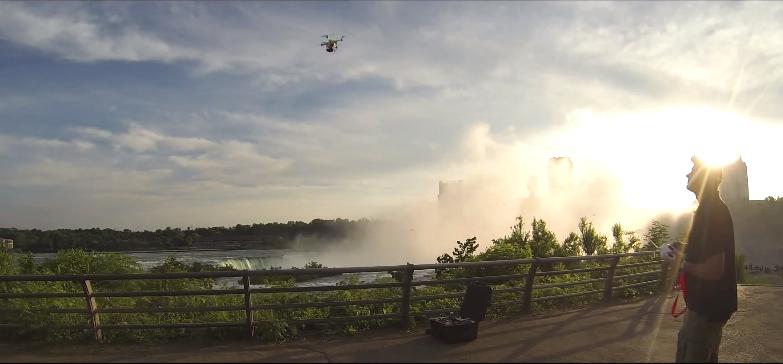
quadcopter niagaraFor his entry into a quadcopter video contest, YouTube user Questpact had the idea to strap a GoPro Hero 3 camera to his DJI Phantom flyer and send it high, and not so high, above Niagara Falls.

With most tourists opting for a good soaking via the Maid in the Mist boat ride instead of a helicopter experience over the falls, Questpact’s video goes some way to showing what the natural wonder looks like from an elevated position, as well as what you can do with a video camera and quadcopter when you put your mind to it – and yes, the results are pretty stunning.

quadcopter niagara falls
Image used with permission by copyright holder

Though they’re not the highest in the world, Niagara Falls – comprising the Horseshoe Falls, American Falls and Bridal Veil Falls – does hold the record for the highest flow rate of any falls on the planet, with Questpact’s video managing to capture some of the incredible energy and power generated by the surging water.

Recommended Videos

Strapping a Fat Shark radio-controlled first-person-view system to his head so he could see exactly what footage he was capturing, Questpact sent his quadcopter over the falls, shooting for 20 minutes in total.

The final video (check it out below), backed with a soothing soundtrack by San Diego band A New Normal, has been edited down to five minutes, and provides some spectacular imagery of this world famous landmark. 

[via Cnet]

Trevor Mogg
Contributing Editor
Not so many moons ago, Trevor moved from one tea-loving island nation that drives on the left (Britain) to another (Japan)…
A new AI model wants self-driving cars to think before they swerve
Forget guessing games, this self-driving AI actually shows its work.
Self driving car

Self-driving cars have gotten pretty good at driving. The harder problem is teaching them to drive safely in situations nobody planned for. We have heard horror stories of self-driving cars, behaving erratically in emergency situations, often times delaying first responders from reaching the scene.

A team at Seoul National University, led by professor Jun Won Choi from the Department of Electrical and Computer Engineering, thinks they have cracked part of that puzzle with a new AI model called SafeDrive. The research was recently selected as a highlight paper at CVPR 2026, a distinction that goes only to roughly 3% of all submissions.

Read more
An AirPods-sized mini lab could help catch disease markers in minutes
Meet VPodDuo, an AirPods-sized molecular testing gadget
VPodDuo Mini Medical Device

Home testing could eventually become a lot more convenient. Researchs at the at the University of Illinois Urbana-Champaign has developed the VPodDuo, a pocket-sized fluorescence reader designed to measure sensitive molecular tests outside a conventional laboratory.

Its housing is roughly comparable in size and shape to an AirPods charging case, while Bluetooth connectivity sends results directly to a smartphone. Meaning, you might not have to wait in line anymore.

Read more
Your future AR glasses might finally stop making the real world look weird
Researchers have developed a new display technique that keeps virtual objects realistic without dimming the real world.
Samsung AR Glasses

One of the biggest promises of augmented reality is blending digital objects seamlessly into the real world. Ironically, today's AR glasses often make the real world harder to see. Researchers at the Shibaura Institute of Technology (SIT) in Japan, led by Assistant Professor Xiaodan Hu in collaboration with Dr. Yan Zhang and Professor Xubo Yang from Shanghai Jiao Tong University in China, and Professor Kiyoshi Kiyokawa from Japan's Nara Institute of Science and Technology, have developed a new AR display technique that aims to make virtual objects look realistic without reducing visibility of the real world. The study was published in IEEE Transactions on Visualization and Computer Graphics.

The biggest AR problem isn't virtual objects; it's everything around them

Read more