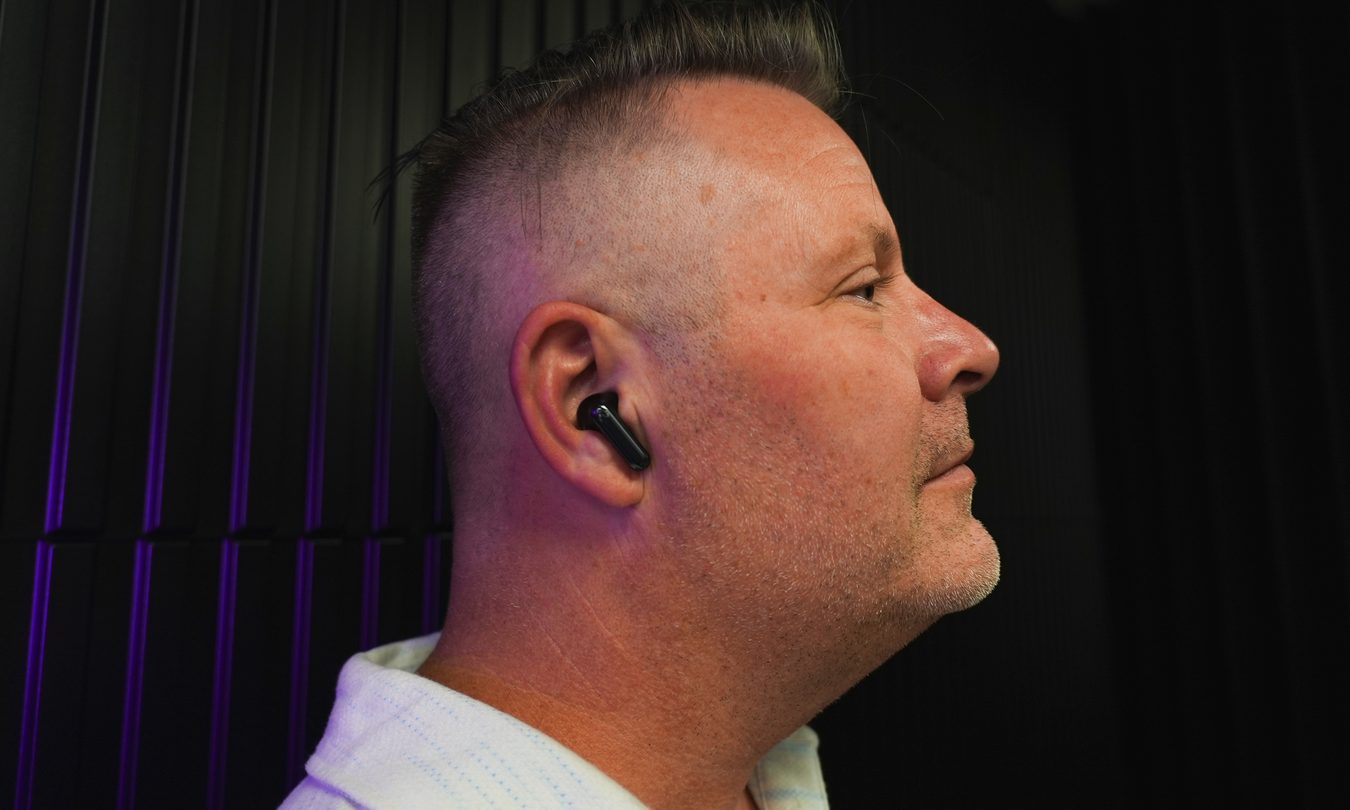
3D video, binaural sound, the MP3 format – countless technologies have relished a figurative fifteen minutes of fame before being left to rot in the tech graveyard. While it’s too early to write its fate, one of the latest technologies to bask in today’s spotlight and enjoy a fashionable moment is spatial audio.
The term began to be thrown around the consumer electronics market when Dolby’s immersive Atmos audio arrived on the scene in the early 2010s, but it only really entered popular culture and the everyday tech vernacular a decade later when Apple (of course it was Apple) popularized it, announcing at its annual Worldwide Developers Conference (WWDC) in 2020 that its AirPods Pro would soon be able to produce a head-tracked and surround-like sound experience called ‘spatial audio’, through the use of both special digital processing and the earbuds’ built-in accelerometers and gyroscopes.
Spatial audio is essentially a way of digitally manipulating sound so that it appears to come from various locations within a room or, in the case of headphones, a soundfield between your ears.
It is sound that transcends stereo; sound that isn’t tied to specific audio channels, speakers… or indeed your headspace. But while Apple has its own proprietary spatial audio technology called just that, it isn’t the only player in the game. Audio giants like Dolby, Sony, Samsung and Google have their own takes on the technology that fall under the generic ‘spatial audio’ umbrella, as does Bose, with its ‘Immersive Audio’ for its headphones and earbuds.
Bose’s Immersive Audio also uses digital audio processing and sensors in a bid to take music out of its headphones – and therefore your head – and has been pushed by the audio company as a big selling point of its flagship QuietComfort Ultra Headphones and QuietComfort Ultra Earbuds, the latter of which have just entered their second generation.
I have spent time testing these new earbuds for our QC Ultra Earbuds 2nd Gen review, and they have taught me a valuable lesson about spatial audio…
Head-tracking is hit and miss
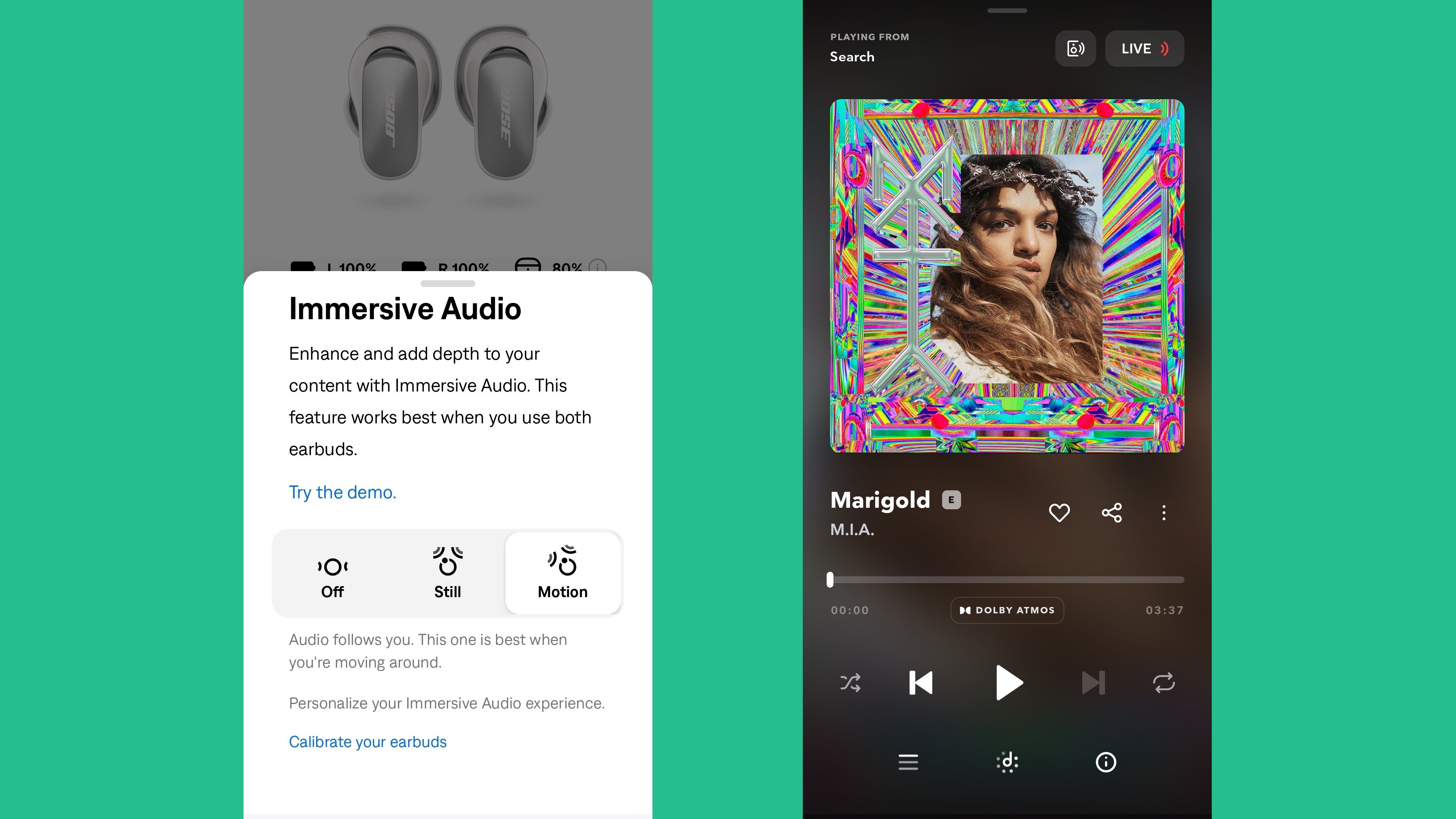
I first listened to Bose’s Immersive Audio in its QC Ultra Earbuds just shy of two years ago and had a slight issue with the two modes. With ‘Still’, which anchors the centre of the sound to your phone or other music-playing device, any movement of your head (to have a conversation, for example) or your device (to put it in a pocket, say) caused the sound to ‘fall’ more into one earbud, serving, in my mind, as a reminder that I was wearing headphones – and isn’t the whole point of any spatial audio effect to forget you’re wearing headphones?
Meanwhile, ‘Motion’, which tracks the centre of sound to your head position and therefore moves with you, was hampered by a slight delay in processing, so when you did move your head you could audibly notice the slight shift as the processing worked its magic.
It didn’t feel very natural and again brought my attention to the headphone aspect of the experience. My preferred setting was the former, though it certainly worked best when my head was fixed to one spot with the intensity of a dog in a staring competition with a cat.
Bose must have improved the head-tracking effect, in the processing or the accuracy of its sensors (or both), since then, as with the new earbuds the ‘Motion’ setting won out.
This time, the processing at play was barely noticeable as I head-danced to Wet Leg’s mangetout, and it was much easier to enjoy the extra dimension on offer without thinking about the earbuds in my ears.
Over-ears > in-ears
As I’ve explained, the idea of spatial audio is to take sound out of your head and push it out beyond your person into the room. Logic determines that there’s only so far earbuds can achieve this, what with their drivers being mere millimeters from your ear canals.
Sure, Immersive Audio and other spatial audio takes certainly open up the soundstage. In the best examples of tracks that have been mixed or specially recorded in spatial audio, such as Marigold’s M.I.A, vocals can float at your forehead (and above) height while instruments can gain width and depth, helping you to visualise a three-dimensional stage in front of you and pinpoint each player on it.
It’s pretty ironic, then, that spatial audio has been somewhat popularized through its implementation in the AirPods Pro and other wireless earbuds, when the effect is much more pronounced through over-ear wireless headphones such as the Apple AirPods Max and indeed Bose’s QC Ultra Headphones.
Naturally, they benefit from inherently having more distance (and, consequently, extra volume) between their drivers and your ears, while also having larger and more sophisticated drivers that are able to better produce the spatial effect.
Whether or not their often more advanced chips carry any extra benefit to delivering spatial processing or not, their physical makeup compared to that of earbuds is just better up to the spatial audio task.
For that reason, and bearing in mind the Immersive Audio improvements delivered by the brand-new Bose QC Ultra 2nd Gen, I’m excited to see how spatial performs in the company’s next-gen over-ear Ultra Headphones. Considering the first-gen model launched hot on the heels of the original Ultra earbuds, appearing within a month, hopefully I won’t have to wait too long to find out.