  1. Home
  2. Computing
  3. News

Micron says the memory shortage crisis is here to stay

AI data centers are soaking up the world's memory supply, and Micron says even massive fab expansions won't fix the imbalance anytime soon, leaving consumers caught in the middle.

Add as a preferred source on Google
Crucial RAM with motherboard
Crucial / Memory

The consumer tech industry is facing an ongoing memory crisis. Due to rising demand from enterprise customers (for building AI data centers), memory makers are directing much of their inventory to these clients, leaving little for consumer-centric product manufacturers.

This has led to a rise in price (or a reduction in the total memory) on PCs and smartphones. In the near future, the memory shortage is also said to impact television sets, tablets, smartwatches, and pretty much every other device that uses RAM.

Recommended Videos

The situation, according to Micron’s VP of Marketing, Mobile and Client Business Unit, Christopher Moore, might not ease before 2028 (via an exclusive interview by wccftech.com).

Micron’s exit from the consumer market signals a strategic shift

In December 2025, Micron shut its consumer-focused RAM and SSD brand, Crucial, to focus on enterprise and AI markets. This led to a backlash against the company, as it showed a clear inclination toward the rapidly rising demands of the AI sector rather than those of the end consumer.

However, Micron has clarified that a “large portion” of its market share still comes from LPDDR5 RAM modules supplied directly to OEMs such as Dell and ASUS.

Under the OEM model, the company still controls a large share of the consumer supply chain. “Our viewpoint is that we’re trying to help consumers around the world,” says Moore, adding that the company remains connected with “every single” PC maker out there.

The executive explains how the exponential rise in the total addressable market (TAM) for DRAM, driven by the rising demand of AI data centers, is now at 40% (up from 30 to 35%). He also mentions how “50 to 60% of the overall market is requiring more bits” than before.

The company is still serving consumers, but on new terms

While the rise in demand due to the surge in AI applications and data centers is too significant for the company to ignore (i.e., it needs to cater to the market as it’s a good business opportunity), the company “is still servicing the consumer market.”

Even as the company ramps up production, the memory shortage isn’t going away anytime soon, at least not until 2028. Moore confirms that Micron’s massive fab expansion won’t bring any significant relief until 2028.

The company is working closely with PC and smartphone manufacturers to limit RAM configurations, as multiple memory sizes hurt the production yields, but that would only stabilize the supply in the short term. In the end, this means one thing: the memory crisis is here to stay, and it might trouble end-consumers for a couple of years.

Shikhar Mehrotra
For more than five years, Shikhar has consistently simplified developments in the field of consumer tech and presented them…
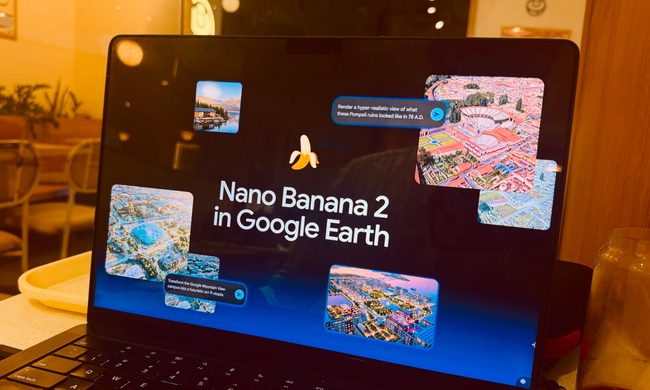
Google Earth’s AI misadventure lasted only a day. It was a tale of dangerous ignorance.
Nuclear reactors, tanks, and historical destruction on a life-like satellite map? Yeah, that's bad.
Nano Banana AI image generator representation.

Technology behemoths are clearly not reading the room, or they are just moving faster than they should when it comes to AI deployment. Google has already stuffed its Gemini AI in every corner of its software stack, from Android to daily productivity tools like Gmail that are used by hundreds of millions of users every day. AI is everywhere. Not all of it is bad, mind you. But in a few places, it just feels forced.

In its latest AI-fication experiment, the company targeted Google Earth. The idea was to let the audience use its Nano Banana 2 AI image generator and make images that can be placed on the map view. On paper, it's a cool idea. What would the Colosseum of Rome look like in your urban neighborhood? Yeah, fun stuff like that.

Read more
AMD is apparently gearing up to raise GPU prices right after Nvidia’s steep hike
AMD has reportedly told AIB partners about a price hike that goes into effect in. August.
AMD RX 7800

AMD is next in line to raise the asking price of its Radeon GPUs, merely days after the news of a similar hike coming for Nvidia graphics cards started making waves. As per ChannelGate on Weibo (h/t VideoCardz), AMD has informed its board partners that the price of GPU and memory bundles will go up by at least 10% in August.

Is a similar price hike coming for standalone graphics cards? I won't be surprised if that happens. The situation is so bad that AMD is planning to bring back graphics cards with 4GB of onboard memory. AMD just introduced the RX 9050 GPU, which costs $279. Notably, it's just $20 less than the RX 9060 XT that offers double the graphics memory.

Read more
Microsoft will make Windows work well with just 8GB RAM. We desperately need it
The dream of a reliable and affordable Windows laptop hinges on the next milestone at Microsoft.
Surface laptop on wooden table

The year 2026 has marked a huge course correction for Microsoft after years of frustrating users with plenty of confusing processes, unoptimized UI elements, and just the generous bloatware that can bring any Windows system to a crawl. Microsoft has finally shifted into a new phase. From fixing the right-click behavior to speeding up the Search system, the company has fixed plenty of papercuts.

The next major milestone is making Windows 11 run smoothly on Windows PCs with just 8GB of RAM. That directly means entry-level and budget laptops will at least get the basics right, even if that means sacrificing the on-device AI bells and whistles. Let's face it. The increasingly AI-first approach to computing on a Windows 11 machine is a little too taxing on the hardware at hand.

Read more