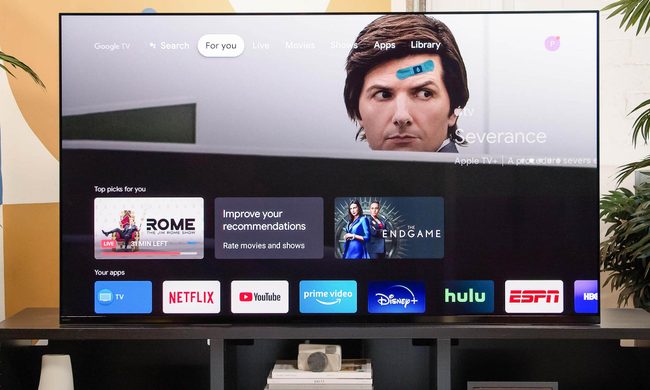
Google TV sucked. It was ugly, difficult to use, and thanks to an embarrassing lack of apps, not terribly useful either.
Couch potatoes collectively rejoiced then, when Google pushed forth Android TV at Wednesday’s Google I/O developer conference. The revamped take on TV is supposed to offer a “fresh start” for Google’s now-notorious foray into television, at long last.
Is Google’s much-maligned, bunny-eared stepchild finally dead, then? A Google rep got a distant look in his eye when I asked where Google TV stood now, like bringing up a family member who just ended up in prison, or was excommunicated from the church. “This is its successor,” he explained tactfully.
So yes, Google TV is finally dead. Of course, whether its perky Android-branded successor is any improvement remains to be seen. So I spent some time plopped on the couch with it to find out for myself.
Where do I put my Halo disc?
There’s no escaping it: The Android TV interface looks an awful like the Xbox One interface. Love or hate Microsoft’s shiny tiles in Windows 8.1, they look spectacular on a TV screen, and Google has lifted some heavy inspiration from its neighbor to the north for Android TV.
Google has lifted some heavy inspiration from its neighbor to the north for Android TV.
The controller for Google’s ADT1 developer box only adds to this impression. It’s pretty much an Xbox clone, right down to the dual triggers, analog joysticks and four-button layout. Of course, on this one you’ll also find Android’s signature Back and Home buttons in the center.
Google isn’t just piling on the buttons to let you make your Netflix picks with extreme precision – it’s pitching Android TV as a legitimate gaming platform. Since it’s supposed to be much easier for developers to port ordinary Android titles over now, that means some potentially heavy-hitting games. We spent a little while playing Meltdown, and despite getting shredded by a turret in a matter of seconds, gameplay was silky smooth on the box’s Nvidia Tegra 4 processor and 2GB of RAM. This machine can handle some heavy lifting.
Getting around
If you’re not looking for a quasi-console, you can use a simple D-pad to control Android TV instead. The box won’t come with a physical one, but a simple app provides the essentials: a four-way directional pad with center button, Back button, Home button, and a prominent red microphone button.
That last button handles voice input, which is a major piece of the navigation puzzle on Android TV – Google expects you to enter pretty much all text this way. Click the mic at any point in the navigation and you can talk to the TV to search for anything. Unlike Amazon’s Fire TV, which only likes to poll results within Amazon when using voice search, Android TV will eventually scour every option available as developers for apps like Netflix’s jump on board. But, the voice recognition system isn’t always the most accurate. A simple search for “Breaking Bad” worked just fine, but “the Beatles” came up as “the wheels” and “Ted Leo” became “the he leo.” The background noise in a crowded convention center certainly wasn’t helping, but we were surprised to see that the Android app doesn’t at least have a conventional keyboard for backup.


Another notable omission that used to appear on Google TV: a browser. A Google rep told me that a browser would not appear in the final version, but other companies would certainly be welcome to develop one for it.
Of course, if you really wanted to pull up something from the Web, you could always Chromecast it from a phone or tablet, since Android TV supports that feature as well. Considering you can get that feature from a $35 gadget the size of a pack of gum, it had better.
There is one holdover from the failed Google TV: Android TV will try to play nice with your cable or satellite TV service. It isn’t clear how it will work, but information about what’s playing now, content suggestions based on previous searches, and a channel guide are all possibilities.
OK developers, your turn
On interface alone, Android TV is a quantum leap ahead of its sloppy, cobbled-together predecessor. It’s quick, attractive and … well, the apps part remains to be seen. If Google’s claim that porting Android apps to Android TV is true, this platform may just remedy the mistakes of the past.
But it isn’t 2010 anymore. Between the super-silky WebOS interface on LG TVs, Amazon’s remarkably similar Fire TV box, Google’s own Chromecast, and a monster release from Apple always looming on the horizon, Google is facing much stiffer competition than the likes of Boxee and Roku. It will need the full weight of its legendary Android developer community churning out apps – not just a better interface – to really stand a chance this time around.
Update by Caleb Denison 6-26-2104: This post was updated to clarify universal search is a work in progress and that live TV feeds will somehow be integrated into the final versions of Android TV.