1. Home
  2. Emerging Tech
  3. Legacy Archives

NASA 3D prints a nebula — and you can do the same at home

Add as a preferred source on Google

Ever wish you could own your very own nebula? Well, if you happen to own a 3D printer, these massive interstellar clouds can be all yours.

A team of NASA astronomers have come together to create the first high-resolution 3D model of a massive binary system called Eta Carinae.  Located more than 7,500 light years from Earth, this system is of particular interest among astronomers, because of its enormous size; it’s smaller star is about 30 times the mass of our sun and nearly a billion times more luminous, while it’s big brother star is a whopping 90 solar masses, emitting 5 million times the sun’s energy output.

Recommended Videos

Eta Carinae is also famous for a little explosive event that happened to it over 150 years ago called the “Great Explosion.” Between 1838 and 1845, the system produced a whole lot of light, almost as much as a supernova explosion, but the stars ultimately survived.  The event caused a giant shell of gas — between 10 and 40 times the sun’s mass — to be shot into space.

The result? A ridiculously large hourglass-shaped cloud of dust called the Homunculus Nebula, which is continually expanding at more than 1.3 miles per hour.
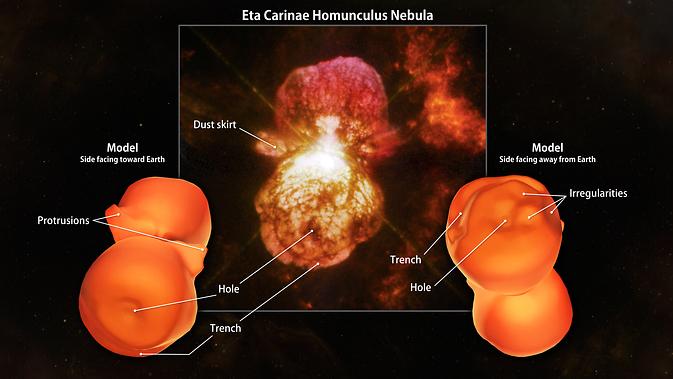
etacarinae_model_comparison_labels
Image used with permission by copyright holder

To create their own model this system, NASA astronomers utilized the European Southern Observatory’s Very Large Telescope and its X-Shooter spectrograph, imaging near-infrared, visible and ultraviolet wavelengths across the nebula. The team ultimately took 92 different swaths of the system, creating the most complete spectral map to date.

That data was then used to create a handheld shape model, which was then 3D printed.  According to the researchers, their work helped them to better understand the properties of the Homunculus Nebula, as well as answer questions about its formation.

“Our model indicates that this vast shell of gas and dust has a more complex origin than is generally assumed,” said Thomas Madura, a NASA Postdoctoral Program fellow at NASA’s Goddard Space Flight Center in Greenbelt, Maryland, and a member of the study team. “For the first time, we see evidence suggesting that intense interactions between the stars in the central binary played a significant role in sculpting the nebula we see today.”

And the best part of the whole process is that NASA isn’t keeping their details a secret.  If you own a 3D printer at home, just download the publicly available plans (and if you’re interested, their study published in the journal Monthly Notices of the Royal Astronomical Society), and you can have your very own nebula paperweight keepsake that fits in the palm of your hand.

[Images courtesy of NASA]

Loren Grush
Former Digital Trends Contributor
Loren Grush is a science and health writer living in New York City, having written for Fox News Health, Fox News SciTech and…
Researchers hid a prompt injection inside a PNG, and AI fell for it
Hacker

AI coding assistants like Claude are becoming every developer's favorite coworker. They can review code, explain confusing functions, and even write entire features with a single prompt. But new research suggests that this growing trust could also become their biggest weakness.

A team of security researchers (professor Sudipta Chattopadhyay and researcher Murali Ediga) has demonstrated an unusual attack that doesn't target the AI model directly. Instead, it targets what the AI doesn't pay enough attention to during code reviews. Rather than hiding malicious instructions in lines of code, the researchers tucked them inside an image file. Since many AI review tools treat images as decorative assets rather than as something worth inspecting, the pull request can appear perfectly harmless and sail through the review.

Read more
AI has already fallen into the wrong hands and they’re using it to make bombs
Logo, Text

Artificial intelligence has quickly become the go-to tool for everything from writing emails and summarizing meetings to helping students study or developers debug code. But the same technology that saves people time can also be misused, and a new report suggests that terrorist organizations are finding ways to do exactly that.

According to a research paper shared with The New York Times ahead of its publication, researchers found evidence that members of Boko Haram have been using popular AI chatbots to support both day-to-day activities and combat-related tasks. Interviews with 27 former members conducted in Nigeria over the past two years suggest that tools such as ChatGPT, Gemini, Claude, Grok, Meta AI, and DeepSeek were used to gather technical information, troubleshoot weapons, and even assist with planning attacks.

Read more
Claude Code can now browse the web without opening Chrome
The desktop app now includes an in-app browser that can read websites, click links, and interact with web apps.
Claude Code Featured

Developers spend a surprising amount of time bouncing between their code editor, browser tabs, API documentation, GitHub issues, and design files. Anthropic thinks Claude Code should simply do all of that without constantly asking users to switch windows. The company has announced a new in-app browser for Claude Code on desktop, allowing its AI coding assistant to open websites, read documentation, inspect designs, and interact with web pages directly from within the application.

A browser built into Claude Code

Read more