  1. Home
  2. Cars
  3. News

Ford’s EcoBoost-powered Rip Rod isn’t your average Hot Wheels car

Add as a preferred source on Google

Your ears aren’t fooling you; the savage sound you’re hearing is coming from a 1.0-liter engine.

The last time we saw Ford’s Hot Wheels Rip Rod, it was a static project car being towed behind the decked out Ford Transit Connect vehicle. Even though the cargo van’s 55-inch television screen, gullwing doors, and nostalgic paint job were cool, we always wondered what the Rip Rod would be like moving under its own power.

Well, now we know.

Recommended Videos

The real life Hot Wheels car, originally designed and built by Mattel and Bandito Brothers, is now powered by Ford’s amazing 1.0-liter EcoBoost engine.

The tiny three-cylinder uses a cast iron block, independent variable camshaft timing, and an overboost function to increase durability, efficiency, and raw power.

Because the Rip Rod is a small vehicle, the EcoBoost’s integrated exhaust manifold and internal timing belt reduce size and weight appropriately. In the video above, Ford Racing says the engine is “small enough to fit in a suitcase.”

There’s no word on output for this particular application, but the 1.0-liter has made anywhere from 99 horsepower to a stunning 202 hp in the FF1 racecar. The Euro-legal one-seater was quick enough to lap the Nurburgring in 7:22 seconds, faster than a Ferrari Enzo.

Considering Ford’s claim that the three-pot is “powerful enough to accelerate the evolution of racing,” it’s a good bet the Rip Rod is toward the high end of the EcoBoost’s potential.

Related: EcoBoost, Coyotes, and Voodoo. Dissecting the tech powering the 2015 Mustang

The engine is developed at the Dunton Technical Centre in Laindon, United Kingdom. It is currently being featured in the Ford Fiesta, and won the International Engine of the Year award in 2012, 2013, and 2014.

Andrew Hard
Andrew first started writing in middle school and hasn't put the pen down since. Whether it's technology, music, sports, or…
Volvo is rolling out Apple Music to over 2 million cars with a simple OTA update
Your Volvo may soon get Apple Music without needing CarPlay
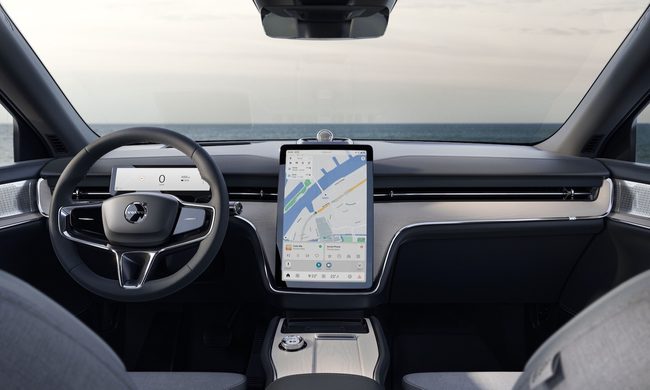
Interior view of the 2024 Volvo EX90.

The line between your smartphone and your car continues to blur. Volvo has announced that it is rolling out an over-the-air software update that brings Apple Music directly to the infotainment systems of more than 2 million vehicles worldwide. Instead of relying on Apple CarPlay or plugging in an iPhone, eligible drivers will be able to stream music natively from their car's built-in system, making Apple Music another integrated feature of Volvo's software experience.

The update is arriving for a wide range of Volvo models, including the EX90, ES90, XC90, S90, V90, XC60, S60, V60, XC40, EX40 and EC40, covering model year 2020 onwards. Availability, however, may vary depending on the vehicle.

Read more
Chery’s latest EV packs flagship tech for the price of a base Tesla, but you can’t buy it
Here's everything packed into Exeed's 2027 Exlantix ES, from its 27-sensor autonomous driving suite to its 860 km range, all starting under $31,000.
Car, Transportation, Vehicle

Chery's premium arm just dropped a sedan that makes you wonder why American EVs cost twice as much for half the tech.

Exeed's 2027 Exlantix ES ships with a driver-assist system called Falcon 700. It is built around an Nvidia Orin-Y chip and a genuinely stacked sensor suite.

Read more
A new AI model wants self-driving cars to think before they swerve
Forget guessing games, this self-driving AI actually shows its work.
Self driving car

Self-driving cars have gotten pretty good at driving. The harder problem is teaching them to drive safely in situations nobody planned for. We have heard horror stories of self-driving cars, behaving erratically in emergency situations, often times delaying first responders from reaching the scene.

A team at Seoul National University, led by professor Jun Won Choi from the Department of Electrical and Computer Engineering, thinks they have cracked part of that puzzle with a new AI model called SafeDrive. The research was recently selected as a highlight paper at CVPR 2026, a distinction that goes only to roughly 3% of all submissions.

Read more