  1. Home
  2. Cars
  3. Photo Galleries
  4. News

To keep its engine cool, BMW’s MotoGP safety car injects some high quality H20

Add as a preferred source on Google

BMW has unveiled the modified M4 Coupe that will serve as safety car for the 2015 MotoGP racing season.

The car uses what BMW calls “an innovative water injection system,” which sprays a fine mist of H2O into the engine’s collector before it enters the combustion chamber.

According to the automaker, the process lowers the temperature of combustion air, reducing the risk of pre-ignition while increasing performance and efficiency. Technology like this is generally used on turbocharged or supercharged engines because of the high temperatures involved.

While the announcement might set off a WATER + ENGINE = BAD alarm off in your brain, remember that similar systems have been used for years in drag racing, military aviation, and production vehicles like the Saab 99 Turbo and Ford Escort Cosworth RS.

“The cooler supercharged air reduces the engine’s tendency to knock, making it possible to bring the point of ignition forward and thus closer to the optimum value,” BMW says. “This makes the combustion process more effective, whilst at the same time reducing the combustion temperature. On the other hand, cool air has a higher density, which increases the oxygen content in the combustion chamber.”

BMW M4 MotoGP safety car
Image used with permission by copyright holder

Aside from enhancing performance, H2O injection can improve the engine’s longevity by lessening thermal strain on the pistons, exhaust valves, catalytic converters, and the turbo itself.

The water is stored in the trunk of the M4 in a five-liter (1.3-gallon), frost-proof tank that’s been fitted with an array of sensors and valves.

How much does the system use? During high-stress racing operation, the water tank must be refilled at the same rate as the fuel tank. When driving normally on the motorway, though, the container will only need replenishing once in every five fuel stops. Make sure to use pure, distilled water though, because tap water could bring some microscopic friends along for the ride.

According to BMW, this technology will eventually make it into a production vehicle. Watch the video below for a computer simulation of how water injection works.

Andrew Hard
Andrew first started writing in middle school and hasn't put the pen down since. Whether it's technology, music, sports, or…
Volvo is rolling out Apple Music to over 2 million cars with a simple OTA update
Your Volvo may soon get Apple Music without needing CarPlay
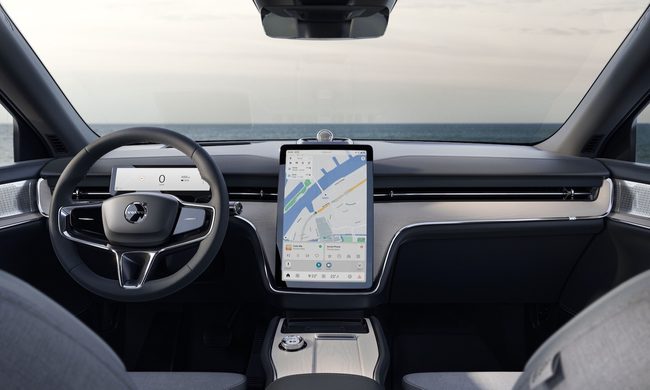
Interior view of the 2024 Volvo EX90.

The line between your smartphone and your car continues to blur. Volvo has announced that it is rolling out an over-the-air software update that brings Apple Music directly to the infotainment systems of more than 2 million vehicles worldwide. Instead of relying on Apple CarPlay or plugging in an iPhone, eligible drivers will be able to stream music natively from their car's built-in system, making Apple Music another integrated feature of Volvo's software experience.

The update is arriving for a wide range of Volvo models, including the EX90, ES90, XC90, S90, V90, XC60, S60, V60, XC40, EX40 and EC40, covering model year 2020 onwards. Availability, however, may vary depending on the vehicle.

Read more
Chery’s latest EV packs flagship tech for the price of a base Tesla, but you can’t buy it
Here's everything packed into Exeed's 2027 Exlantix ES, from its 27-sensor autonomous driving suite to its 860 km range, all starting under $31,000.
Car, Transportation, Vehicle

Chery's premium arm just dropped a sedan that makes you wonder why American EVs cost twice as much for half the tech.

Exeed's 2027 Exlantix ES ships with a driver-assist system called Falcon 700. It is built around an Nvidia Orin-Y chip and a genuinely stacked sensor suite.

Read more
A new AI model wants self-driving cars to think before they swerve
Forget guessing games, this self-driving AI actually shows its work.
Self driving car

Self-driving cars have gotten pretty good at driving. The harder problem is teaching them to drive safely in situations nobody planned for. We have heard horror stories of self-driving cars, behaving erratically in emergency situations, often times delaying first responders from reaching the scene.

A team at Seoul National University, led by professor Jun Won Choi from the Department of Electrical and Computer Engineering, thinks they have cracked part of that puzzle with a new AI model called SafeDrive. The research was recently selected as a highlight paper at CVPR 2026, a distinction that goes only to roughly 3% of all submissions.

Read more