1. Home
  2. Computing
  3. Apple
  4. News

Macbook Air and Pro run through the ringer, and the results may surprise you

Add as a preferred source on Google

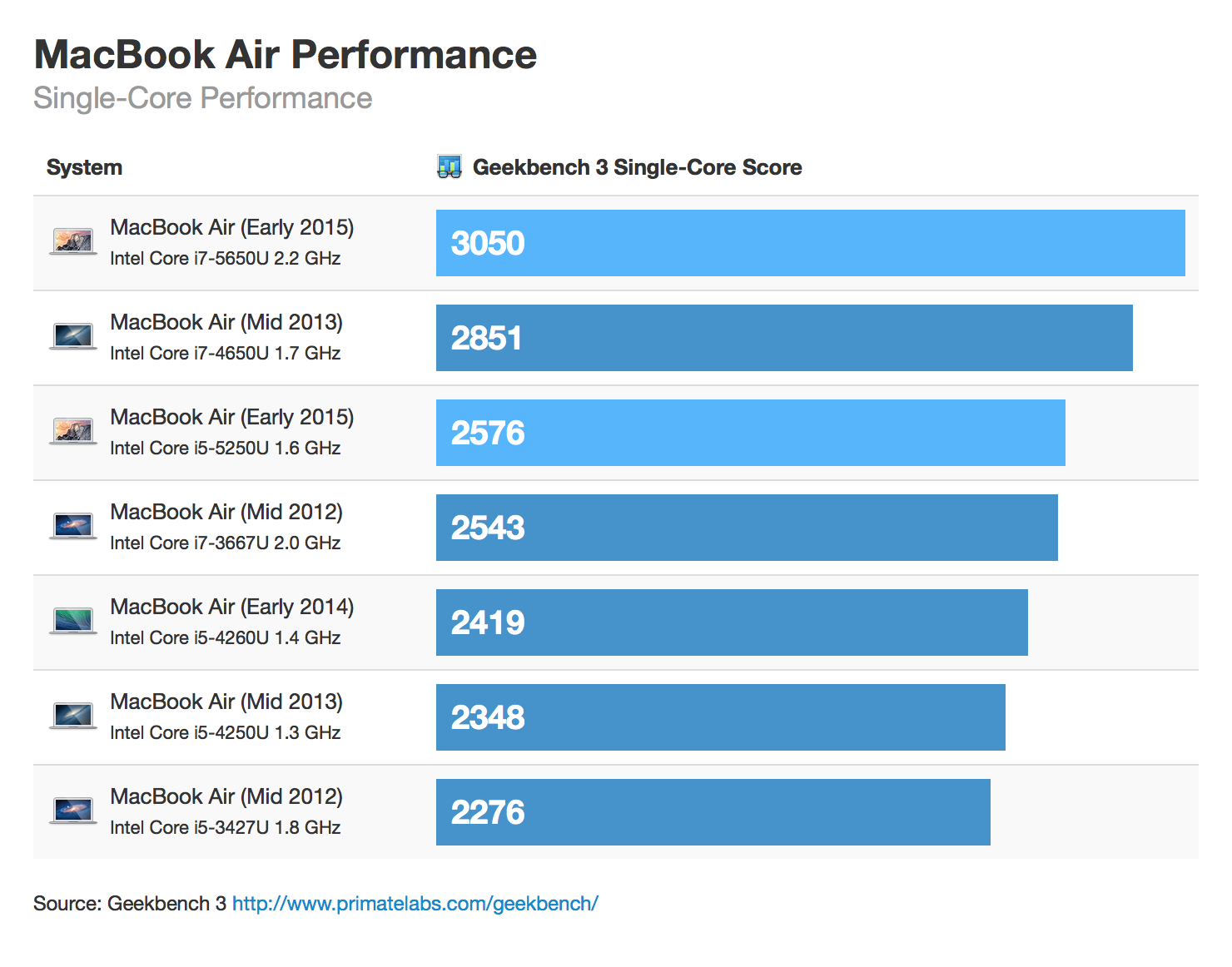
On Friday, the team at Primate Labs released their updated Geekbench benchmarks used to test the power of the brand new Macbook Air and Pro models released earlier this week.

Somewhat surprisingly, in both single core and multi-core tests it looks as though the 2015 Macbook Air and Pro just barely eeked out the last versions, updated in 2014. The performance difference is generally ten percent or less.

Recommended Videos

Primate’s results also found that while the bump between the two i7 processors was significant in the Pro model, the effect was less noticeable in the i5 variant, only yielding about a three to seven percent increase in performance during single core tests.

Granted, these results fall just about in line with the current trajectory of Moore’s Law, but it brings up the fundamental question that many consumers have been pondering for the past few years now: is the law officially starting to reach its limit?

To that quandry, Intel says ‘no’.
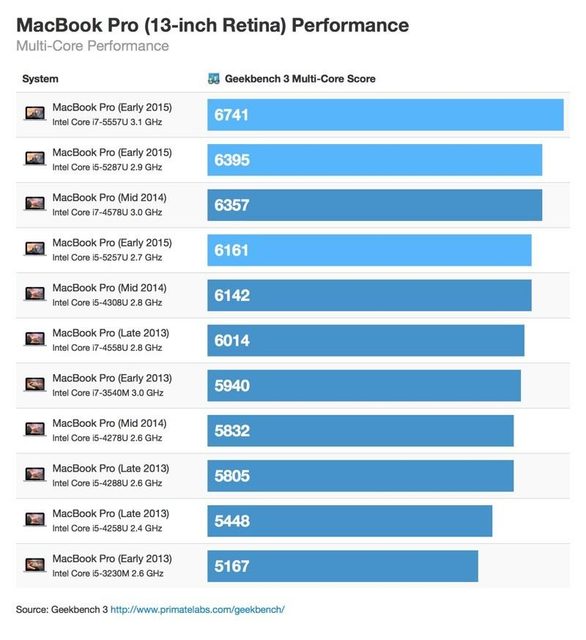
mbp-march-2015-multicore-800x875
Image Credit: Primate Labs

According to the company, while the challenges jumping from 22nm to 14nm were substantial, they were attributed primarily to stumbling blocks in manufacturing rather than a slowdown in Moore’s original theorem. With those issues worked out, Intel sounds confident it’ll be able to smoothly transition from 14nm to 10nm (and beyond) without any further hiccups.

This means that while the improvements we’ve seen in this year’s Macbook Air and Pro models might seem somewhat inconsequential on the surface, they serve as more of a stepping stone to what we should see in the next few years than anything else.

Chris Stobing
Former Digital Trends Contributor
Self-proclaimed geek and nerd extraordinaire, Chris Stobing is a writer and blogger from the heart of Silicon Valley. Raised…
Asus’ powerful new gaming laptop with a 240Hz Mini LED display makes its global debut
The 2026 ROG Strix G18 pairs up to RTX 5080 graphics with an Intel Core Ultra 9 290HX Plus CPU
ROG Strix G18 (2026) laptop

Asus has started rolling out the 2026 ROG Strix G18 globally, and the easiest way to describe it is as a slightly toned-down version of the ridiculous ROG Strix Scar 18. It keeps the same 24-core Intel Core Ultra 9 290HX Plus processor but tops out at an Nvidia GeForce RTX 5080 Laptop GPU instead of the Scar’s RTX 5090. (via Notebookcheck)

The Mini LED model gets the best balance

Read more
Every app on my phone has decided I need AI, and none of them bothered to ask
AI assistants are invading everything from photo libraries to messaging apps, and dismissing them only seems to guarantee they’ll return later.
Electronics, Phone, Mobile Phone

My wife doesn’t use AI very much. She isn’t philosophically opposed to it, nor is she waiting for the machines to overthrow civilization. She simply opens Google Photos because she wants to look at her photos.

Lately, however, the app keeps greeting her with invitations to try its AI tools. Google would very much like her to search her library conversationally, generate something new, or ask Gemini to edit a photo. She dismisses the prompt, gets on with her life, and eventually meets it again.

Read more
Shopping for Back-to-school? These are the gaming laptops I’d recommend
Powerful enough for AAA games, practical enough for everyday lectures, assignments, and everything in between.
oled gaming laptop

Every gamer knows the pain of trying to do too much with the wrong hardware. Back-to-School is the perfect excuse to fix that. A good gaming laptop shouldn’t just hit high frame rates -- it should also survive endless browser tabs, assignments, coding sessions, video edits, and everything else college throws at it. These five machines strike that balance better than most, which is exactly why they’d be my picks this semester.

Alienware 16 Aurora

Read more