  1. Home
  2. Cars
  3. Photo Galleries
  4. News

Want a beefier battery for your Tesla Roadster? That’ll be $29,000

Add as a preferred source on Google

The all-electric Roadster was Tesla’s first production automobile, but that doesn’t mean the company is letting it rest on its laurels.

Following an announcement late last year, the American brand has finally released details of the Roadster 3.0 upgrade, which involves switching out the old 53kWh battery in favor of a larger, beefier unit measured at around 70kWh. For Roadster drivers, that means 40 percent more energy and roughly 35 percent more range, equating to a mileage capacity of 330 miles or more on a full charge. With the previous battery, the Lotus-based Roadster could travel approximately 245 miles.

There are some penalties however. The new pack is slightly heavier than its predecessor — exactly how much Tesla hasn’t said — and the upgrade itself costs $29,000. That’s definitely a good chunk of change, but the brand assures there is no markup included in the price.

“The price of the battery upgrade is $29,000, including all labor and logistics, which is equal to Tesla’s expected cost,” said the automaker. “It is not our intention to make a profit on the battery pack.”

Upgrades aside, Tesla stopped building new Roadsters back in 2012, which brings us to the car’s replacement. According to CEO Elon Musk, the next-generation electric car will arrive by 2019, and it will likely be one of the fastest vehicles on the road.

“There is of course only one thing beyond ludicrous,” he wrote in a blog post, referring to the Tesla Model S’s Ludicrous Mode. “But that speed is reserved for the next generation Roadster in four years: maximum plaid.”

Just how fast is maximum plaid? Fans of the 1987 film Spaceballs will recall a scene where heroes Lone Starr and Barf attempt to evade capture by activating the secret hyperjets on their Eagle 5 Winnebago, which propels them well past light speed. The enemy ship, Spaceball One, gives chase, but goes too fast, entering a nigh-omnipresent velocity known simply as plaid. So pretty fast.

Andrew Hard
Andrew first started writing in middle school and hasn't put the pen down since. Whether it's technology, music, sports, or…
Volvo is rolling out Apple Music to over 2 million cars with a simple OTA update
Your Volvo may soon get Apple Music without needing CarPlay
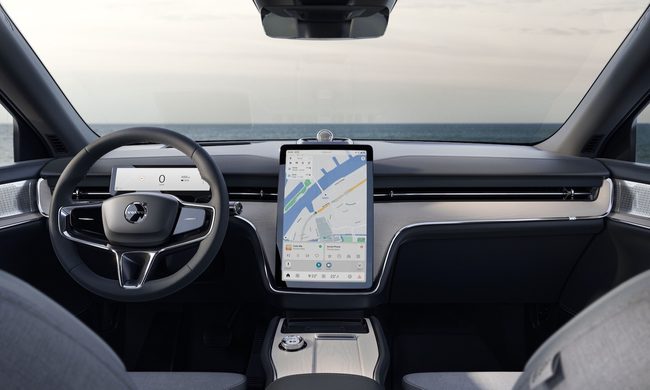
Interior view of the 2024 Volvo EX90.

The line between your smartphone and your car continues to blur. Volvo has announced that it is rolling out an over-the-air software update that brings Apple Music directly to the infotainment systems of more than 2 million vehicles worldwide. Instead of relying on Apple CarPlay or plugging in an iPhone, eligible drivers will be able to stream music natively from their car's built-in system, making Apple Music another integrated feature of Volvo's software experience.

The update is arriving for a wide range of Volvo models, including the EX90, ES90, XC90, S90, V90, XC60, S60, V60, XC40, EX40 and EC40, covering model year 2020 onwards. Availability, however, may vary depending on the vehicle.

Read more
Chery’s latest EV packs flagship tech for the price of a base Tesla, but you can’t buy it
Here's everything packed into Exeed's 2027 Exlantix ES, from its 27-sensor autonomous driving suite to its 860 km range, all starting under $31,000.
Car, Transportation, Vehicle

Chery's premium arm just dropped a sedan that makes you wonder why American EVs cost twice as much for half the tech.

Exeed's 2027 Exlantix ES ships with a driver-assist system called Falcon 700. It is built around an Nvidia Orin-Y chip and a genuinely stacked sensor suite.

Read more
A new AI model wants self-driving cars to think before they swerve
Forget guessing games, this self-driving AI actually shows its work.
Self driving car

Self-driving cars have gotten pretty good at driving. The harder problem is teaching them to drive safely in situations nobody planned for. We have heard horror stories of self-driving cars, behaving erratically in emergency situations, often times delaying first responders from reaching the scene.

A team at Seoul National University, led by professor Jun Won Choi from the Department of Electrical and Computer Engineering, thinks they have cracked part of that puzzle with a new AI model called SafeDrive. The research was recently selected as a highlight paper at CVPR 2026, a distinction that goes only to roughly 3% of all submissions.

Read more