“Why you can trust Digital Trends – We have a 20-year history of testing, reviewing, and rating products, services and apps to help you make a sound buying decision. Find out more about how we test and score products.“
Spectre is no Skyfall 2, but Craig’s lighter, more nostalgic portrayal of Bond remains familiar, if unexpected.
Despite all of the box-office success and accolades earned by the last few installments of the James Bond film franchise, actor Daniel Craig’s term as the famous secret agent has been somewhat polarizing among fans. Where past iterations of the franchise reveled in a mix of campy wit, impossibly attractive cast members, and fantastic set pieces shaken (not stirred) to just the right measure, the modern era of James Bond has been one of darker, more cerebral stories that explore the mind of a man with a license to kill and the safety of a nation depending on his every action.
That’s why Spectre comes as a bit of a surprise, especially given the blockbuster success of director Sam Mendes’ previous, exceptionally heavy installment of the franchise, Skyfall. One would think all parties involved would want to continue sending 007 down that dark, brooding path, but apparently the world’s greatest spy still has some surprises up his finely tailored sleeve, because Spectre ends up feeling more like a spiritual successor to those earlier, simpler James Bond adventures than the dramatic thrillers we’ve grown accustomed to lately.


In many ways, Spectre is a by-the-numbers James Bond film. Set not too long after the events of Skyfall, the film puts Bond on the trail of a mysterious organization engaged in all manner of criminal undertakings at every level of society around the world — including the British government. As 007 follows a series of leads posthumously provided by his former boss, M (Judi Dench), he must contend with the rapid dissolution of his own agency and finally confront the mysterious head of the criminal organization responsible for many of the events that brought James Bond’s life and career to this point.
From the film’s opening sequence to its explosive finale, Spectre does an impressive job of upping the ante when it comes to set pieces that are as memorable for the action occurring on the screen as they are for where the action is set. The film opens during The Day of the Dead celebrations in Mexico, in the midst of a parade filled with colorful extras dressed up like the finest skeletons the fashion world can offer. The festive tone is short-lived, however, as Bond’s attempted assassination of a bomber results in a massive explosion that sends the secret agent running from the crumbling facade of a neighboring building. Bond eventually flings himself through the disintegrating building and makes a perfect landing on a couch conveniently located on the first floor, only to straighten his cuffs, adjust his necktie, and proceed on with the mission as only 007 can do.
A fitting conclusion to one of the most interesting, unpredictable eras in James Bond’s history.
Given what’s to follow in the remainder of Spectre, it’s surprising that the scene didn’t feature Bond casually reaching for an undisturbed martini that happened to be left on a table near the couch. In many ways, Spectre is indeed that sort of James Bond movie.
While the opening sequence doesn’t feature that martini moment, it does reach its climax with a fight between Bond and the aforementioned bomber in a helicopter flying above the crowded streets of the city. The pair brawls mercilessly as the ‘copter dives low to the streets, and in a brilliant bit of camera work, it loops through the air and ascends to dizzying heights, pushing the combatants from one end of the cockpit to the other and periodically flinging them outside, then back inside the craft.
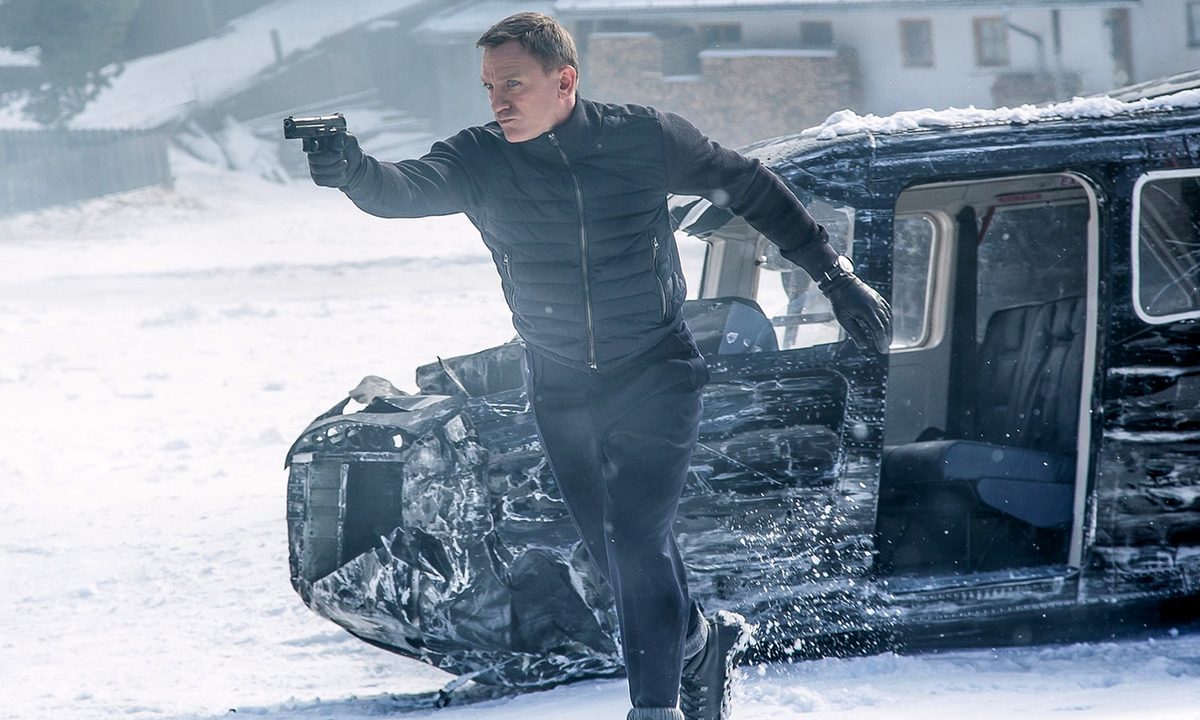
It’s a great establishing scene that ends up being one of many memorable action sequences and settings in Spectre. Other sequences have Bond chasing a convoy of trucks while piloting a cargo plane through the snow-covered mountains of Austria, and another equally impressive sequence has 007 engaged in a fierce, close-quarters brawl with the silent assassin Hinx (played with just the right amount of menace by Guardians of the Galaxy actor Dave Bautista) while traversing Morocco in a fast-moving, narrow train.

Not only does Spectre add to the franchise’s long tradition of breathtaking set pieces, but it also draws inspiration from the past for some of its colorful characters, too. Along with Bautista’s Hinx, whose entrance scene is worthy of a spot in Bond’s rogues gallery alongside iconic henchmen Jaws and Oddjob, Christoph Waltz makes for a good (but not great) criminal mastermind in his role as Franz Oberhauser. His character’s willingness to spend a significant amount of time explaining his diabolical plot to Bond before subjecting him to an overly complicated death will feel particularly familiar to anyone well-versed in 007’s pre-Daniel Craig adventures.
Still, while Waltz does his scene-chewing best to give audiences a memorable villain, his performance suffers from the same problem that afflicts much of Spectre: a surprisingly weak script.
The connective tissue provided in the plot is conspicuously thin.
Despite the obvious desire to bring together all of the Craig-era films and link the events of Spectre to the major villains (and some of their victims) from Casino Royale, Quantum of Solace, and Skyfall, the connective tissue provided in the plot is conspicuously thin. The notion that all of these characters and events are part of some greater, overarching criminal enterprise is simply presented as fact with little supporting evidence or — more importantly — reason for their connection. It’s an unfortunate gap in the film’s narrative foundation that leaves a significant portion of the story on shaky ground, particularly when many of the characters’ actions become singularly motivated by this far-reaching but poorly explained threat.
The film’s willingness to embrace some of the more campy elements of traditional James Bond movies also doesn’t seem to sync up well with its leading man, who has spent the last three films convincing audiences that James Bond doesn’t need to smile to be smooth. Previous 007 actors Sean Connery and Roger Moore could make a well-timed smirk as effective as a Walther PPK in getting what they wanted, but Craig’s version of Bond seems acutely uncomfortable when the script calls for moments of levity — something Craig’s films have generally lacked, and apparently for good reason.
If Spectre does turn out to be Craig’s swan song as James Bond, it’s certainly an intriguing way to conclude his run. In many ways, Mendes’ second adventure with 007 feels very different from his previous effort, Skyfall, and distinctly different from the tone established by the rest of the Craig-era franchise. Despite the back-to-basics feel of some of the more traditional elements, Spectre still manages to over-reach with a script that never quite supports the story’s grand ambitions, and feels like a James Bond movie written for a different James Bond era.
It’s difficult to predict where Spectre will rank among the franchise’s many installments years from now, but one thing seems certain: If it does turn out to be Craig’s final adventure as Agent 007, it’s a fitting conclusion to one of the most interesting, unpredictable eras in James Bond’s history.