1. Home
  2. Photography
  3. Emerging Tech
  4. News

Olympus' experimental image sensor shoots color and near-infrared simultaneously

Add as a preferred source on Google

Olympus has partnered with the Tokyo Institute of Technology to develop a new imaging sensor that is capable of capturing both color information and near-infrared information simultaneously. This is notable because most modern sensors available these days are only capable of one or the other, color or infrared.

The sensor works by modifying the standard Bayer RGB sensor layout and incorporating a NIR, or near-infrared pixel, into the layout. Traditional image sensors, like the one in your smartphone or digital camera, are based on what is called the Bayer filter. This is an arrangement of color filters over the image sensor that allow specific pixels to only capture the color of the filter above it. The traditional layout is RGGB (Red, Green, Green, Blue), as you can see in the example below.
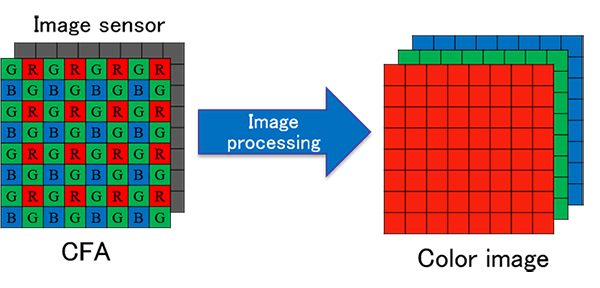
a standard bayer arrangement
A standard Bayer arrangement Image used with permission by copyright holder

How this new Olympus sensor differs is by removing the red or blue pixel on every other sequence of pixels and replacing that with a NIR pixel to capture the near-infrared image information. The result is an image sensor that is both capable of capturing color information as well as near-infrared information. This could be incredible useful for applications like video surveillance cameras, and other similar uses in which the users would have use for both color and near-infrared information.

Recommended Videos

As you can see by the images (see below), the sensor is still in the prototype phase, so don’t expect your next smartphone to have this capability. But that said, this proves that the concept is possible, and now the team over at Olympus and TIT can focus on improving the technology.
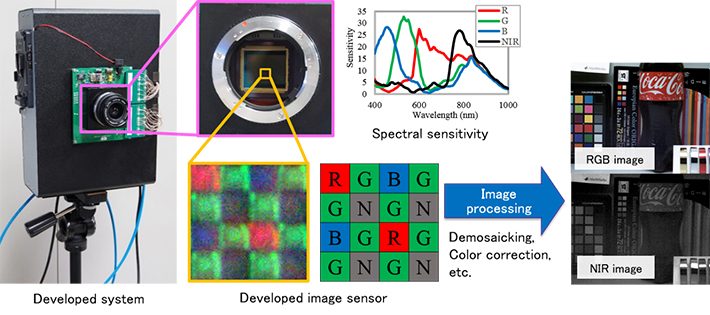
news_10910_2
Image used with permission by copyright holder

This could also be of interest to infrared photographers, who in some cases spend hundreds of dollars to convert their standard Bayer-based cameras into infrared cameras. If this sort of technology made its way into the digital camera realm, many of these individuals would likely be incredibly intrigued at the possibility of being able to capture near-infrared images as well as standard color or black-and-white images.

The technology is still a fair way off from that point, but its certainly an exciting development in the imaging sensor world.

Anthony Thurston
Anthony is an internationally published photographer based in the beautiful Pacific Northwest. Specializing primarily in…
Fujifilm Instax Mini 13 review: This instant camera won me over with its no-frills retro charm
From printing instant memories to rediscovering the fading charm of polaroids, Fujifilm's camera offers a budget route to a simple indulgence.
Fujifilm Instax mini 13 camera.

See at Amazon

Quick review

Read more
Want to try film photography? Kodak’s new $35 camera is a great place to start
This retro inspired Kodak EC35 camera keeps film photography refreshingly simple.
Kodak-EC35

If you've been curious about film photography but didn't want to spend a fortune, Kodak has a new camera worth checking out. The new Kodak EC35 is a reusable 35mm point-and-shoot camera that costs just $34.99, making it one of the most affordable ways to try shooting on film.

Developed by Reto Project under the Kodak brand, the EC35 keeps things simple with a lightweight design, automatic flash, and a pocket-friendly body. It also arrives as interest in analog photography continues to grow, offering beginners an inexpensive alternative to disposable film cameras.

Read more
The FCC’s latest crackdown could put more than DJI drones at risk in the US
Robot, Person, Face

DJI may have found creative ways to keep some of its products flowing into the US, but those efforts are now drawing increased attention from regulators. According to The Verge, the US Federal Communications Commission (FCC) has started cracking down on several companies it believes could be helping DJI continue selling products in the country. These businesses have been described by industry observers as "DJI front companies" because they market or import products that appear to be closely tied to the Chinese drone maker while operating under different brand names.

DJI's alleged back door may be closing

Read more