
Facebook wants you to share every awesome article, video, and webpage you stumble upon with your friends. And it wants to make doing so as easy as algorithmically possible. So, it’s no surprise, really, that the billion-plus-strong social network is rolling out new tools that effectively kill those two birds with one stone: two new Chrome extensions that simplify bookmarking and updated web plugins that integrate with any webpage.
The new plugins are the most drastic, visually speaking. They feature a redesigned “Like” button that’s a little more rounded and a little less colorful than the old design. It also dispenses with Facebook’s “f” logo for the “thumbs up” icon synonymous with internet approval. They also sport a tweaked share count (i.e., the text that indicates the total number of times a page or article has been “Liked”) that lives within the new button’s borders rather than outside them, as was the case with the old button.
Those changes were well-reasoned, said Facebook. After side-by-side “qualitative and quantitative” testing, the network determined that the new design encouraged clicks at a higher frequency than its outmoded counterpart.
But the new Like button confers benefits in other areas. It comes in several sizes optimized for smartphones, tablets and other mobile devices (Facebook says 30 percent of Like button impressions come from mobile devices), and features a “refined, modern” aesthetic — i.e., muted tones and a flatter appearance — consistent with Facebook’s current design language. And it’s backwards compatible, which is to say it won’t adversely impact third-party websites that currently implement the retired button.
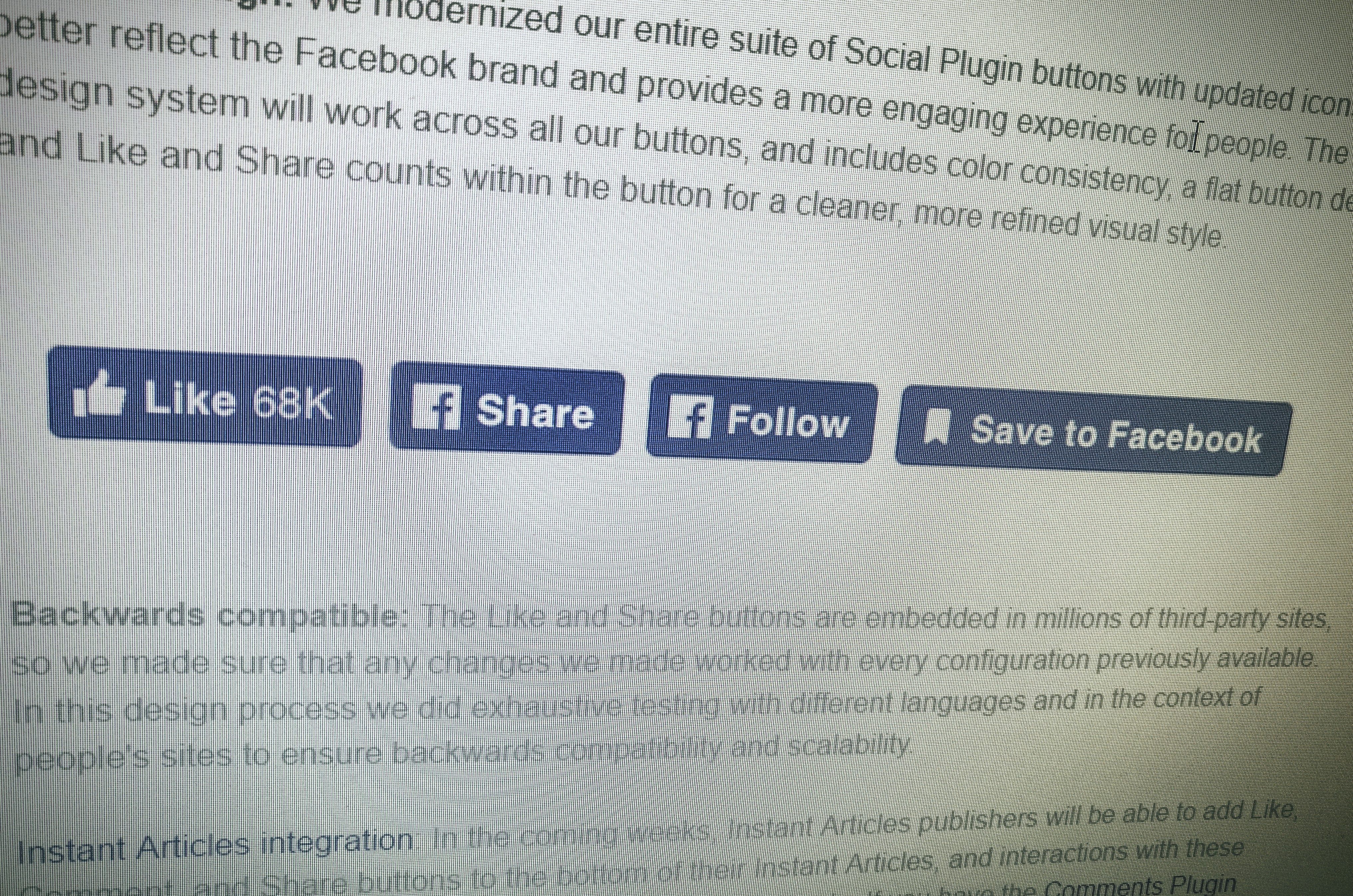
“We made sure that any changes we made worked with every configuration previously available,” said Facebook in a press release. “In this design process, we did exhaustive texting with different languages and in the context of people’s sites to ensure backwards compatibility and scalability.”
Moreover, the new buttons play nicely with Instant Articles, Facebook’s hosted solution for publishers. In the coming weeks, articles will gain “Like,” “Comment,” and “Share” buttons, and partners who use Facebook to power their comment section — and have the “comment mirroring” feature enabled — will see conversations synced across the web, Facebook Instant, and related posts in News Feed.
The new buttons will roll out “over the coming weeks,” Facebook said. If you’ve already got a web plugin installed, it’ll update automatically.
Facebook’s new Chrome extensions are a tad narrower in scope. One of them, Share to Facebook, provides shortcuts to share links to Groups, Messenger, and Facebook proper. The other, Save to Facebook, ties into the social network’s web bookmarking features. You can quickly save articles, videos, products, or entire webpages to a central Facebook hub that syncs across your signed-in devices. It’s accessible via Facebook’s “saved” tab.
The extensions launch on the Chrome Web Store on Tuesday. Save on Facebook boasts more than 300 million active users, Facebook said in a blog post.


