  1. Home
  2. Cars
  3. News

Bengala dunked a Ferrari F12 in carbon fiber to create this 730hp showstopper

Add as a preferred source on Google

Modifying an exotic car is different than modifying your average daily driver. There’s so much craftsmanship and engineering instilled within each body panel that it almost seems sacrilegious to alter it. You’re changing a work of art, after all. In other words, if you’re going to take a sharpie to the Mona Lisa, you better mean it.

Spanish design house Bengala Automotive means it. The firm has just debuted its F12 Caballeria supercar online, which starts out in life as a Ferrari F12berlinetta. Inspired by Ferrari’s racecars, the Caballeria forgoes the epic GT3 rear wing but features plenty of extreme aerodynamic enhancements all over its body, which is fashioned completely from carbon fiber. The overall design is far more violent and aggressive than the original Ferrari, and the added vents on the hood and rear fenders are nice touches. One thing’s for sure — the F12 Caballeria is a car to get noticed in.

Recommended Videos

“Uniqueness is in most cases a state of mind, while most people fail to understand the meaning of it very few people get a taste of the irreplaceable reality the word brings to those who earn it,” Bengala said on the car’s release. “We mastered and created a unique piece of design and engineering and ten exclusive individuals earned it, the Bengala F12 Caballeria.”
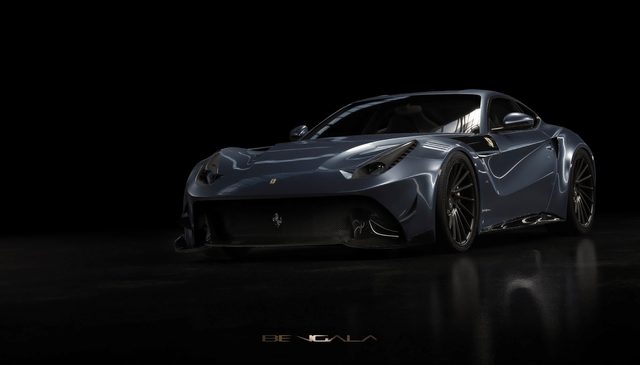
Bengala F12 Caballeria
Image used with permission by copyright holder

Bengala didn’t mention whether or not there had been alterations to the Berlinetta’s 6.3-liter V12 (we’re guessing not), but either way, 730 horsepower and 509 pound-feet of torque will just have to do. 0 to 60 mph and top speed figures should be unchanged from the Ferrari at 3.1 seconds and 211 mph, respectively.

Read more: Ferrari abandons manual transmissions, says they don’t perform as well

As the brand hints, just 10 examples of the Caballeria will be produced for a to-be-announced price, and we have yet to hear confirmation that those buyers have been chosen. Production is expected to begin in summer 2017.

Andrew Hard
Andrew first started writing in middle school and hasn't put the pen down since. Whether it's technology, music, sports, or…
Chery’s latest EV packs flagship tech for the price of a base Tesla, but you can’t buy it
Here's everything packed into Exeed's 2027 Exlantix ES, from its 27-sensor autonomous driving suite to its 860 km range, all starting under $31,000.
Car, Transportation, Vehicle

Chery's premium arm just dropped a sedan that makes you wonder why American EVs cost twice as much for half the tech.

Exeed's 2027 Exlantix ES ships with a driver-assist system called Falcon 700. It is built around an Nvidia Orin-Y chip and a genuinely stacked sensor suite.

Read more
A new AI model wants self-driving cars to think before they swerve
Forget guessing games, this self-driving AI actually shows its work.
Self driving car

Self-driving cars have gotten pretty good at driving. The harder problem is teaching them to drive safely in situations nobody planned for. We have heard horror stories of self-driving cars, behaving erratically in emergency situations, often times delaying first responders from reaching the scene.

A team at Seoul National University, led by professor Jun Won Choi from the Department of Electrical and Computer Engineering, thinks they have cracked part of that puzzle with a new AI model called SafeDrive. The research was recently selected as a highlight paper at CVPR 2026, a distinction that goes only to roughly 3% of all submissions.

Read more
Your next car’s software update could become its biggest security risk
Your next car could receive updates like your smartphone. That's also becoming a cybersecurity nightmare.
OTA technology allows manufacturers to remotely deliver software updates.

Modern cars are no longer machines that stay the same after they leave the showroom. Increasingly, they're becoming software-defined vehicles that receive new features, bug fixes, and security patches wirelessly, much like smartphones. But while over-the-air (OTA) updates have made vehicle maintenance easier and cheaper, cybersecurity experts are warning that the same technology could also become one of the automotive industry's biggest security challenges.

Researchers and policymakers are now calling for stronger oversight as connected vehicles become increasingly dependent on remote software updates. Their concern isn't just about hackers stealing personal data. It's about someone potentially interfering with the operation of a moving vehicle.

Read more