1. Home
  2. Cars
  3. Legacy Archives

Ford’s blazing Focus RS coming to America in 2016 after all?

Add as a preferred source on Google

American car buyers were thrilled when Ford announced its GTI-fighting Focus ST in 2010, and it’s easy to see why.

It’s powered by a 252-horsepower turbo four-cylinder, with aggressive, enthusiastic styling, and carrying a reasonable $24,155 price tag. Europeans had been romping about in “hot hatches” for years, so when Ford brought another one here, it went over pretty well.

Recommended Videos

But if you give a mouse a cookie … he’s going to want 350 horsepower and an electronic differential. Or something like that.

According to an Autoexpress report, Ford has plans to release the even-hotter Focus RS to U.S. markets in 2016, which could be given a 350-hp version of the 2.3-liter EcoBoost from the new Mustang.

Barb Samardzich, Chief Operating Officer for Ford of Europe, couldn’t confirm any details, but expressed that there is a “strong desire” for the Focus RS in America.

Another Ford spokesman said, “We have a rich heritage of RS cars, and we’re not about to let any competitors overtake us in that respect. You can rest assured that Martin (Smith, Ford of Europe director of design) and his team are fully focused on the future of our performance strategy.”

An immediate concern for any front-wheel-drive car with that much power is torque steer, but Ford has plans to counteract that. An electronic front differential will deliver all 350 horses to the pavement, maximizing traction in all conditions.

Ford’s crafty RevoKnuckle suspension design, itself a variation of the MacPherson layout, presumably uses some sort of witchcraft and magic to reduce steering feedback. It also weighs and costs less than your typical double wishbone setup, further improving the performance of the Focus RS.

Ford is reportedly looking to keep the base price of the RS around £27,000, emphasizing the strong value of the Focus brand.

Given the popularity of hot hatches in Europe, it’s hard to imagine why an insanely high-powered RS wouldn’t sell in the States. The power of a Mustang and the practicality of a Focus? Sign me up. 

Andrew Hard
Andrew first started writing in middle school and hasn't put the pen down since. Whether it's technology, music, sports, or…
Volvo is rolling out Apple Music to over 2 million cars with a simple OTA update
Your Volvo may soon get Apple Music without needing CarPlay
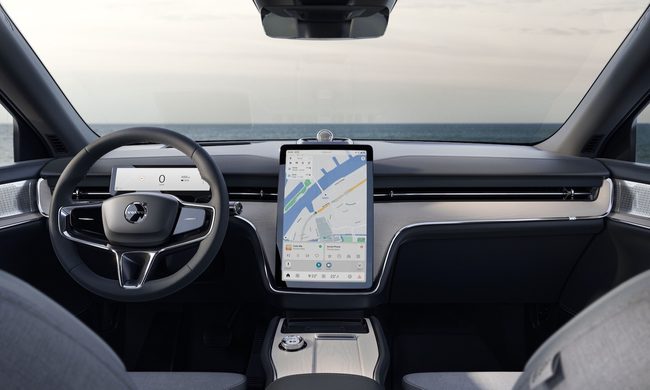
Interior view of the 2024 Volvo EX90.

The line between your smartphone and your car continues to blur. Volvo has announced that it is rolling out an over-the-air software update that brings Apple Music directly to the infotainment systems of more than 2 million vehicles worldwide. Instead of relying on Apple CarPlay or plugging in an iPhone, eligible drivers will be able to stream music natively from their car's built-in system, making Apple Music another integrated feature of Volvo's software experience.

The update is arriving for a wide range of Volvo models, including the EX90, ES90, XC90, S90, V90, XC60, S60, V60, XC40, EX40 and EC40, covering model year 2020 onwards. Availability, however, may vary depending on the vehicle.

Read more
Chery’s latest EV packs flagship tech for the price of a base Tesla, but you can’t buy it
Here's everything packed into Exeed's 2027 Exlantix ES, from its 27-sensor autonomous driving suite to its 860 km range, all starting under $31,000.
Car, Transportation, Vehicle

Chery's premium arm just dropped a sedan that makes you wonder why American EVs cost twice as much for half the tech.

Exeed's 2027 Exlantix ES ships with a driver-assist system called Falcon 700. It is built around an Nvidia Orin-Y chip and a genuinely stacked sensor suite.

Read more
A new AI model wants self-driving cars to think before they swerve
Forget guessing games, this self-driving AI actually shows its work.
Self driving car

Self-driving cars have gotten pretty good at driving. The harder problem is teaching them to drive safely in situations nobody planned for. We have heard horror stories of self-driving cars, behaving erratically in emergency situations, often times delaying first responders from reaching the scene.

A team at Seoul National University, led by professor Jun Won Choi from the Department of Electrical and Computer Engineering, thinks they have cracked part of that puzzle with a new AI model called SafeDrive. The research was recently selected as a highlight paper at CVPR 2026, a distinction that goes only to roughly 3% of all submissions.

Read more