  1. Home
  2. Cars
  3. Legacy Archives

You’re doing it wrong. Driver climbs into backseat of his self-driving Infiniti on highway

Add as a preferred source on Google

Self-driving cars are still being tested around the world, but that didn’t stop one daring (and stupid) German from letting his car take the reins for a bit.

German Magazine Vanishing Point has published a video on its YouTube channel of a driver in Germany testing his Infiniti Q50S. In the video, two men experiment with the Infiniti’s safety features, and the driver takes his hands and feet off the controls.

Recommended Videos

Partway through the film, however, he actually climbs out of the drivers seat entirely, putting his fate (and everyone else) in the hands of his luxury sedan.

Why is this so crazy, you ask? Aren’t autonomous cars a thing now?

Well, this Infiniti Q50S car is not really self-driving; it’s merely semi-autonomous and equipped with Active Lane Control. The safety function assists the driver by keeping the vehicle in the center of the lane, and its Distance Control Assist adjusts throttle and braking during certain traffic conditions.

This particular Infiniti is also equipped with Predictive Forward Collision Warning, which produces an alert tone when it senses an impending collision between the two vehicles in front of you. It does this by measuring respective velocities of the cars ahead, but it does not interfere with braking or throttle.

Another impressive feature of the Q50S is its Forward Emergency Braking system, which detects incoming collisions and engages the brakes if necessary. Despite the Q50’s impressive tech, the testicular fortitude required to leave the driver’s seat on a crowded freeway does not come standard.

RELATED: Torc Robotics develops autonomous military vehicle for the Marines

To be fair, the Infiniti does perform quite well on the gently sloping highway, but I’m not sure it’s worth the risk for a few YouTube hits.

Watch the video of the gumptious German below. The white-knuckled maneuver starts at the 1:26 mark.

Andrew Hard
Andrew first started writing in middle school and hasn't put the pen down since. Whether it's technology, music, sports, or…
Volvo is rolling out Apple Music to over 2 million cars with a simple OTA update
Your Volvo may soon get Apple Music without needing CarPlay
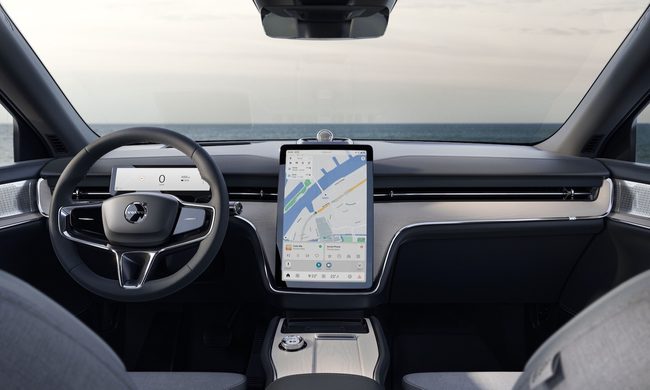
Interior view of the 2024 Volvo EX90.

The line between your smartphone and your car continues to blur. Volvo has announced that it is rolling out an over-the-air software update that brings Apple Music directly to the infotainment systems of more than 2 million vehicles worldwide. Instead of relying on Apple CarPlay or plugging in an iPhone, eligible drivers will be able to stream music natively from their car's built-in system, making Apple Music another integrated feature of Volvo's software experience.

The update is arriving for a wide range of Volvo models, including the EX90, ES90, XC90, S90, V90, XC60, S60, V60, XC40, EX40 and EC40, covering model year 2020 onwards. Availability, however, may vary depending on the vehicle.

Read more
Chery’s latest EV packs flagship tech for the price of a base Tesla, but you can’t buy it
Here's everything packed into Exeed's 2027 Exlantix ES, from its 27-sensor autonomous driving suite to its 860 km range, all starting under $31,000.
Car, Transportation, Vehicle

Chery's premium arm just dropped a sedan that makes you wonder why American EVs cost twice as much for half the tech.

Exeed's 2027 Exlantix ES ships with a driver-assist system called Falcon 700. It is built around an Nvidia Orin-Y chip and a genuinely stacked sensor suite.

Read more
A new AI model wants self-driving cars to think before they swerve
Forget guessing games, this self-driving AI actually shows its work.
Self driving car

Self-driving cars have gotten pretty good at driving. The harder problem is teaching them to drive safely in situations nobody planned for. We have heard horror stories of self-driving cars, behaving erratically in emergency situations, often times delaying first responders from reaching the scene.

A team at Seoul National University, led by professor Jun Won Choi from the Department of Electrical and Computer Engineering, thinks they have cracked part of that puzzle with a new AI model called SafeDrive. The research was recently selected as a highlight paper at CVPR 2026, a distinction that goes only to roughly 3% of all submissions.

Read more