  1. Home
  2. Cars
  3. News

Tesla Model 3 traveling on Autopilot explodes twice after hitting a tow truck

Add as a preferred source on Google
Gagorun/Instagram

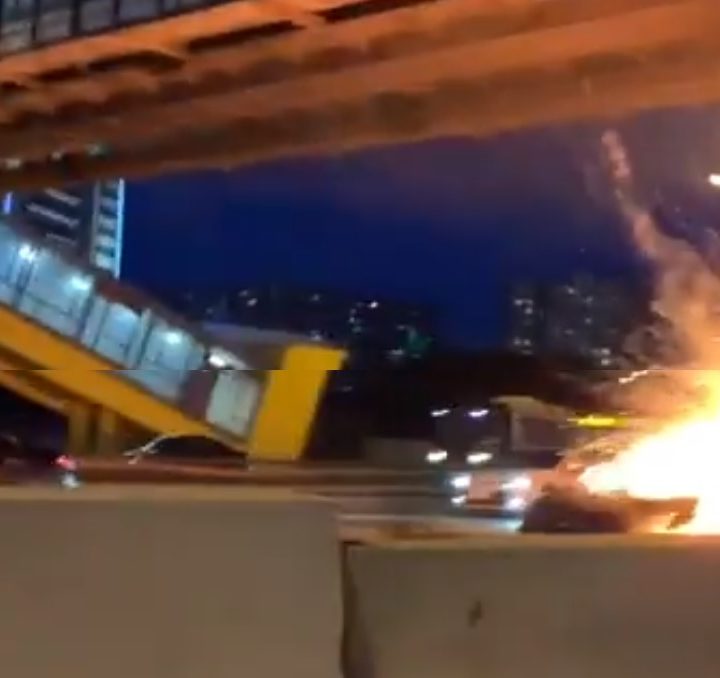
Part of Moscow’s main ring road became a fiery mess after a Tesla Model 3 crashed into the back of a tow truck and exploded twice on the evening of Saturday, August 10. The driver and two of his children miraculously escaped the wreck with only minor injuries. He told investigators the collision happened while he was using Autopilot.

Details about the accident and the subsequent explosions are still trickling in. Investigators say Russian businessman Alexey Tretyakov was behind the wheel of his Model 3 when it slammed into a parked tow truck at about 62 mph. Early reports claimed Tretyakov and the two children sitting in the back were severely injured, but Reuters learned the driver merely broke his leg during the accident, while his kids suffered little more than bruises, which is impressive.

Recommended Videos

Video footage posted by Instagram user Gagorun shows the electric sedan engulfed in flames behind the tow truck it hit. As the user cruises by, two small explosions coming from the car pelt debris and black smoke into the air. The cause of the explosion hasn’t been determined yet, though it’s not unreasonable to assume they came from the battery pack. Digital Trends reached out to Tesla for more information, and we’ll update this story if we hear back.

The accident happened after dark. Tretyakov told Moscow police that he didn’t see the tow truck his car hit, and that Tesla’s Autopilot technology was engaged at the time of the accident. He said both of his hands were on the steering wheel, but Dutch newspaper De Telegraaf reported he was looking at his kids in the back seat when the Model 3 rammed into the truck. The publication added the sedan made no attempt to slow down, swerve, or warn the driver of an imminent collision. If these statements are accurate, the car and the driver would both deserve to share the blame.

The crash comes shortly after the National Highway Traffic Safety Administration (NHTSA) revealed it asked Tesla to stop making misleading statements about the Model 3’s safety in late 2018. The agency also served Tesla subpoenas to obtain information about several accidents involving its vehicles, according to the same report.

Ronan Glon
Ronan Glon is an American automotive and tech journalist based in southern France. As a long-time contributor to Digital…
Volvo is rolling out Apple Music to over 2 million cars with a simple OTA update
Your Volvo may soon get Apple Music without needing CarPlay
Interior view of the 2024 Volvo EX90.

The line between your smartphone and your car continues to blur. Volvo has announced that it is rolling out an over-the-air software update that brings Apple Music directly to the infotainment systems of more than 2 million vehicles worldwide. Instead of relying on Apple CarPlay or plugging in an iPhone, eligible drivers will be able to stream music natively from their car's built-in system, making Apple Music another integrated feature of Volvo's software experience.

The update is arriving for a wide range of Volvo models, including the EX90, ES90, XC90, S90, V90, XC60, S60, V60, XC40, EX40 and EC40, covering model year 2020 onwards. Availability, however, may vary depending on the vehicle.

Read more
Chery’s latest EV packs flagship tech for the price of a base Tesla, but you can’t buy it
Here's everything packed into Exeed's 2027 Exlantix ES, from its 27-sensor autonomous driving suite to its 860 km range, all starting under $31,000.
Car, Transportation, Vehicle

Chery's premium arm just dropped a sedan that makes you wonder why American EVs cost twice as much for half the tech.

Exeed's 2027 Exlantix ES ships with a driver-assist system called Falcon 700. It is built around an Nvidia Orin-Y chip and a genuinely stacked sensor suite.

Read more
A new AI model wants self-driving cars to think before they swerve
Forget guessing games, this self-driving AI actually shows its work.
Self driving car

Self-driving cars have gotten pretty good at driving. The harder problem is teaching them to drive safely in situations nobody planned for. We have heard horror stories of self-driving cars, behaving erratically in emergency situations, often times delaying first responders from reaching the scene.

A team at Seoul National University, led by professor Jun Won Choi from the Department of Electrical and Computer Engineering, thinks they have cracked part of that puzzle with a new AI model called SafeDrive. The research was recently selected as a highlight paper at CVPR 2026, a distinction that goes only to roughly 3% of all submissions.

Read more