
  1. Home
  2. Computing
  3. Legacy Archives

Cisco: Spammers shifting to targeted attacks

Add as a preferred source on Google
Scammer hand through monitor, spam, phishing, security
Image used with permission by copyright holder

Cisco’s Security Intelligence Operations group has published a new report, Email Attacks: This Time It’s Personal (PDF) that indicates the Internet is experiencing a fundamental shift in the nature of spam: instead of spammers relying on sending as many messages as possible and hoping to get responses from a tiny fraction of one percent of gullible recipients, spammers are shifting to a far smaller number of targeted, personalized attacks—a.ka. spearphishing. The good news is that the overall volume of mass spam has declined sharply, along with the amount of money criminals gain from them. The bad news is that targeted attacks are up sharply…and criminals make a lot more money every time one of them succeeds.

“Cybercriminal business models have recently shifted towards low-volume targeted attacks,” Cisco wrote. “With email remaining the primary attack vector, these attacks are increasing in both their frequency and their financial impact on targeted organizations.”

Recommended Videos

According to Cisco, spam volumes peaked at an average of about 300 billion spams per day in June 2010 down to about 40 billion spams a day in June 2011. With that decline, spammers have also found the amount of money they haul in from mass email spam is going down: Cisco estimates mass spam attacks netted spammers about $1.1 billion in June 2010, but that figure dropped to $500 million by June 2011.

One reason that spammers’ revenues haven’t declined in proportion to the amount of messages they send out is that an increasing number of messages are individualized with personalization tools and other information designed to pull in a potential victim and “convert” them into a paying victim, or get them to click through to a site that will try to install malware. Cisco estimates that spammer revenue from these customized attacks grew from $50 million in June 2010 to $200 million by June 2011.

Cisco also notes that while spam filters and blocking technologies are able to block about as many targeted attacks as mass attacks, targeted attacks are far more likely to be opened by their intended victims, and have click-through rates as high as 50 percent.
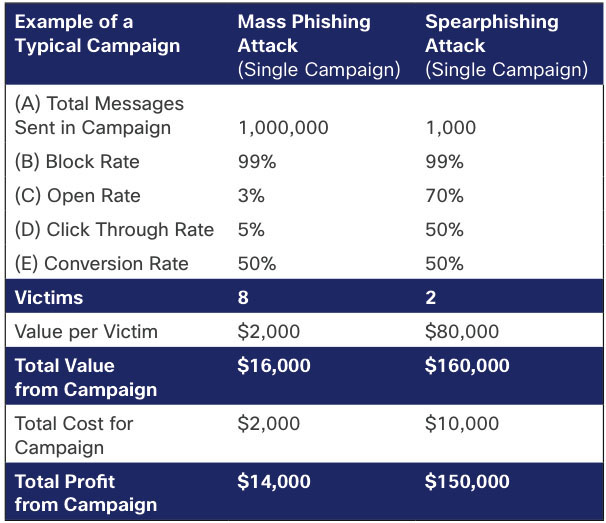
Cisco Spam Attack Campaign Economics
Image used with permission by copyright holder

Cisco also credits the decline in mass attack spam to the work of industry organizations, security firms, and law enforcement, noting that in the last year botnets like SpamIt, Rustock, Bredolab, and Mega-D have been severely curtailed by law enforcement actions.

Geoff Duncan
Former Contributor
Geoff Duncan writes, programs, edits, plays music, and delights in making software misbehave. He's probably the only member…
Gemini Notebook’s new Collections arrive just as Google turns it into a bigger workspace
Google is cleaning up notebook organization as the former NotebookLM expands across Gemini and Search
Gemini Notebook branding on a MacBook

Google has barely finished renaming NotebookLM, and it’s already addressing one of the headaches that comes with building a large research library.

Collections are rolling out to all Gemini Notebook users, giving them a way to group related notebooks while keeping everything visible under My Notebooks. The dashboard gets some structure without asking users to rearrange the library they’ve already built.

Read more
Samsung’s humanoid robot ambitions are real, but factories come first
Samsung’s new robotics division has humanoids in its sights, although its immediate business is far more practical factory automation
Robot Touch Human Finger

Samsung wants a place in the humanoid race, but its new robotics push begins with machines built for factories rather than homes.

The CEO-led RX robotics division will initially focus on manufacturing robots. Samsung has separately identified humanoids as a priority, although it hasn’t announced a commercial model or explained where one fits into the division’s immediate plans.

Read more
WhatsApp’s Liquid Glass redesign is finally coming to Mac after months of waiting
WhatsApp's Mac app is getting Apple's Liquid Glass-inspired makeover
WhatsApp

WhatsApp has been steadily adopting Apple's new design language across its apps, but Mac users have largely been left watching from the sidelines. That is finally beginning to change.

The messaging platform has started rolling out its Liquid Glass redesign for the WhatsApp Mac app, bringing the desktop experience much closer to what iPhone and iPad users have been seeing over the past few months. The update introduces a refreshed interface with redesigned navigation elements, updated menus, and a cleaner layout that aligns with Apple's latest software aesthetic. According to WABetaInfo, the rollout has begun through the latest Mac App Store update and is currently reaching a limited number of users.

Read more