
  1. Home
  2. Computing
  3. Emerging Tech
  4. Legacy Archives

Engineer creates old-world mechanical computer with 3D-printed parts

Add as a preferred source on Google
TurboEntabulatorComputer
Image used with permission by copyright holder

Let’s be honest; a mechanical computer probably isn’t practical in this day and age. Back in the 1800s, mechanical computers were works of modern art and a huge step in engineering. All you history buffs might recall Charles Babbage’s “Difference Engine,” (1822), or even the “Kerrison Predictor” (late 1930s). But the only place you’re likely to see a mechanical computing creation today is at your local science museum. At least, that used to be the case, until one brave electrical engineer decided to create his own version.

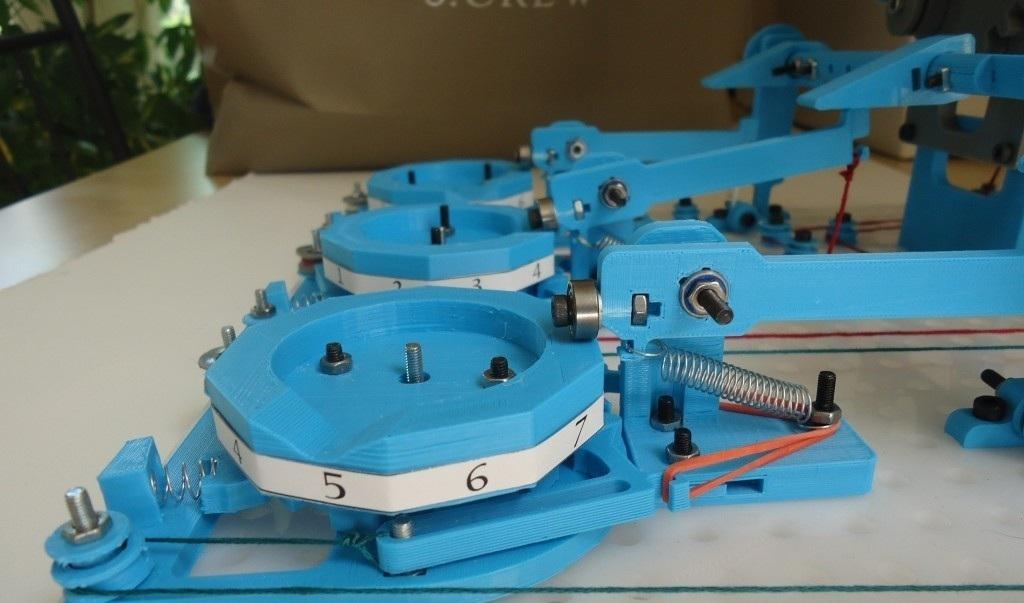
An inventive chap, known simply as “Chris” used his electrical engineering background to put together a simplistic mechanical device that tabulates numbers. The Turbo Entabulator, as Chris dubbed it, uses a construct to punch out a series of numbers onto cards that would make any Fibonacci fan proud. That’s the extent of this archaic-looking machine, and although it doesn’t do much more than tabulate, the key feature of this machine separates it from all other mechanical computers in existence.

Recommended Videos

Chris used his MakerBot 3D printer to assemble this unique creation, which makes it one of the first old-world mechanical computers to be made from new-world technology. It also (most likely) makes it the first “computer” to technically be “printed.”

The project wasn’t without struggle, though. “The mechanical counters [were fiddly],” Chris told TechHive. “I had extremely little experience designing anything with moving parts prior to this project. The counters don’t always ‘snap’ into position, and can wind up reading ‘7 3/4’ instead of ‘8’, which can jam up the machine when you go to process the next instruction.” Still, when you watch the video, and realize that the machine is completely mechanical, requiring human-powered cranking to operate, you understand just how impressive this feat really is.

If you’re interested in learning more about the steps that Chris took to build the Entabulator, you can view the journey on his blog. He also uploaded some “schematics” to Thingverse, where you can take a crack at building your own device. 

Russ Boswell
Former Digital Trends Contributor
Russ Boswell is an aspiring video game and technology journalist from Colorado. He's been an avid gamer since he was old…
How to install macOS 27 Golden Gate public beta on your Mac?
From a smarter Siri to a more reliable Spotlight, here's your full walkthrough for installing macOS 27 Golden Gate's public beta today.
macOS 27 Golden Gate

Along with iOS 27’s public beta, Apple has also released macOS 27 Golden Gate’s public beta build, so that early adopters can get their hands on the new features, including Siri AI, and provide timely feedback to help ensure a stable iOS launch in September. 

If you’re sold on all the new features but don’t want to put your faithful MacBook through developer beta duty, a public beta offers a much more refined experience. To install macOS 27’s public beta, follow the steps given below. 

Read more
Microsoft is finally fixing the worst thing about Windows Search, but you can’t try it just yet
Windows Insiders in the Experimental channel are getting a Search experience that finally feels less of a billboard and more of what users actually need.
Page, Text, Person

Windows Search has been a mess for years, and I do not use that word lightly. Open it to find a file, and you get trending Bing topics, Microsoft Store promotions, and an AI tools tile that just opens a browser. 

That is changing, but not immediately for all users. Microsoft is rolling out a batch of Windows Search improvements to Insiders in the Experimental channel, and for once, this isn't just a fresh coat of paint.

Read more
Apple doesn’t want to share this AirPods feature with Meta, but the EU may force its hand
Spring 2027, EU only, built under DMA pressure.
The front of the Ray-Ban Meta smartglasses.

I’ve been an AirPods user for the last four years, and one of the things that makes it genuinely hard to leave behind is the seamless, almost magical pairing experience across devices. Open an AirPods case near your iPhone, and a pop-up appears within seconds. Switch to your Mac and the audio follows. 

However, the experience is limited only to Apple devices. Doesn’t matter whether you have one of the coolest pieces of tech on the market right now; if it’s not Apple, it won’t get the same treatment. However, that might change for the Meta Quest or the Ray-Ban Meta glasses, thanks to pressure from the EU. 

Read more