The Interactive Advertising Bureau has released its figures for U.S. online advertising revenue for the 2010 calendar year, and while the U.S. economy overall might still be in the doldrums, the online ad market is still growing strong. According to the IAB, Internet ad revenues for 2010 reached a record $26 billion, an increase of 15 percent compared to 2009. In the fourth quarter of 2010 alone—which includes the lucrative end-of-year holiday season—online advertisers spent a record $745 billion on online advertising, a 19 percent increase compared to the previous year.
“Brand advertisers and marketers have adopted the power of digital media as a central element of their campaigns,” said IAB president and CEO Randall Rothenberg, in a statement. “Consumers have shifted more of their time to digital media—watching television shows and movies online—and advertisers now accept this multifaceted medium as a key component for reaching their targets.”
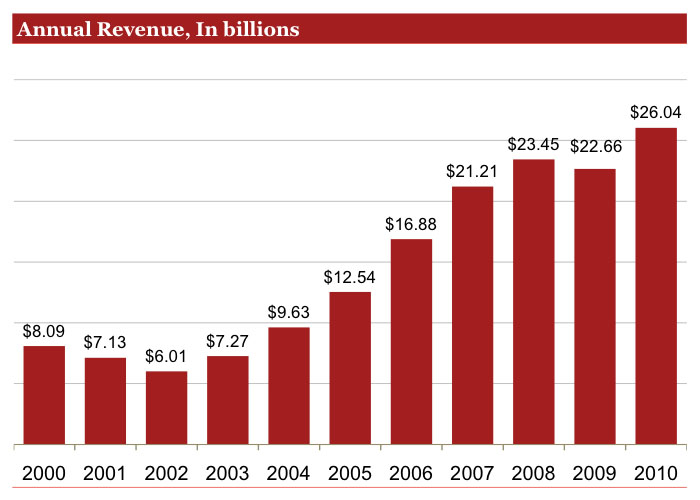
The figures mark the fifth consecutive quarter of revenue growth for the online advertising industry. Although the global economic downturn impacted online ad revenue in 2009, the industry seems to have quickly rebounded.
The IAB finds that search advertising remains the most popular ad format for U.S. online advertisers, accounting for some 46 percent of online ad spending for the year. Although the revenue from search advertising was up some 12 percent compared to 2009, the percentage of revenue coming in from search ads remained flat: it was 47 percent of online ad spending in 2009. The fastest growing segment of online ad spending in 2010 was sponsorships, while say an 88 percent increase from 2009, and a 142 percent increase during the fourth quarter of 2010 alone. Display-related advertising—commercials embedded in video feeds, traditional ad banners and display advertisements, rich media, and sponsorships combined accounted for nearly $10 billion in revenue during 2010, a 24 percent increase over 2009.
Revenue from lead-generation and email marketing actually declined from 2009 to 2010, with email marketing now account for $195 million in ad revenue compared to $2929 million a year ago. Lead generation saw a smaller proportional decline, and still accounts for some $1.4 billion.
For the first time, IAB broke out mobile ad revenue as a separate figure: the report estimates U.S. companies spend between $550 and $650 million on mobile advertising in 2010.
The IAB’s report data was collected and compiled by PriceWaterhouseCoopers. The full text of the report is available in PDF format.