  1. Home
  2. Computing
  3. Trash
  4. News

Teardown reveals good news for Steam Deck repairability

Add as a preferred source on Google

Right to Repair fans, you’re in luck, because the Steam Deck is pretty easy to fix according to iFixit’s teardown.

Valve released its own teardown video a few months ago, but it was packed with warnings about why you shouldn’t do it yourself. Undeterred by the warning, iFixit went to work and quickly tore down its model provided by Valve. The results are pretty surprising. Nearly every relevant part of the machine can be taken out, with rumors that Steam will have replacement parts widely available down the line.

A Steam Deck with the back covered removed, showing that one can easily remove the thumb sticks.
iFixit

Of note is just how simple it is to swap out the thumbsticks. Drifting is a major problem on pretty much every controller in this console generation, most notably on the Nintendo Switch. Valve made it simple by letting users easily disconnect the entire thumbtack module for easy replacement.

Steam Deck Teardown: Everything Valve Said Not to Do!

The SSD is also easy to get out, needing only one screw removed to free it from the motherboard. The motherboard is also labeled very clearly, so it’s easy to remember what needs to go where when reassembling it. Everything is simple to remove and only requires a Phillips-head screwdriver to take almost everything out.

Not everything is easy to remove, though. The trigger buttons require a bit more manhandling to remove. The battery is the real problem, though. It is tucked awkwardly into the frame and held down with lots of adhesive. That’s obnoxious, considering battery replacement will likely be the most common type of repair on a device like this.

All in all, iFixit gave it a 7 out of 10 on the repairability scale, which is quite high compared to other modern handheld electronics. It didn’t score as high as the Nintendo Switch (8 out of 10), but it’s leaps and bounds ahead of Apple devices. The 11-inch iPad Pro scored a paltry 3 out of 10. That’s not a handheld console, but you get the idea.

It looks like Valve has put a lot of work into making the Steam Deck a viable product that consumers will be able to enjoy for years to come. That benefits Valve, whose primary income is from game purchases and not hardware, and it benefits consumers as well.

Caleb Clark
Former Digital Trends Contributor
Caleb Clark is a full-time writer that primarily covers consumer tech and gaming. He also writes frequently on Medium about…
Google finally lets you turn any website into an app on Googlebook
Google heard your complaints, and now every website can be an app on your Googlebook.
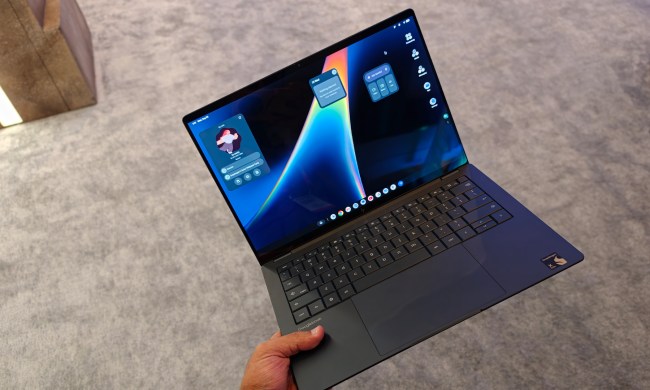
Using the HP Googlebook

Googlebook users, rejoice. Google is rolling out a Chrome update that turns any website into a web app, and you have the community to thank for it.

When Googlebook first arrived, Chrome was picky about which sites you could install. Only websites that developers had set up as web apps got the Install option. Everything else ended up as a shortcut that simply launched a browser tab.

Read more
DigUp lets users find Mac files by describing them, not remembering their names
Can't remember where that screenshot, PDF or recording went? Just describe it and let AI do the digging.
DigUp App in Use screenshot

There's a particular kind of frustration that comes with knowing a file exists somewhere on a computer but having absolutely no idea what it's called. Was that screenshot saved as IMG_4837? Which PDF contained that clause? And where did that podcast recording mention the thing worth remembering? DigUp wants to end the filename guessing game, letting Mac users search for files by describing what they remember instead. The free, open-source app uses Google's EmbeddingGemma 2 to search across photos, documents, PDFs, audio recordings and videos, all without sending personal files to the cloud.

DigUp turns everyday descriptions into file searches

Read more
A new AI detector looks beyond words to check whether the ideas came from AI
This could help journals distinguish AI-written research from human work polished with AI.
ai-writing-book

Most AI detectors look for telltale signs of AI-generated text by examining word and sentence patterns. A new tool called IdeaLens takes a different route to solving this problem. It spots AI-generated research by looking at the ideas behind it instead of the wording itself (via TechXplore).

Researchers from the University of Maryland, Google DeepMind, and Simon Fraser University built IdeaLens to check whether a document's core arguments came from a human or a machine, regardless of who wrote the final draft.

Read more