1. Home
  2. Emerging Tech
  3. News

Adidas unveils eye-catching laceless soccer shoe for better ball control

Add as a preferred source on Google

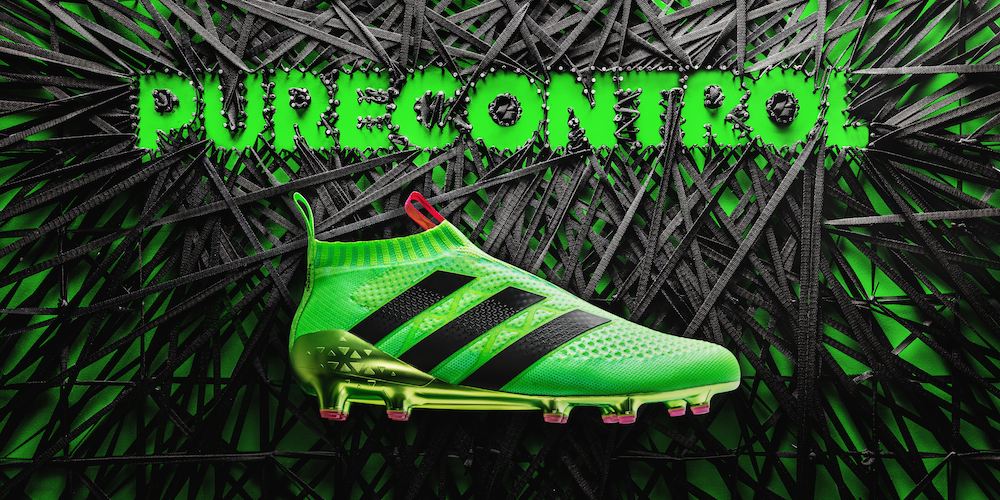
Certainly not shy about experimentation, Adidas has taken another big step forward in footwear design, this time coming up with its first-ever laceless soccer shoe – the ACE 16+ Purecontrol.

While obviously a boon for those who haven’t yet mastered the art of tying shoe laces, Adidas actually designed them with top soccer players in mind. Forwards, midfielders, and defenders alike all know how knots and flapping laces create uneven shoe surfaces that can sometimes lead to botched plays (that’s their excuse, anyway), so these laceless alternatives allow players a much more controlled, and hopefully more accurate, kick of the ball.
adidas laceless 2
Adidas
Adidas
Recommended Videos

In its own words, Adidas says the new design offers “a glove-like fit and the cleanest possible strike using a larger surface area to generate more power and accuracy.”

That glove-like fit comes courtesy of a thermoplastic polyurethane cage that secures the upper part of the foot, important if you don’t want the shoe flying off after a shot on goal. Further security comes by way of its knitted upper and an “internal knitted techfit locking system.”

Pro players

To show it’s serious about the new design, the German sports-clothing giant has managed to persuade some of Europe’s top players to slip into the shoes for professional games taking place this weekend.

Arsenal ace Mesut Ozil and Barcelona star Ivan Rakitic are among the chosen few who’ll be wearing onto the pitch what Adidas describes in superbly crafted marketing-speak as its “most disruptive boot in years.” It also appears to be its flashiest boot in years, its dazzling green color ensuring there’ll be no hiding place for Ozil and Rakitic as they zip about the soccer field.

Ozil was apparently influential in the shoe’s final design, taking time out of his busy schedule to offer Adidas advice on its look and feel, and possibly its color, too.

“My whole career I have tried to minimise the impact of laces on my strike and ball control,” Ozil says, adding, “I revealed to Adidas in 2014 that in the changing room I knot the laces over and over again and then tuck in the ends, that way they do not interfere with my touch.”

He said when the company approached him last year with a prototype of the shoes, “it was like they have created my dream product. I cannot wait to wear them on the pitch.”

While these aren’t the first laceless soccer shoes to hit the market, they’re certainly the snazziest we’ve seen yet. Fancy your own pair of ACE 16+ Purecontrol shoes? It’ll be easier if you’re in Europe, as a limited number of pairs will soon be available in flagship Adidas stores in London, Manchester, Barcelona, Paris, and Marseille, price currently unknown.


Trevor Mogg
Contributing Editor
Not so many moons ago, Trevor moved from one tea-loving island nation that drives on the left (Britain) to another (Japan)…
Anker just exposed a big problem with portable power stations
Appliance, Device, Electrical Device

When you're shopping for a portable power station, there's one number that's almost impossible to ignore: battery capacity. A 2 kWh battery should give you roughly 2 kWh of usable power, right? Unfortunately, things aren't quite that simple. Anker SOLIX has published new efficiency data for its S Series portable power stations, and it's putting the spotlight on something that doesn't get nearly as much attention as capacity: how much of the energy stored inside the battery actually makes it to your devices.

According to Anker, portable power stations are commonly advertised with efficiency figures measured under relatively heavy loads, where they can reach roughly 89% to 92% efficiency. But that's not necessarily how most people use one during an outage. Think about what you'd actually plug in. A Wi-Fi router might sip power continuously, a refrigerator switches its compressor on and off throughout the day, and a CPAP machine could run overnight. Together, those devices may draw just a fraction of what a large power station is capable of supplying. And that's where efficiency can start slipping.

Read more
OpenAI’s first gadget sounds like a tiny expressive AI companion
The device will have a doughnut-shaped body, built-in cameras, and moving parts
OpenAI press image

For months, reports have suggested that OpenAI’s first hardware product would be a screen-free smart speaker designed to act more like an AI companion. We already knew it could understand its surroundings, be carried around the home, and proactively help users. A new Bloomberg report now gives us a clearer picture of what the device may actually look like.

As per the report, OpenAI’s first gadget will be shaped like a doughnut and measure about the same size as a hockey puck. You will be able to carry it between rooms or leave it nearby on whatever surface is convenient. The device is expected to be on the expensive side, as the company has pondered pricing it around $300 to $400. A release is currently planned for 2027.

Read more
Google Antigravity just built an AI translator that works without the internet
Electrical Device, Switch, Robot

Google has shown off a new AI project that could make language barriers a little less intimidating, and it doesn't need an internet connection to do it. The company has introduced the Gemma Translator, a compact prototype built in collaboration with Antigravity. Unlike most AI translation tools that rely on cloud processing, this device runs entirely offline using Gemma 4 E2B, Google's lightweight open model. Everything happens locally on the device, making it both portable and independent of an internet connection. The prototype is powered by a Raspberry Pi 5 and includes a microphone and speaker inside a custom 3D-printed enclosure, creating a self-contained translator you can carry almost anywhere.

AI translation, without the cloud

Read more